

On this page
If you are preparing for exams like JEE or NEET, questions asking for the number of electrons, protons or neutrons in a given mass of a substance are a staple. The trap is usually trying to skip straight from the mass to the final answer in one giant calculation. The reliable, error-free way is to break the problem into smaller, logical steps, counting the moles first.
How to find the number of electrons in a given mass?
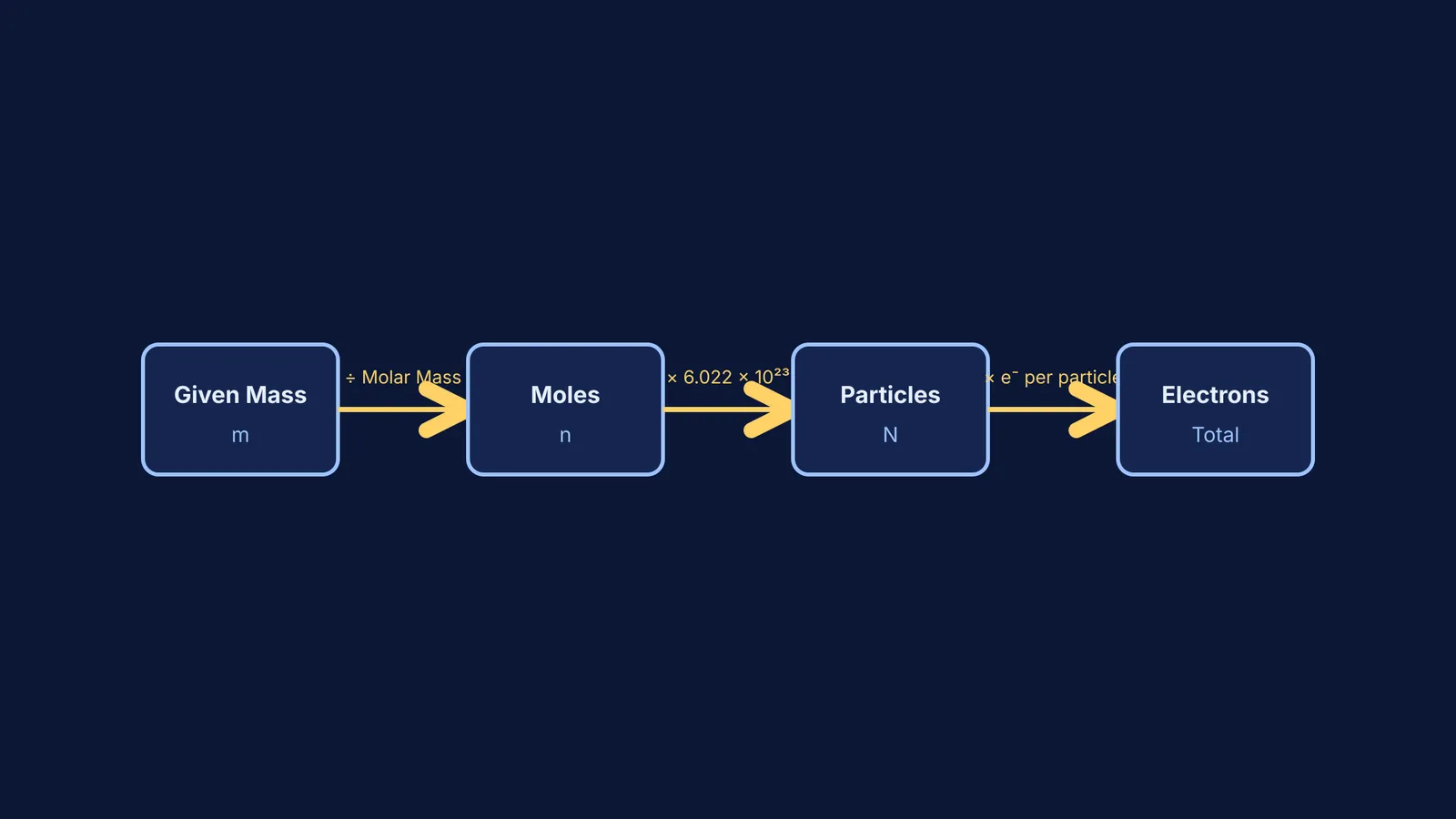
To solve these problems systematically, break the calculation into three specific steps:
Find the number of moles: Divide the given mass of your sample by the molar mass of the substance.
Find the total number of particles: Multiply the number of moles by the Avogadro constant. The NCERT Chemistry textbook defines this constant as 6.022 × 10²³. This step converts your macroscopic mass (what you would measure on a balance) into a count of individual molecules or ions.
Count the subatomic particles: Work out exactly how many electrons, protons, or neutrons are present in one single molecule or ion, and multiply this by your total number of particles from the previous step.
If you struggle to recall how these steps link together, the Fermi Concept Library maps out the mole concept, providing lessons that ground these abstract calculations in physical reality.
How many electrons are in 1.6 g of methane?
Methane has the chemical formula CH₄. Let us walk through the three steps to find out how many electrons are inside a 1.6 g sample.
First, we need the molar mass. A carbon atom has an atomic mass of 12 u, and each of the four hydrogen atoms has an atomic mass of 1 u. Molar mass of CH₄ = 12 + (4 × 1) = 16 g/mol. Number of moles = 1.6 g / 16 g/mol = 0.1 mol.
Next, we find the total number of molecules in the sample. Number of CH₄ molecules = 0.1 × 6.022 × 10²³ = 6.022 × 10²² molecules.
Finally, we count the electrons in one single molecule of CH₄. The atomic number of an element tells you its proton count, which equals its electron count in a neutral atom. A neutral carbon atom (atomic number 6) has 6 electrons, and each hydrogen atom (atomic number 1) brings 1 electron. Electrons in one CH₄ molecule = 6 + (4 × 1) = 10 electrons.
To find the total number of electrons in the sample, we multiply the number of molecules by the electrons per molecule. Total electrons = 6.022 × 10²² × 10 = 6.022 × 10²³ electrons. So, 1.6 g of methane contains exactly one mole of electrons.
How to count electrons, protons, and neutrons in ions?
When dealing with ions, the method is identical, but you must adjust the electron count for the overall electrical charge. A positive charge (a cation) means electrons have been lost, and a negative charge (an anion) means electrons have been gained. The number of protons and neutrons depends entirely on the atomic nuclei and never changes with the charge.
Let us find the number of electrons, protons and neutrons in 1.8 g of the ammonium ion (NH₄⁺).
First, find the moles. Nitrogen has an atomic mass of 14, and hydrogen is 1. The mass of the missing electron is completely negligible, so we use the standard molar mass. Molar mass of NH₄⁺ = 14 + (4 × 1) = 18 g/mol. Number of moles = 1.8 g / 18 g/mol = 0.1 mol. Total NH₄⁺ ions = 0.1 × 6.022 × 10²³ = 6.022 × 10²² ions.
Now, look closely at a single NH₄⁺ ion to count its subatomic makeup:
Protons: The nitrogen atom brings 7 protons, and the four hydrogen atoms bring 4. Total = 11 protons.
Neutrons: The standard nitrogen-14 isotope has 7 neutrons (mass number 14 − atomic number 7 = 7), and standard hydrogen-1 has 0 neutrons. Total = 7 neutrons.
Electrons: The neutral atoms would possess 11 electrons, but the +1 charge means one electron has been lost. Total = 10 electrons.
Finally, multiply these counts by the total number of ions:
Total protons = 11 × 6.022 × 10²² = 6.624 × 10²³ protons.
Total neutrons = 7 × 6.022 × 10²² = 4.215 × 10²³ neutrons.
Total electrons = 10 × 6.022 × 10²² = 6.022 × 10²³ electrons.
Whether you are working with neutral gases or charged radicals, keeping the mass-to-moles conversion completely separate from the particle-level counting prevents careless exam errors. For more practice with the properties of charged particles, see how to find the electron configuration of ions like Fe³⁺ and Cu⁺, or learn to determine oxidation numbers from structure for complex molecules.


