

On this page
These eight questions are written for Section B of JEE Main Physics, where you type a number instead of choosing an option. None comes from NCERT, the exemplar or a past paper.
How are numerical-value questions marked in JEE Main?
The Information Bulletin for JEE (Main) 2027 gives Physics 20 multiple-choice questions in Section A and 5 numerical-value questions in Section B. In Section B you enter an integer on an on-screen keypad, and the answer "should be rounded off to the nearest integer". A correct answer earns +4, a wrong one −1 and a blank 0.
All eight questions stay inside Unit 15, Electromagnetic Waves, of the Syllabus for JEE (Main) - 2027 and Chapter 8 of the NCERT Class 12 Physics Part I textbook (Reprint 2026-27). Take c = 3.0 × 10⁸ m/s, ε₀ = 8.85 × 10⁻¹² F/m, μ₀ = 4π × 10⁻⁷ T m/A and h = 6.63 × 10⁻³⁴ J s.
New to the chapter? Start with how to prepare Electromagnetic Waves for JEE Main, then try the multiple-choice Electromagnetic Waves JEE Main practice questions, set 1.
Easy: displacement current, radar and phase
Q1 (easy). While a capacitor charges, the electric flux through its gap rises uniformly from 0 to 6.0 × 10³ V m in 1.5 μs. Find the displacement current in the gap, in mA, to the nearest integer.
Answer: 35. i_d = ε₀ dΦ_E/dt = 8.85 × 10⁻¹² × (6.0 × 10³/1.5 × 10⁻⁶) = 8.85 × 10⁻¹² × 4.0 × 10⁹ = 0.0354 A = 35.4 mA.
Trap: 0, from reading 1.5 μs as 1.5 ms, which gives 0.035 mA.
Q2 (easy). A radar pulse returns to the antenna 0.40 ms after it was sent. Find the distance of the aircraft, in km.
Answer: 60. The pulse goes out and back, so 2d = ct and d = (3.0 × 10⁸ × 0.40 × 10⁻³)/2 = 6.0 × 10⁴ m = 60 km.
Trap: 120, the total path, which forgets the round trip.
Q3 (easy). A 75 MHz wave travels in vacuum. Two points on its line of travel are 0.50 m apart. Find the phase difference between the fields at these points, in degrees.
Answer: 45. λ = c/ν = 3.0 × 10⁸/(75 × 10⁶) = 4.0 m. The phase difference is 360° × 0.50/4.0 = 45°.
Trap: 1, the right phase in radians (0.785).
Medium: timing, a medium and energy delivered
Q4 (medium). A plane wave of wavelength 6.0 m travels in vacuum. At a fixed point, its electric field is at a maximum at t = 0. After how many nanoseconds is the magnetic field at that point first zero?
Answer: 5. NCERT writes E and B with the same sin(kz − ωt), so they are in phase and both reach zero a quarter period later. T = λ/c = 20 ns, so T/4 = 5 ns.
Trap: 0, from thinking B is zero when E peaks.
Q5 (medium). A plane wave travels in a non-magnetic medium of relative permittivity 1.96. Its electric field amplitude is 42 V/m. Find its magnetic field amplitude, in nT.
Answer: 196. NCERT's v = 1/√(με) with μ = μ₀ gives v = c/√1.96 = c/1.4 = 2.14 × 10⁸ m/s. In the medium B₀ = E₀/v = 42 × 1.4/(3.0 × 10⁸) = 1.96 × 10⁻⁷ T = 196 nT.
Trap: 140, which divides by c as if the wave were in vacuum.
Q6 (medium). A plane wave with magnetic field amplitude 0.40 μT falls normally on a 2.0 m² panel that absorbs all of it. Find the energy absorbed in 10 minutes, in kJ, to the nearest integer.
Answer: 23. The average intensity is I = cB₀²/(2μ₀), from OpenStax University Physics, section 16.3: 3.0 × 10⁸ × (0.40 × 10⁻⁶)²/(2 × 4π × 10⁻⁷) = 19.1 W/m². Energy = IAt = 19.1 × 2.0 × 600 = 2.29 × 10⁴ J = 22.9 kJ.
Trap: 46, the peak energy flow instead of its average.
Hard: photon density and dV/dt inside the plates
Q7 (hard). A beam of 450 nm light in vacuum has electric field amplitude 100 V/m. Find the average number of photons per cubic centimetre of the beam, in units of 10³ cm⁻³, to the nearest integer.
Answer: 100. Averaging OpenStax's u = ε₀E² gives u = ½ε₀E₀² = 0.5 × 8.85 × 10⁻¹² × 10⁴ = 4.43 × 10⁻⁸ J/m³. Each photon carries hc/λ = 4.42 × 10⁻¹⁹ J. So n = 4.43 × 10⁻⁸/4.42 × 10⁻¹⁹ = 1.00 × 10¹¹ m⁻³ = 1.00 × 10⁵ cm⁻³, or 100 in units of 10³.
Trap: 200, which uses the peak ε₀E₀² instead of its average.
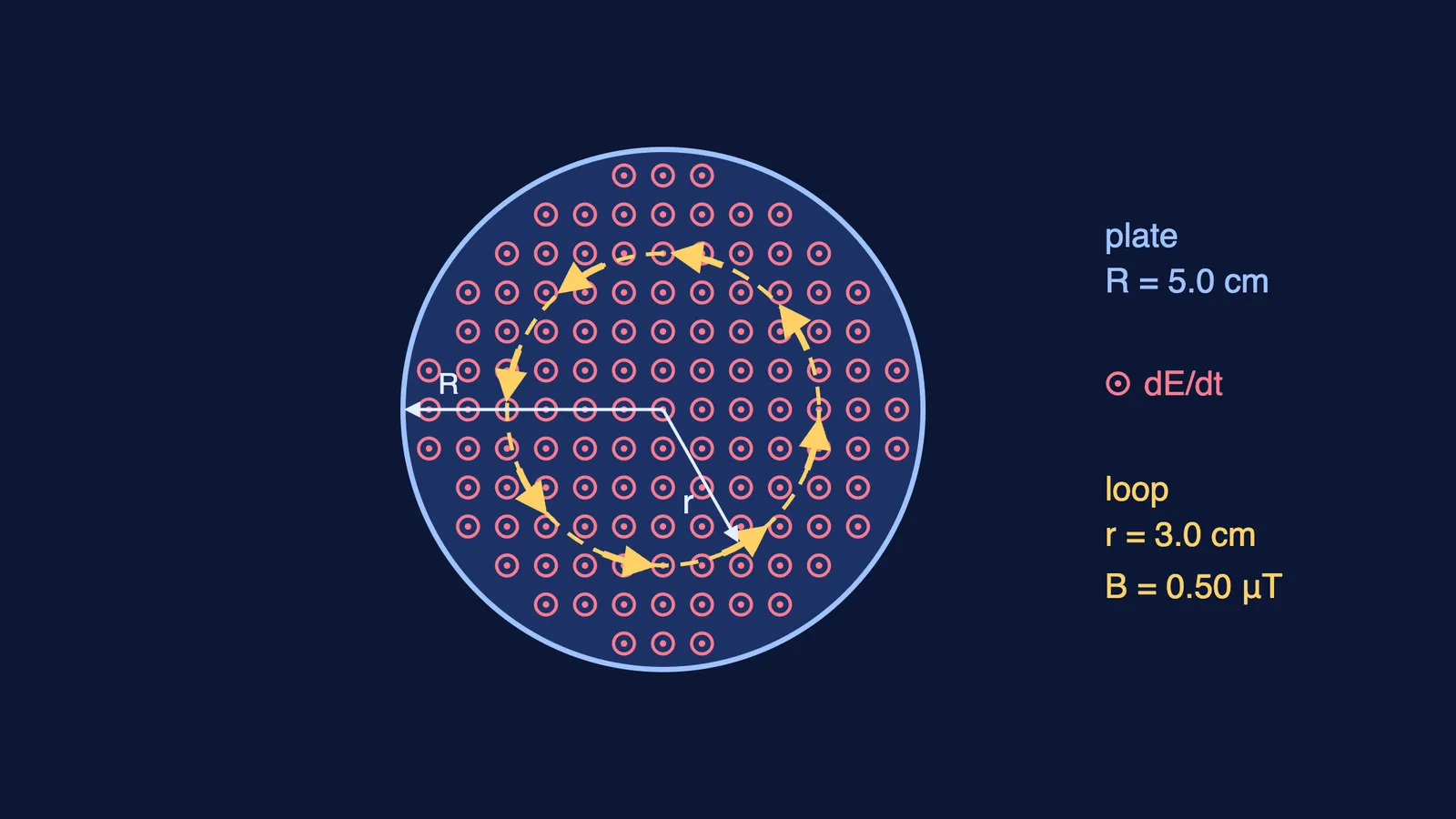
Q8 (hard). A capacitor has circular plates of radius 5.0 cm, 1.0 mm apart, and the voltage across it rises at a steady rate. Ignore edge effects. In the plane midway between the plates, the magnetic field 3.0 cm from the axis is 0.50 μT. Find dV/dt, in units of 10⁸ V/s, to the nearest integer.
Answer: 30. Inside the plates the loop encloses only the displacement current through its own area: B(2πr) = μ₀ε₀πr² dE/dt, giving dE/dt = 2B/(μ₀ε₀r) = 3.0 × 10¹² V m⁻¹ s⁻¹; the plate radius drops out. With E = V/d, dV/dt = d dE/dt = 1.0 × 10⁻³ × 3.0 × 10¹² = 3.0 × 10⁹ V/s, or 30 in units of 10⁸.
Trap: 11, from using the whole plate's displacement current in B = μ₀i_d/(2πr) at a point inside the plates.
How do you get the number right in Electromagnetic Waves?
Match prefixes to the stem. μs against ms, or nT against μT, moves the answer a thousandfold.
Keep the ½ in averages. The average of sin² over a cycle is ½; Q6 and Q7 punish dropping it or using the peak.
Use v, not c, inside a medium. Speed, wavelength and E₀/B₀ all drop by the same factor.
Check where the loop sits. Inside the plates only the fraction r²/R² of the displacement current is enclosed; outside, all of it.
Round once, at the end. Carry three or four significant figures; an early rounding near .5 can flip the integer.
Does the in-phase idea in Q4 still feel wrong? The Fermi Simulation Lab has interactive simulations for the ideas that are easier to see than to read.


