

On this page
These eight new questions follow the JEE Main numerical format: no options, just a number to type. They run easy to hard inside the electromagnetic induction half of Unit 14 in the NTA syllabus for JEE (Main) 2027 and NCERT Class 12 Physics Chapter 6. For theory, see how to prepare electromagnetic induction and AC for JEE Main.
How are JEE Main numerical-value questions marked?
In JEE (Main) 2027 Paper 1, each subject has 20 multiple-choice questions in Section A and 5 numerical-value questions in Section B, according to the NTA Information Bulletin for JEE (Main) 2027. Section B scores +4 if correct, −1 if wrong and 0 if blank. You type the answer on an on-screen keypad, rounded off to the nearest integer, so every answer below is one.
Easy: can you find the rate of change of flux?
Q1 (easy). The magnetic flux through a single loop varies as Φ = (5t² − 4t + 2) mWb, with t in seconds. Find the magnitude of the emf induced in the loop at t = 3 s, in mV.
Answer: 26. The emf is |dΦ/dt| = (10t − 4) mV, which at t = 3 s is 30 − 4 = 26 mV.
Trap: 35 is the flux itself at t = 3 s, not its rate of change.
Q2 (easy). A 50-turn coil of area 0.040 m² has its area vector along a uniform 0.50 T field. In 0.025 s it turns until that vector makes an angle θ with the field, where cos θ = 0.8. Find the average emf induced, in volts.
Answer: 8. The flux linkage falls from NBA = 1.0 Wb to NBA cos θ = 0.80 Wb. The average emf is 0.20 Wb / 0.025 s = 8 V.
Trap: 32 uses the final flux linkage instead of the change.
Q3 (easy). A flexible conducting ring lies perpendicular to a uniform 0.20 T field. Its radius shrinks steadily at 4.0 mm/s. Find the emf in the ring at the moment its radius is 15 cm, in μV, to the nearest integer.
Answer: 754. The area changes, not the field: emf = B dA/dt = B × 2πr × dr/dt = 0.20 × 2π × 0.15 × 4.0 × 10⁻³ = 7.54 × 10⁻⁴ V.
Trap: 377 differentiates πr² as πr and drops the factor 2.
Medium: what changes when the field is not uniform?
Q4 (medium). The current in a 2.0 H inductor varies as i = (4t − t²) A, with t in seconds. Find the rate at which energy is being stored in its magnetic field at t = 1 s, in watts.
Answer: 12. The stored energy is U = ½Li², so dU/dt = Li(di/dt). At t = 1 s, i = 3 A and di/dt = 4 − 2t = 2 A/s, giving 2.0 × 3 × 2 = 12 W.
Trap: 9 is the stored energy, not its rate.
Q5 (medium). A long straight wire carries a steady 50 A. A 30 cm rod in the same plane lies perpendicular to the wire, its near end 10 cm away. It moves at 10 m/s parallel to the wire. Take μ₀ = 4π × 10⁻⁷ T m A⁻¹ and ln 2 = 0.693. Find the emf between the ends of the rod, in μV, to the nearest integer.
Answer: 139. B = μ₀I/(2πr) varies along the rod, so integrate Bv dr from r = 0.10 m to 0.40 m: emf = (μ₀Iv/2π) ln 4 = 2 × 10⁻⁷ × 50 × 10 × 1.386 = 1.386 × 10⁻⁴ V.
Trap: 300 uses the field at the near end for the whole rod.
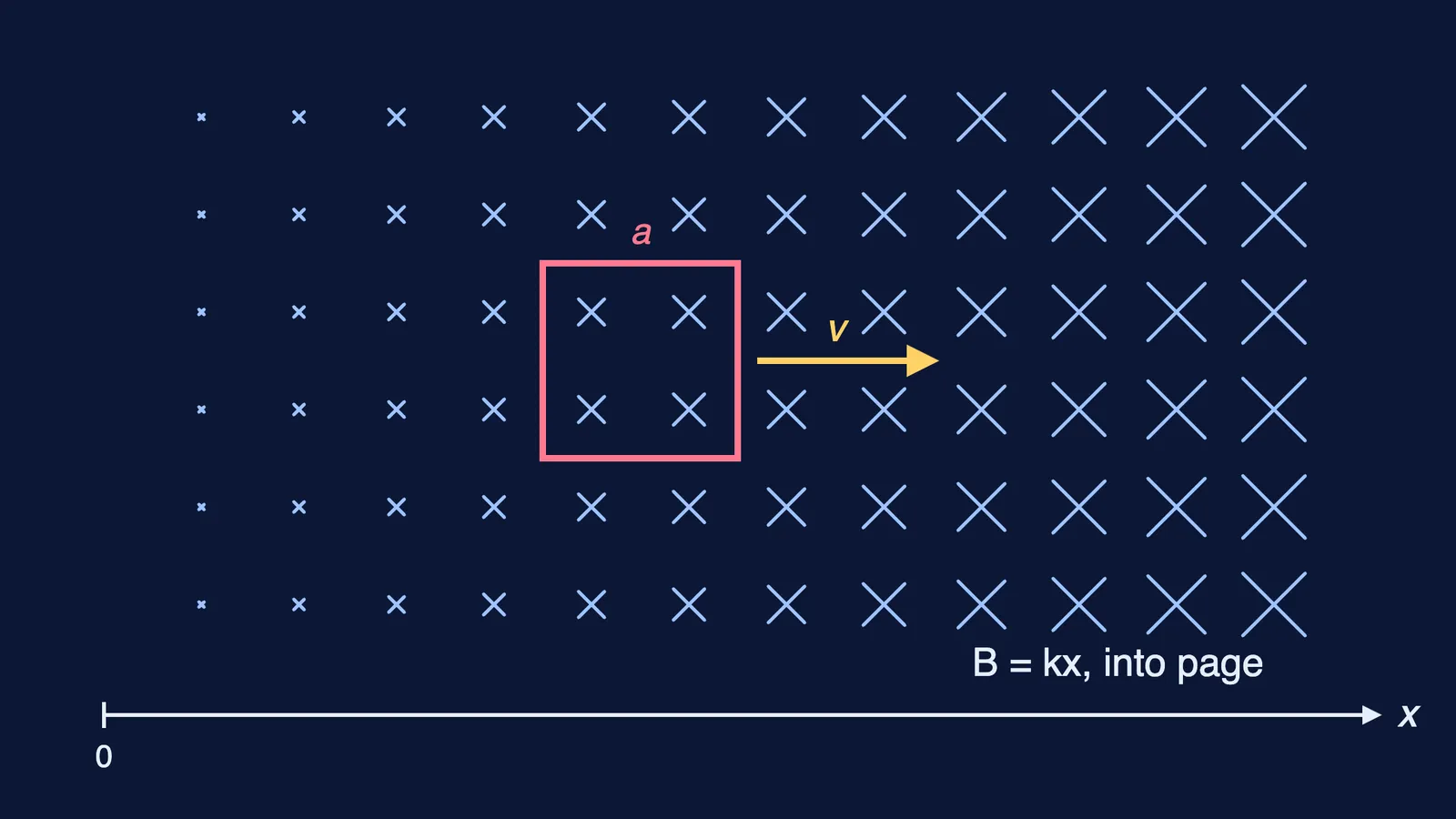
Q6 (medium). A field perpendicular to the xy-plane grows along x as B = kx, with k = 2.0 T/m. A square loop in the plane, side 10 cm and resistance 0.20 Ω, sides parallel to the axes, moves along +x at 3.0 m/s. Find the induced current, in mA.
Answer: 300. The leading side (at x + a) and trailing side (at x) give opposing emfs, differing by k(x + a)av − kxav = ka²v = 2.0 × 0.010 × 3.0 = 0.060 V, at every position. The current is 0.060/0.20 = 0.30 A.
Trap: 0 assumes steady motion inside a field never changes the flux. That holds only for a uniform field.
Hard: which questions need a force balance?
Q7 (hard). A rod of mass 0.15 kg lies across smooth horizontal rails 0.30 m apart, joined by a 0.20 Ω resistor. A vertical 1.0 T field is present everywhere. The rod is given a speed of 6.0 m/s along the rails and then left to coast. Ignoring other resistance, find the distance it travels before stopping, in cm.
Answer: 200. The drag is B²L²v/R, so mv(dv/dx) = −B²L²v/R. Speed falls linearly with distance, and the total is mv₀R/(B²L²) = 0.15 × 6.0 × 0.20/(1.0 × 0.090) = 2.0 m.
Trap: 100 treats the starting drag as constant; it shrinks as the rod slows.
Q8 (hard). A rod of mass 0.040 kg slides without friction on horizontal rails 0.40 m apart in a vertical 1.0 T field. The rails are joined by an uncharged 0.20 F capacitor, and all resistance is negligible. A constant force of 0.36 N along the rails starts the rod from rest. Find the rod's speed after 2.0 s, in m/s.
Answer: 10. The capacitor charge is q = CBLv, so i = CBLa. Then F − BiL = ma, so a = F/(m + CB²L²) = 0.36/(0.040 + 0.032) = 5.0 m/s². After 2.0 s, v = 10 m/s.
Trap: 18 ignores the capacitor and uses a = F/m.
How to get the number right
Convert first: mm to m, cm² to m².
Read the asked unit: 7.54 × 10⁻⁴ V "in μV" is 754.
Average or instant: "in 0.025 s" means ΔΦ/Δt; "at t = 3 s" means a derivative.
When the stem asks for the size of the emf, give its magnitude; Lenz's law only fixes the direction.
Check limits: a uniform field makes Q6 zero; no capacitor makes Q8 F/m.
Stuck on writing the flux in Q5 or Q6? The Fermi Problem Library has worked problems with a step-by-step solver that explains the reasoning rather than printing an answer.
For multiple-choice practice, try our electromagnetic induction and AC JEE Main questions with solutions.


