

On this page
An electric fence around a field can carry several thousand volts, yet a cow that touches it gets a sharp jolt and backs away unharmed. Touch a 230 V mains wire and you can be killed. The difference is not the voltage. It is how much energy each pulse carries, how short the pulse is, and the long gap between pulses. Inside the box that drives the fence, called the energiser, there is a capacitor, and the physics is the ½CV² you already know. This post explains how the fence works, puts numbers on one pulse, and shows why the safety limits are set where they are.
How does an electric fence work?
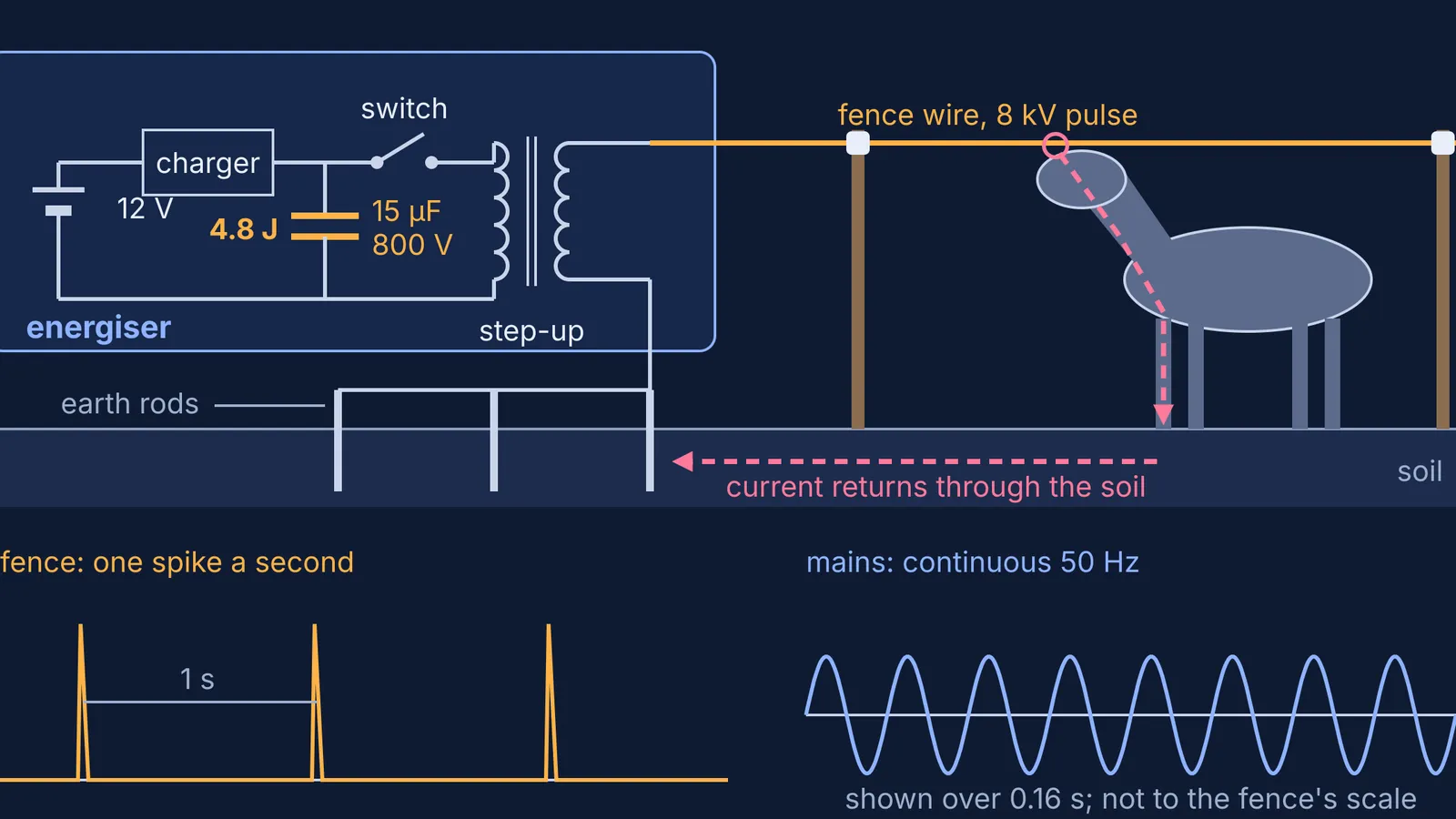
The energiser does three things, over and over:
Charge. A circuit inside charges a capacitor from a battery or a power supply.
Dump. About once a second, a switch discharges the capacitor through a step-up transformer. The output is a single pulse of several kilovolts that lasts well under a millisecond.
Wait. Nothing is on the wire until the next pulse.
One output terminal of the energiser goes to the fence wire, which is held off the posts by insulators. The other goes to metal earth rods driven into the ground. On its own, the wire is part of an open circuit, so no current flows. When an animal touches the wire while standing on the ground, its body closes the circuit: current flows from the wire, through the animal, into the soil and back through the soil to the earth rods.
This is the same rule that explains why birds on a power line don't get a shock: there is no current through you unless you are part of a complete path between two points at different potentials. A bird on one wire is not; an animal touching the fence wire and standing on damp soil is.
How much energy is in one fence pulse?
The numbers below are illustrative, chosen to be typical in size. Real energisers vary a lot.
Storage capacitor C = 15 µF, charged to V = 800 V
Pulse into a 500 Ω load (the standard test load, described in the next section), peaking at 8 kV
Pulse length about 0.3 ms, one pulse a second
Energiser efficiency 70%, running from a 12 V, 60 Ah battery
Stored energy. E = ½CV² = ½ × 15 × 10⁻⁶ × 800² = 4.8 J. Charge stored Q = CV = 0.012 C.
Peak current. I = V/R = 8000/500 = 16 A. That sounds large, but it lasts for a fraction of a millisecond.
Average power within the pulse. If the 4.8 J is delivered in about 0.3 ms, P = 4.8 ÷ (0.3 × 10⁻³) = 16 kW.
Average power over a second. One 4.8 J pulse per second averages 4.8 W, about a small phone charger.
Power from the battery. At 70% efficiency the energiser draws 4.8 ÷ 0.7 = 6.9 W, which is 6.9 ÷ 12 = 0.57 A.
Battery life. The battery stores 12 V × 60 Ah = 720 Wh. Time = 720 ÷ 6.9 = 105 h, about 4.4 days.
Units: F × V² = (C/V) × V² = C × V = J, and Wh ÷ W = h.
The point of the example is the contrast: a kilowatt-scale burst for a fraction of a millisecond, then nearly a full second of nothing. A defibrillator uses the same capacitor physics at a much larger scale, about 200 J in one pulse, as described in the story of Frank Pantridge's portable defibrillator. How fast a capacitor empties through a resistor, and when its energy falls to half, is worked in capacitor discharge: when the stored energy becomes half.
What safety limits apply to electric fence energisers?
Energisers are covered by the international safety standard IEC 60335-2-76. Its 1999 amendment, IEC 60335-2-76 Amendment 1, sets these output limits, all measured with a standard load that includes a 500 Ω resistor:
The impulse repetition rate must not exceed 1 Hz, so at most one pulse a second.
Each impulse must last no more than 10 ms.
For energy-limited energisers, the energy per impulse in the 500 Ω load must not exceed 5 J.
Current-limited energisers instead have a current limit that depends on the pulse duration, up to 15.7 A for pulses shorter than 0.1 ms.
That amendment has since been replaced by later editions (the current one is from 2018), whose full text is behind a paywall, so check the current edition before relying on exact figures. Our 4.8 J example sits just under the 5 J limit.
Why is a fence pulse safer than mains electricity?
The danger of an electric shock depends on the current through the body and on how long it flows, not on voltage alone.
Mains is continuous. A 50 Hz supply drives current through you without a break. Current through the forearm can make the hand muscles clench, so a person gripping a live wire may be unable to let go, and the current keeps flowing.
A fence pulse is short and spaced out. The pulse is over in a fraction of a millisecond, and the next one is at least a second away. The muscles contract once and then release, so the animal or person can pull back.
The energy is capped. At most 5 J per pulse into the test load for an energy-limited unit, against a mains supply that can keep delivering kilowatts for as long as contact lasts.
This is why a fence must only ever be powered by an energiser built and certified to the safety standard. Home-made energisers, or any fence connected directly to the mains, remove the short-pulse and energy limits that make the fence safe, and they can kill people and animals.
Why does an electric fence stop working?
The current returns through the soil, so the earth side of the circuit matters as much as the wire.
Poor earthing. In dry or sandy soil, the resistance between the earth rods and the ground is high. The animal then completes a circuit with a large resistance in series, so less current flows and the jolt is weak. This is a common reason a fence that reads a high voltage still fails to stop animals.
Vegetation on the wire. Wet grass or weeds touching the wire form a leakage path to the ground. Each pulse loses charge through them, which pulls down the fence voltage along its whole length.
Dry ground under the animal. The same series-resistance idea applies at the animal's feet.
If you would like to practise more capacitor energy and circuit problems, the Fermi Problem Library has a step-by-step solver that explains the reasoning.
Quick checklist
An energiser charges a capacitor and dumps it through a step-up transformer as a short high-voltage pulse.
The animal completes the circuit through the soil to the earth rods.
Energy per pulse: E = ½CV²; 15 µF at 800 V gives 4.8 J.
The 1999 IEC amendment caps pulses at 1 per second, 10 ms long and 5 J per pulse (energy-limited units).
Safety comes from short, spaced pulses and capped energy, not from low voltage.
Bad earthing and vegetation on the wire are common causes of a weak fence.


