

On this page
When a heart stops beating properly, a well-timed electric shock can sometimes reset it. Frank Pantridge, a heart doctor in Belfast, decided the machine that gives that shock had to travel to the patient, rather than wait for the patient to reach hospital.
Who was Frank Pantridge and what did he build?
Pantridge was born in 1916 on the outskirts of Hillsborough, Northern Ireland, qualified in medicine at Queen's University Belfast in 1939, and died on 26 December 2004, according to his obituary in the BMJ. The same obituary says he built the first portable defibrillator in 1965 with technician Alfred Mawhinney and senior house officer John Geddes, then installed it in an ambulance.
The first model weighed 70 kg and ran on two 12-volt car batteries, according to the Ulster Transport Museum. The museum records that the Royal Victoria Hospital's cardiac ambulance was launched on 1 January 1966, and that its first patient, a woman treated at home, survived.
Later, using a miniature capacitor made for NASA, Pantridge designed a defibrillator weighing only 3 kg, the BMJ obituary notes. The museum dates a lightweight portable version, made by Professor Anderson and Dr John Geddes, to 1968, and adds that in 1990 all frontline ambulances in the UK were fitted with defibrillators.
Pantridge and Geddes reported the Belfast results in The Lancet in August 196790110-9), in a paper titled "A mobile intensive-care unit in the management of myocardial infarction".
Why did the defibrillator need to go to the patient?
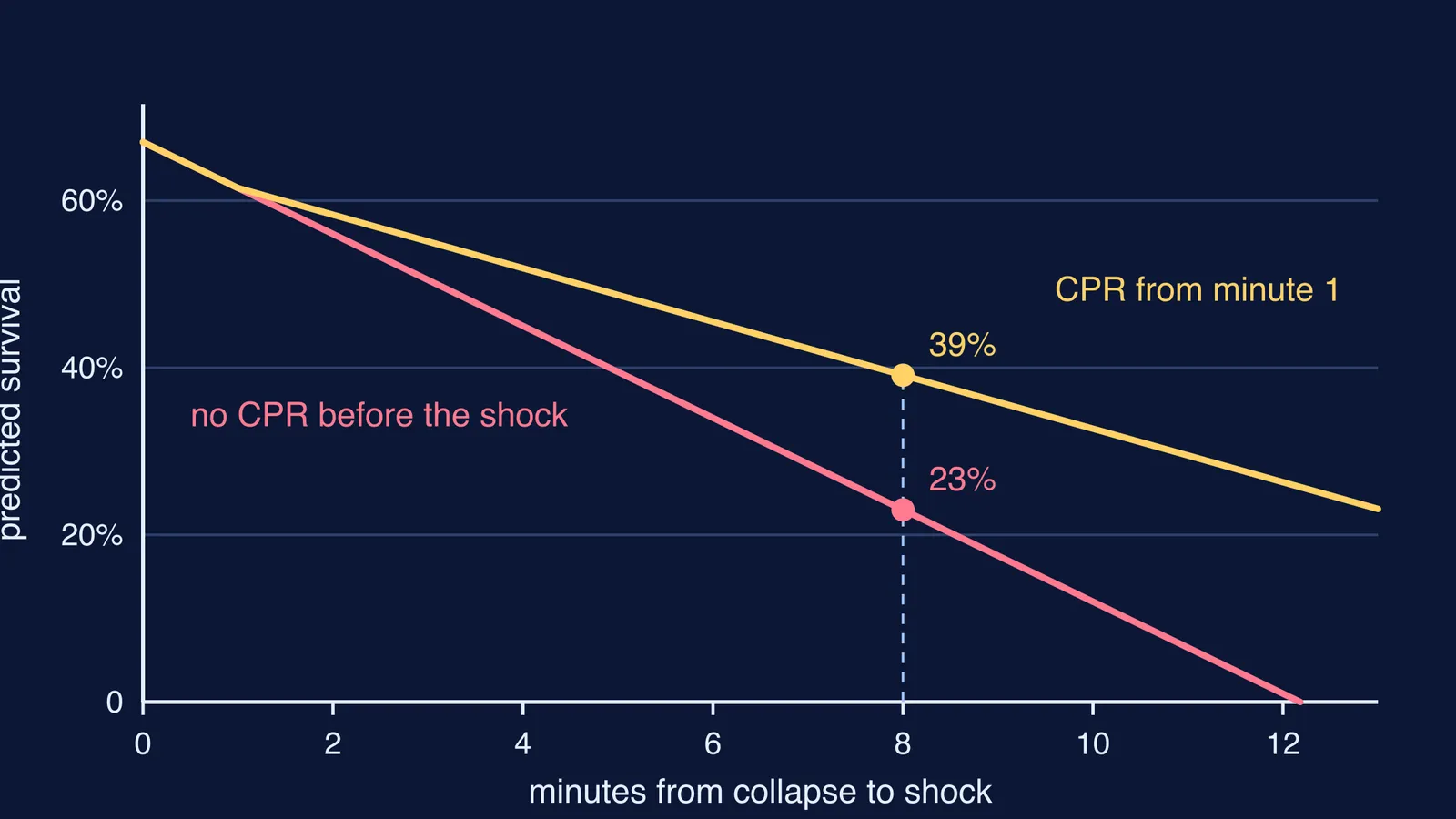
Because every minute counts. In a study of 1,667 people in King County, Washington, who had heart disease, were in ventricular fibrillation and collapsed before the emergency crew arrived, Larsen and colleagues (1993)81302-2) fitted a simple equation:
survival rate = 67% − 2.3% per minute to CPR − 1.1% per minute to the first shock − 2.1% per minute to advanced care
Their summary: with no treatment at all, the survival rate falls by about 5.5 percentage points for every minute that passes (Larsen et al., Annals of Emergency Medicine81302-2)).
How much does each minute matter in the model?
Say someone collapses and the ambulance arrives at minute 8. These made-up cases show how the Larsen model81302-2) works; they are not predictions for any real person.
Nobody starts CPR. CPR, the shock and advanced care all begin at minute 8: 67 − 5.5 × 8 = 23%.
A bystander starts CPR at minute 1, and the rest still comes at minute 8: 67 − 2.3 − 8.8 − 16.8 = 39.1%.
CPR at minute 1, a public defibrillator brought over at minute 4, the ambulance at minute 8: 67 − 2.3 − 4.4 − 16.8 = 43.5%.
The chart at the top plots the first two cases. Pantridge's ambulance moved the shock from "after the drive to hospital" to "minutes after the call".
For the earlier, in-hospital story, read Claude Beck and the first human defibrillation.
How can a car battery power a heart shock?
A battery gives out energy slowly. A shock has to deliver a lot of energy in a few thousandths of a second. The fix is a capacitor: charge it up slowly from the battery, then dump the stored energy all at once.
The energy stored in a capacitor is E = ½CV², where C is the capacitance and V is the voltage across it. Here is a textbook-style example (not the specs of Pantridge's machine):
A 100 µF capacitor charged to 2,000 V stores ½ × 100 × 10⁻⁶ × 2,000² = 200 J.
If the battery-driven charger feeds in 50 W, filling it takes 200 ÷ 50 = 4 seconds.
If the 200 J leaves in about 5 milliseconds, the average power is 200 ÷ 0.005 = 40,000 W.
Low power in, very high power out. Charging is not free, either: see why half the energy is lost when charging a capacitor, and for the body's side of the circuit, why a small current through the body is dangerous.
If ½CV² still feels like a formula to memorise rather than understand, the Fermi Concept Library gives each physics concept its own lesson and shows its place in the map, and the Fermi Simulation Lab has interactive simulations for ideas that are easier to see than to read.
What should you do if someone collapses?
This is general awareness, not medical training:
Call for help straight away. In India, 112 brings together the emergency numbers, including 100 for police, 101 for fire and 108 for ambulance, according to the Press Information Bureau.
Follow what the call handler tells you.
Ask someone to look for a defibrillator if your school, mall, station or airport has one.
Learn CPR properly from a certified first-aid course. A class teaches what no article can.
The footballer Fabrice Muamba, who collapsed during an FA Cup match in 2012, said he would not be here today without Pantridge's portable defibrillator, the Ulster Transport Museum reports. The ½CV² in your textbook is the same physics that rode in that ambulance.


