

On this page
Pheretima, the Indian earthworm of biology textbooks, gets rid of nitrogenous waste through hundreds of tiny coiled tubes called nephridia. The hard part is remembering which of the three kinds sits where, where each opens and how many there are. Here are all three answers from Karm Narayan Bahl's 1919 study of Pheretima's nephridia, plus a grid to redraw from memory.
What are the three types of nephridia in earthworm?
Nephridia are the tubular excretory structures of earthworms and other annelids; they remove nitrogenous wastes and keep fluid and ionic balance, according to NCERT Class 11 Biology, Chapter 16.
Pheretima posthuma has three kinds of nephridia, septal, pharyngeal and integumentary, “named according to the position they occupy in the worm”, wrote Bahl, a zoologist at Muir Central College, Allahabad, in a 1919 paper in the Quarterly Journal of Microscopical Science.
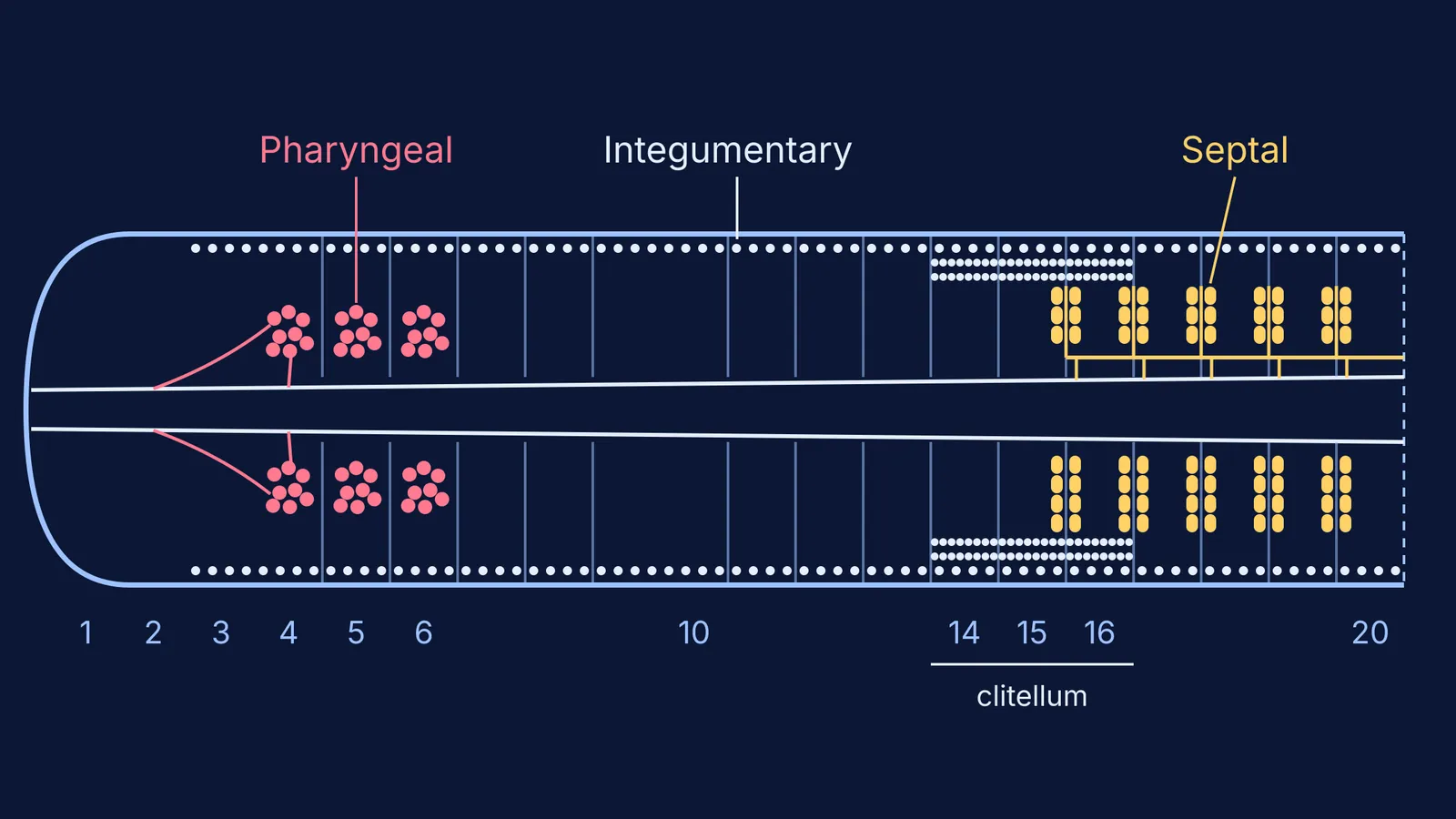
Septal nephridia are the largest. They hang on both faces of the septa (the walls between segments), starting at the septum between segments 15 and 16.
Pharyngeal nephridia are paired tufts lying beside the oesophagus in segments 4, 5 and 6.
Integumentary nephridia are very minute, less than half the size of a septal nephridium, hardly visible to the naked eye, and stuck to the inner surface of the body wall in every segment except the first two.
For flame cells and Malpighian tubules, see our guide on matching each excretory organ to its animal.
How do septal, integumentary and pharyngeal nephridia differ?
Compare them on three things only: location, opening and number. Every figure below comes from Bahl's dissections and counts in the 1919 paper.
Septal. Location: both faces of every septum behind segment 15. Opening: into the intestine, through canals on each septum that drain into a pair of ducts running above the gut. Number: 40 to 50 on each face of a septum, so 80 to 100 in each segment's body cavity.
Pharyngeal. Location: three pairs of tufts beside the oesophagus in segments 4, 5 and 6. Opening: into the buccal cavity and pharynx, through three pairs of ducts that open in segments 2 and 4. Number: three paired tufts.
Integumentary. Location: inner surface of the body wall from segment 3 onward. Opening: straight to the outside, each through its own pore on the skin. Number: about 200 to 250 per segment, but more than ten times as many in segments 14, 15 and 16, where Bahl described a “forest” of them.
One more detail that turns up in MCQs: Bahl saw a funnel (nephrostome) opening into the body cavity on each septal nephridium, but found no funnels on the integumentary ones.
Why do most earthworm nephridia open into the gut?
Earlier zoologists described earthworm nephridia as opening through the skin. Bahl found that Pheretima's septal and pharyngeal nephridia empty into the gut instead, and termed the septal duct system the “enteronephric” type (Bahl, 1919). He suggested it is “probably a device for the conservation of water in this tropical genus”: the gut lining takes back water from the excretory fluid while the solid waste leaves with the faeces.
The integumentary nephridia are the exception because they open on the skin. Exam guides call them exonephric (PW notes on earthworm excretion). For why animals differ in the waste they make in the first place, see ammonotelic, ureotelic and uricotelic animals explained.
How do you redraw the comparison from memory?
Take a blank page and build the grid in this order.
Draw three rows: Pharyngeal, Integumentary, Septal (front, everywhere, back).
Add three columns: Where, Opens into, How many.
Where: 4, 5, 6; 3 onward; behind 15.
Opens into: pharynx and buccal cavity; skin (integument means skin); intestine. Septal is the one to learn by heart.
How many: three pairs of tufts; 200 to 250 per segment, with a forest in 14 to 16; 80 to 100 per segment.
Check: two of the three open into the gut, and only one opens to the outside.
Now test it. A statement reads: “Nephridia that open on the body surface begin at segment 15.” It mixes two rows. Integumentary nephridia open on the skin but begin at segment 3; septal nephridia begin behind segment 15 but open into the intestine.
For the segment numbers and clitellum, see our explainer on earthworm segments, setae and the clitellum. If words like septum or coelom are still fuzzy, the Fermi Concept Library has a lesson for each biology concept and shows where it sits in the map.
Is the earthworm still in the NCERT Class 11 book?
The current reprint of NCERT Class 11 Biology, Chapter 7, Structural Organisation in Animals, describes only the frog, though Chapter 16 still names nephridia as the excretory organs of earthworms. Check your own syllabus and past papers before deciding how deep to go.
Redraw the grid once today and once more in three days, without looking.


