

On this page
If a quiz asks how many hearts an earthworm has, the honest answer starts with a question back: which earthworm? The Indian zoology notes cited below describe Pheretima posthuma, and for that worm the answer is four pairs.
How many hearts does an earthworm have?
Pheretima has four pairs of hearts that connect the dorsal vessel with the ventral vessel, according to a 1921 study of its blood system by the Indian zoologist Karm Narayan Bahl of Muir Central College, Allahabad. Four pairs means eight hearts, one on each side of the body in four segments.
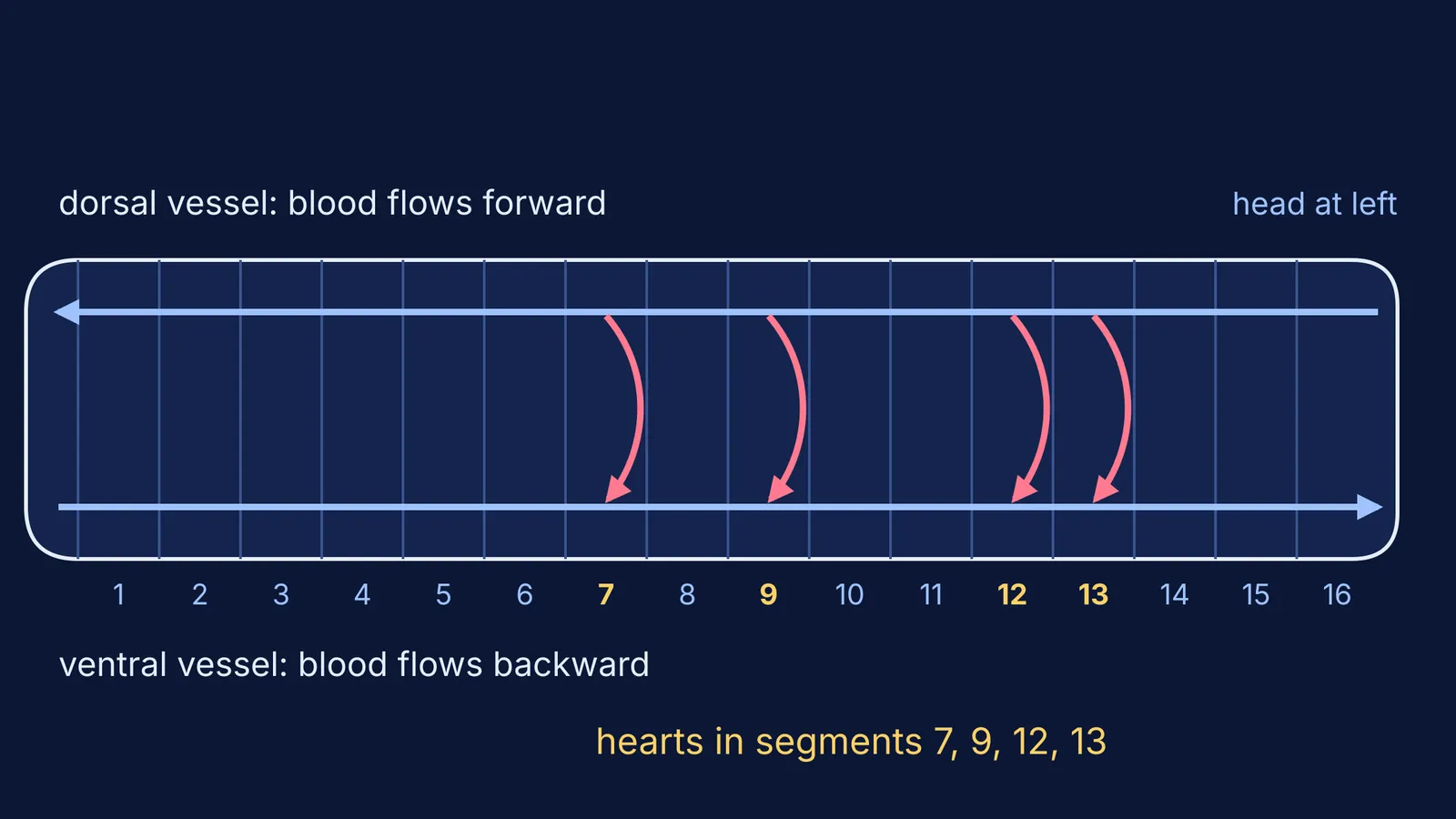
The hearts sit in segments 7, 9, 12 and 13, as set out in this college zoology unit on Pheretima's circulatory system. They are thick, muscular vessels with valves.
Other earthworms differ. A college lab handout on Lumbricus, the common earthworm, lists five muscular aortic arches as its hearts. That is why you will see "five hearts" online and "four pairs" in notes on Pheretima. Both can be right; they describe different worms.
Which segments hold the earthworm's hearts?
The heart region lies between segments 7 and 13, but not every segment in that range has a heart. This map follows the same college zoology unit and the notes on IAS Zoology's earthworm page:
Segments 4, 5, 6: blood glands, which make blood cells and haemoglobin.
Segment 7: first pair of lateral hearts, joining the dorsal vessel to the ventral vessel.
Segment 8: no hearts.
Segment 9: second pair of lateral hearts.
Segments 10, 11: one pair of anterior loops each. These are thin-walled, non-muscular and have no valves, so they are not hearts.
Segment 12: first pair of lateral-oesophageal hearts, joining the dorsal and supra-oesophageal vessels to the ventral vessel.
Segment 13: second pair of lateral-oesophageal hearts.
Each lateral heart has four pairs of valves and each lateral-oesophageal heart has three pairs, according to the college unit.
For the segments around the hearts (mouth, gizzard, clitellum), see our guide to earthworm segments, setae and the clitellum.
Which way does blood flow in the dorsal and ventral vessels?
The dorsal vessel runs along the top of the gut. It is contractile, pushes blood from the back of the worm towards the head, and has valves that stop backflow, as Online Biology Notes explains.
The ventral vessel runs below the gut. It has thin walls with no muscles or valves, carries blood backwards, and is the main vessel that distributes blood to the body.
The hearts are the bridges. Their valves let blood flow only one way: down from the dorsal side into the ventral vessel.
Bahl's 1921 study called the ventral vessel "the arterial trunk throughout", and found the dorsal vessel "venous" (collecting) behind the hearts but "arterial" (distributing) in the heart region and in front. So the loop is: body and gut, into the dorsal vessel, forward to the hearts, down into the ventral vessel, back out to the body.
Why is the earthworm's circulatory system called closed?
A closed circulatory system is one in which blood stays inside the heart, vessels and capillaries and never pools freely around the organs. Annelid worms stand out among most invertebrates by having a closed vascular system, as Kjell Johansen and Arthur Martin noted in 1965. Their blood usually carries haemoglobin dissolved in the plasma.
Compare the cockroach, whose open system lets blood bathe the organs; we walk through it in why the cockroach heart has 13 chambers.
The giant earthworm Johansen and Martin studied has no special breathing organs; its skin is the only surface for gas exchange. In Pheretima, Bahl described capillary loops in the body wall where an artery passes into a vein, so the closed vessels bring blood close to the skin.
How can you remember the earthworm heart segments?
Try this drill before a test.
Draw a strip of 14 boxes and number them.
Shade 4, 5 and 6 and write "blood glands".
Put a heart in 7 and 9 and label them "lateral". Remember them as the odd pair.
Draw thin loops in 10 and 11 and write "not hearts".
Put a heart in 12 and 13 and label them "lateral-oesophageal". Remember them as the back-to-back pair.
Add arrows: dorsal vessel forward, hearts downward, ventral vessel backward.
Then test yourself without the drawing. How many hearts does Pheretima have? (Four pairs, eight hearts.) Which segments have loops, not hearts? (10 and 11.) Which vessel has no valves? (The ventral vessel.) Why is the system closed? (Blood never leaves the vessels.)
Our list of common body fluids and circulation mistakes in NEET Biology covers the human side of the same ideas. For open versus closed systems, or how haemoglobin carries oxygen, the Fermi Concept Library gives each concept its own lesson and shows where it sits among related ideas, so you can fill the gap before moving on.


