

On this page
If a spade slices through a worm in your garden, you usually end up with one injured worm, not two. Which piece lives depends on the species and on where the cut falls, and researchers have measured both.
What happens when you cut an earthworm in half?
An earthworm's body is a chain of repeated segments, and the vital organs are packed into the front end. Our guide to metameric segmentation, from earthworms to tapeworms explains how that repeated body plan works. Cut through the middle and the two halves face very different jobs.
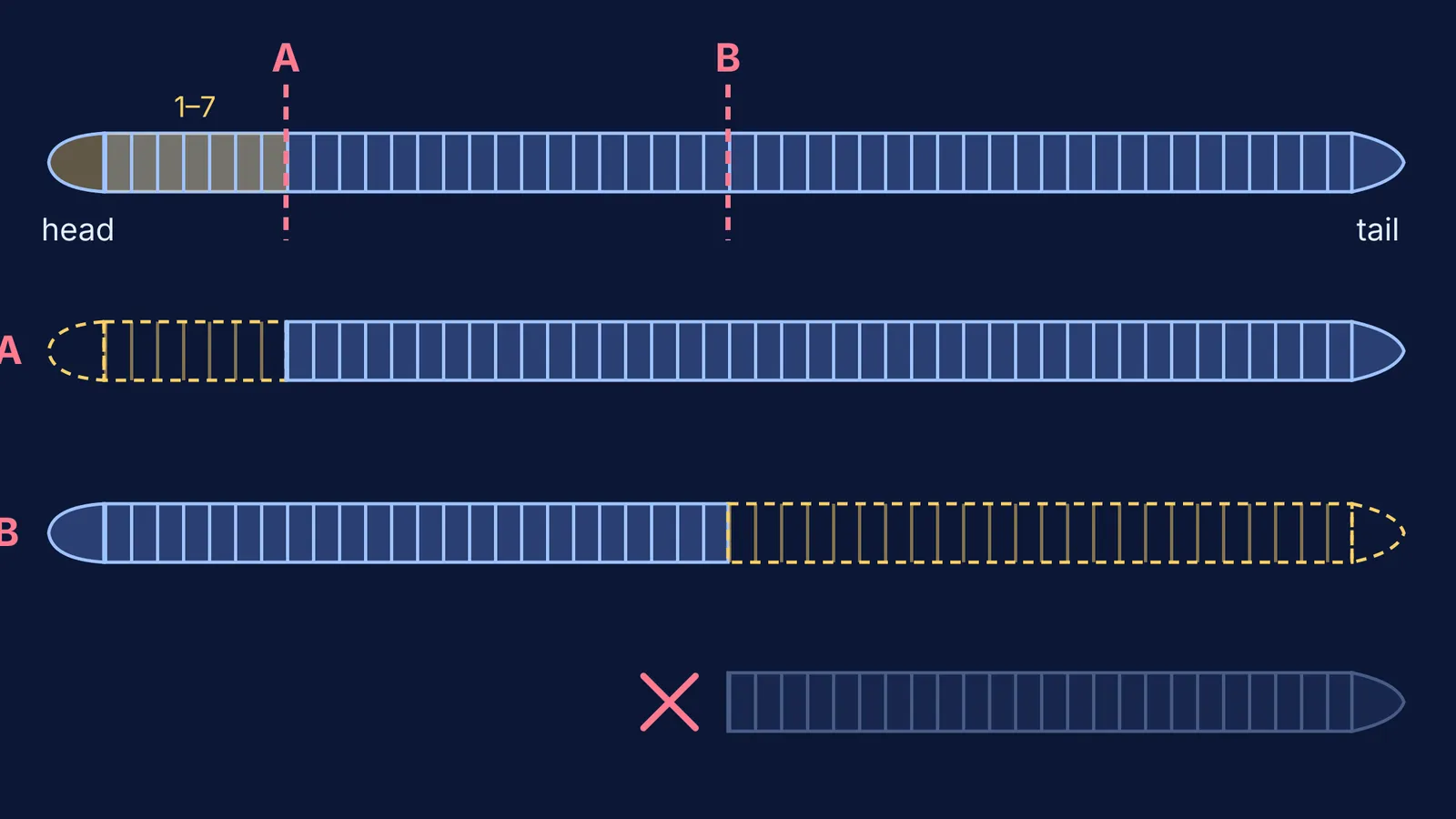
The front half keeps the mouth and brain, so it only has to build a new tail. In a 2026 study, researchers removed the last 25 segments of adult Eisenia andrei worms: the wound closed within 6 hours, a regeneration bud (blastema) was visible by the first week, and clearly defined new segments appeared by the third week (Tóth et al., Life, 2026).
The back half has to build a whole new front end, mouth and brain included. Most worms cannot do that from the middle of the body. In the compost worm Eisenia fetida, one study found that the back piece survived and regrew a head only when the loss was limited to the first 7 segments (Bhambri et al., PLOS ONE, 2018, summarising Xiao et al., 2011). Another lab saw Eisenia fetida restore all 10 front segments after a cut behind segment 10 (Banik and Chaudhuri, Journal of Environmental Biology, 2017), so the exact limit varies between studies. Both figures are far short of the middle of the body.
Why do only some segments regrow?
Biologists separate two abilities: regrowing the back end (posterior regeneration) and regrowing the front end (anterior regeneration). In a review across all annelids, Alexandra Bely found that posterior regeneration is nearly universal, while anterior regeneration is common but absent in about a dozen groups (Bely, Integrative and Comparative Biology, 2006).
A later analysis of 401 annelid species found strong support for both abilities being present in the group's common ancestor, with anterior regeneration lost 18 times and posterior regeneration 5 times, and never regained (Zattara and Bely, Invertebrate Biology, 2016).
Earthworm regeneration is also epimorphic: new parts are added to the remaining piece, unlike Hydra, which remodels existing cells into a new individual (Banik and Chaudhuri, Journal of Environmental Biology, 2017). The same authors note that the full number of lost segments is not always regrown.
Is it true that you get two worms?
As a general rule, no. Banik and Chaudhuri tested 17 earthworm species from Tripura by cutting 5 segments off the front or the back (Journal of Environmental Biology, 2017). Their results:
7 species regrew both front and back segments.
4 more regrew only back segments.
6 species regrew neither, including all 5 deep-soil species.
Only one species in the study, Perionyx excavatus, a tropical worm used in vermicomposting, was cut into two equal halves, and it gave two viable worms. The front half regrew more than 25 tail segments and the back half rebuilt 18 front segments, including the clitellum and the digestive, nervous and reproductive systems (Banik and Chaudhuri, 2017). That is a lab result for one strong regenerator, not what happens to a typical garden worm.
The authors suggest a reason for the pattern: worms near the surface face predators and ploughing, so losing segments is common for them, while deep-soil worms face little predator pressure and showed no regeneration. Treat that as their interpretation, not a settled fact.
How do you predict which piece survives?
Use this four-step check, in class or in the garden.
Which end was lost? Losing the tail is the easy case; losing the head is the hard one.
How far back is the cut? In Eisenia fetida, one study found no new head once more than the first 7 segments were lost (Bhambri et al., 2018); Banik and Chaudhuri, 2017 saw 10 regrow.
Which species? Ability ranges from none (the deep-soil species) to both ends (Perionyx excavatus).
Which piece holds the head? That piece has the best chance.
Worked example: an Eisenia fetida is cut near its middle. The front half has its head and regrows a tail over the following weeks. The back half has lost far more front segments than any of these studies saw regrow, so expect it not to build a head. Answer: one worm, not two.
It helps to set this against animals that really can rebuild a whole body from a piece. Compare regeneration and fragmentation in Planaria and Spirogyra, and see how axolotls regrow limbs and how Hydra and Planaria differ. If those terms still blur together, the Fermi Concept Library gives each biology concept its own lesson and shows where it sits in the map, so you can see how regeneration, fragmentation and budding connect.
Next time someone says a cut worm turns into two, ask them two questions: which species, and which segment?


