

On this page
A dung beetle has a problem you will recognise from a crowded canteen: the food is in one place, and so is everyone else. Its answer is to shape a ball and leave in a line so straight it looks ruled.
Why do dung beetles roll dung away from the pile?
The pile is a fight. In a 2012 PLOS ONE study, Emily Baird, Marie Dacke and colleagues explain that rolling in a straight line guarantees a beetle will not wander back to the pile, where competition is intense and other beetles may try to steal a ball. An earlier field and laboratory study by Marcus Byrne and colleagues started from the idea that a straight line steered by a sky cue should be the most successful way to reach a burial site the beetle has not yet chosen.
Before setting off, a beetle climbs on its ball and turns on the spot with brief pauses, a move researchers call the "dance". In the 2012 study's tunnel test, every beetle danced, on average 4 ± 2 seconds after hitting an obstacle (Baird et al., PLOS ONE), which fits the idea that the dance is a way of re-checking direction.
How do dung beetles roll in a straight line using the Sun?
Byrne's team tested five species of ball-rolling beetles with barriers, ramps, reflected sunlight and lamps (Journal of Comparative Physiology A, 2003). Beetles pushed round a barrier, or dropped off a ramp, went back to their original path. The Sun was the main cue, and a reflection of the Sun or an artificial light could stand in for it.
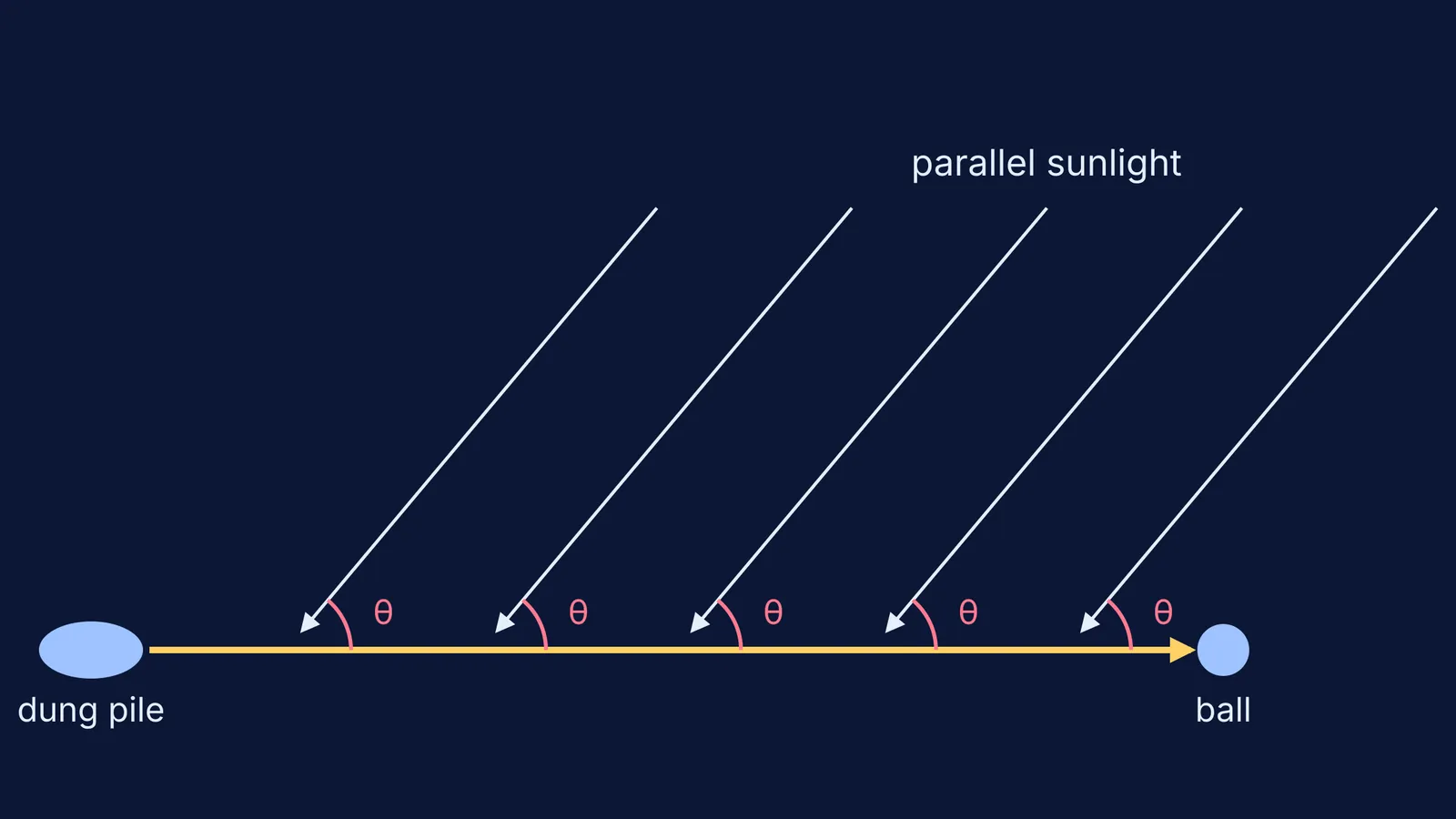
The trick is geometry. The Sun is so far away that its rays reach the ground parallel to each other. If you keep the Sun at a fixed angle to your direction of travel, say 50° to your left, every step points the same way, and your path is a straight line. That is what the diagram at the top shows.
Humans need a cue too. In a 2009 Current Biology study, people in a forest or the Sahara walked in circles when they could not see the Sun. Blindfolded, they often walked circles less than 20 metres across.
How do dung beetles navigate at night?
Some species roll after dark. The Moon's disc turns out to matter less than the pattern of polarised light around it. A 2004 study in Proceedings of the Royal Society B notes that this moonlit polarisation pattern is a million times dimmer than the Sun's, yet moving the Moon's apparent position, or hiding its disc, generally did not change how well *Scarabaeus zambesianus* oriented. Our explainer on why scattered skylight is polarised covers the physics behind that pattern.
On moonless nights, the stars take over. In 2013, Dacke and colleagues reported in Current Biology that beetles rolled straight under a starlit sky but lost that ability under cloud. In a planetarium, they oriented equally well under a full starry sky and under the Milky Way alone. The authors called it the first documented use of the Milky Way for orientation in the animal kingdom. The species was *Scarabaeus satyrus*, tested in a Johannesburg planetarium (Science News).
How did the experiments rule each cue in or out?
Each study used the same logic you need in any practical: change one thing, predict, compare.
Sun: swap the Sun for a reflection or a lamp. Prediction: beetles follow the substitute. They did (2003).
Moon: move or hide the Moon's disc. Prediction: orientation fails. It generally did not, so the cue was polarised light (2004).
Stars: compare clear and cloudy nights, then show only the Milky Way. Beetles were straight under stars, lost under cloud, and fine with the Milky Way alone (2013).
You can run a human version on a school ground in 15 minutes:
Pick a target 50 steps away on flat, open ground, with a friend walking beside you as a spotter.
Write down a prediction: how far off will you finish with your eyes shut?
Walk to the target eyes open, then go back and walk 50 steps with eyes closed.
Measure how far off you ended, and on which side. Repeat three times and compare with your prediction.
If the angle-keeping geometry is hard to picture, the Fermi Simulation Lab has interactive simulations for ideas that are easier to see than to read.
Why do dung beetles matter for soil and farms?
Scarabaeinae dung beetles feed on dung as adults and as larvae. A 2008 review in Biological Conservation credits them with nutrient cycling, bioturbation (mixing the soil), plant growth enhancement, secondary seed dispersal and parasite control, and warns that many of these processes have already been disrupted or may be in future. For the bigger picture, see why energy flows one way but nutrients cycle.
To revise the ecosystem chapter, the Fermi Concept Library gives every biology concept its own lesson and its place in the map.
Next time you pass a cow pat, look closely: someone may already be dancing on a ball.


