

On this page
This is set 2 of our Dual Nature practice questions and follows set 1 of the Dual Nature NEET practice questions. These eight new questions cover what set 1 left out: photon properties, photon counting, Hallwachs' electroscope and matter waves of everyday objects and gas molecules.
Which parts of Dual Nature does this set cover?
The NEET (UG)-2026 syllabus from the National Medical Commission lists Dual Nature of Matter and Radiation as Physics Unit 17, from Hertz and Lenard's observations to the de Broglie relation. Q7 also uses the rms speed of gas molecules from Unit 9, Kinetic Theory of Gases. The matching text is Chapter 11 of NCERT Class 12 Physics Part II, marked Reprint 2026-27.
New to the chapter? Read our guide on how to prepare Dual Nature of Matter and Radiation for NEET first.
How should you use this set?
Allow a minute per easy question, two per hard one.
Write the relation first: E = hc/λ, N = P/E, K(max) = hν − φ or λ = h/p.
Score yourself as in NEET-UG 2026, where the NTA information bulletin gives +4 for a correct answer, −1 for a wrong one and 0 for a blank.
Note which trap caught you on every miss.
Use h = 6.63 × 10⁻³⁴ J s, c = 3.0 × 10⁸ m/s, e = 1.6 × 10⁻¹⁹ C, electron mass = 9.1 × 10⁻³¹ kg and hc = 1240 eV nm.
Easy: photons and everyday matter waves
Q1 (easy). Which statement about photons is NOT correct?
(A) Every photon of a given frequency carries the same energy, whatever the intensity
(B) Photons are electrically neutral, so electric and magnetic fields do not deflect them
(C) In a photon-electron collision the number of photons is always conserved
(D) A brighter beam of the same frequency sends more photons per second through a given area
Answer: (C). Energy and momentum are conserved, but a photon can be absorbed or created, so the photon count can change.
Trap: (D) looks wrong if you think brighter light means more energetic photons. Brightness changes the photon count, not each photon's energy.
Q2 (easy). A 2.0 mW blue laser emits at 450 nm and a 1.5 mW orange laser emits at 600 nm. What is the ratio of photons emitted per second, blue to orange?
(A) 1 : 1 (B) 4 : 3 (C) 16 : 9 (D) 9 : 16
Answer: (A). N = P/E = Pλ/hc, so N(blue)/N(orange) = (2.0 × 450)/(1.5 × 600) = 1.
Trap: (C) assumes shorter wavelength means more photons. Each blue photon carries more energy, so fewer fit in a joule.
Q3 (easy). A 58 g tennis ball is served at 50 m/s. What is its de Broglie wavelength?
(A) 2.3 × 10⁻³⁴ m (B) 1.1 × 10⁻³² m (C) 9.1 × 10⁻³⁶ m (D) 2.3 × 10⁻³⁷ m
Answer: (A). p = 0.058 × 50 = 2.9 kg m/s, so λ = h/p = 2.3 × 10⁻³⁴ m, far too small to detect.
Trap: (D) keeps the mass in grams. Convert to kilograms before using h in J s.
Medium: Hallwachs, wavelength changes and two metals
Q4 (medium). An uncharged zinc plate is connected to a gold-leaf electroscope and lit with ultraviolet light. What do you observe?
(A) The leaves diverge because the plate becomes positively charged
(B) The leaves diverge because the plate becomes negatively charged
(C) The leaves stay closed because light carries no charge
(D) The leaves stay closed because the plate was uncharged to begin with
Answer: (A). As NCERT describes Hallwachs' result, ultraviolet light ejects electrons, leaving the plate positively charged, so the leaves spread.
Trap: (B) imagines light adding charge. The plate only loses electrons.
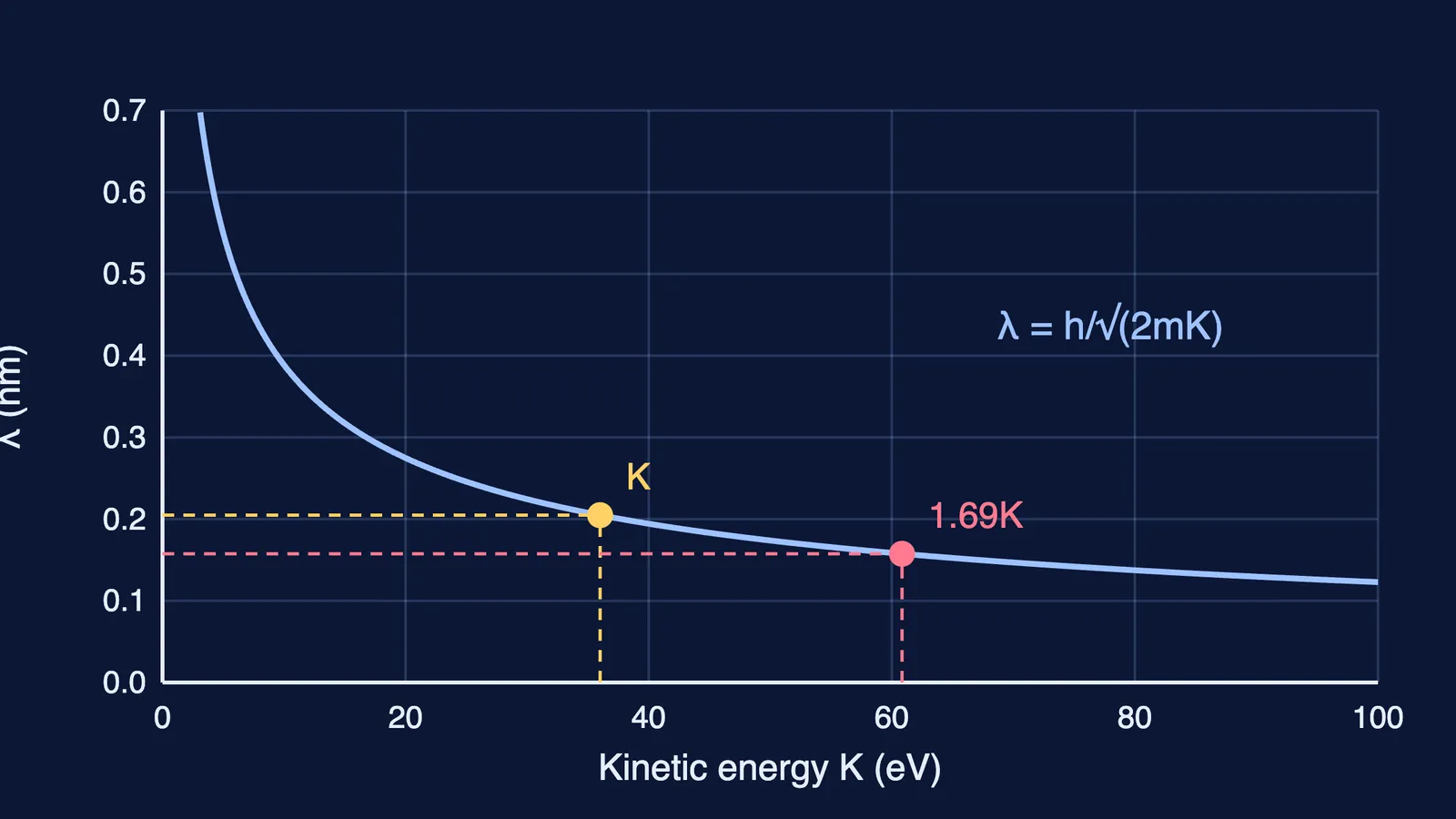
Q5 (medium). An electron's kinetic energy is increased by 69%. How does its de Broglie wavelength change?
(A) It decreases by about 41% (B) It decreases by about 23% (C) It increases by about 30% (D) It decreases by 69%
Answer: (B). λ = h/√(2mK), so the new wavelength is λ/√1.69 = λ/1.3 ≈ 0.77λ, a fall of about 23%.
Trap: (A) divides by 1.69 and forgets the square root.
Q6 (medium). Ultraviolet photons of energy 5.5 eV fall on metal X (work function 2.3 eV) and metal Y (work function 4.7 eV). What is the ratio of the maximum speeds of their photoelectrons, X to Y?
(A) 2.0 (B) 4.0 (C) 1.4 (D) 0.5
Answer: (A). K(max) is 5.5 − 2.3 = 3.2 eV for X and 5.5 − 4.7 = 0.8 eV for Y. Speed goes as √K, so the ratio is √(3.2/0.8) = 2.0.
Trap: (B) is the ratio of kinetic energies, not speeds.
Hard: gas molecules and a lamp seen from afar
Q7 (hard). Hydrogen gas (H₂, 2 u) is at 27 °C and oxygen gas (O₂, 32 u) is at 327 °C. Using the rms speed of the molecules, what is the ratio of their de Broglie wavelengths, hydrogen to oxygen?
(A) 4.0 (B) 5.7 (C) 13.9 (D) 32
Answer: (B). The rms speed is √(3kT/m), so p = √(3mkT) and λ = h/√(3mkT). The ratio is √[(32 × 600)/(2 × 300)] = √32 ≈ 5.7.
Trap: (C) uses Celsius instead of 600 K and 300 K.
Q8 (hard). A small lamp radiates 1.0 W of 600 nm light equally in all directions. About how many photons per second enter an eye pupil of diameter 4.0 mm, facing the lamp from 10 m away?
(A) 3.0 × 10¹⁰ (B) 6.0 × 10¹⁰ (C) 1.2 × 10¹¹ (D) 3.0 × 10¹⁸
Answer: (A). Each photon carries hc/λ = 3.3 × 10⁻¹⁹ J, so the lamp emits 3.0 × 10¹⁸ photons per second. The pupil (radius 2.0 mm) catches π(2.0 × 10⁻³)²/(4π × 10²) = 1.0 × 10⁻⁸ of them: 3.0 × 10¹⁰ per second.
Trap: (C) uses the diameter as the radius, making the area four times too big.
What should you do after set 2?
Compare your score with set 1. If Q5 or Q7 caught you, revise the λ = h/p family on our Dual Nature formula sheet and redo both without notes. If matter waves still feel shaky, the Fermi Concept Library gives every physics concept its own lesson and shows where it sits on the map.


