

On this page
Eight original dual nature questions for the JEE Main numerical-value section, easy to hard, each with a worked solution and the wrong number students most often type.
What does the JEE Main numerical section look like?
The Information Bulletin for JEE (Main) 2027 from NTA says each subject in Paper 1 has Section A (MCQs) and Section B, whose answers are filled in as a numerical value. Physics has 5 Section B questions, marked +4 if correct and −1 if incorrect. You enter an integer on an on-screen keypad, and the answer should be rounded off to the nearest integer.
All eight questions sit inside Unit 17, Dual Nature of Matter and Radiation, of NTA's Syllabus for JEE (Main) 2027, and inside NCERT Class 12 Physics Chapter 11 (Reprint 2026-27). For theory first, see how to prepare Dual Nature of Matter for JEE Main.
Take h = 6.63 × 10⁻³⁴ J s, c = 3.0 × 10⁸ m/s, e = 1.6 × 10⁻¹⁹ C, electron mass 9.1 × 10⁻³¹ kg and hc = 1240 eV nm.
Easy: photocells, frequencies and accelerated electrons
Q1 (easy). A small lamp 0.40 m from a photocell gives a saturation current of 27 µA. The lamp is moved to 1.20 m from the cell, with nothing else changed. What is the new saturation current, in µA?
Answer: 3. Saturation current is proportional to intensity, and a point source's intensity falls as 1/r². Tripling the distance cuts it by 9, so 27/9 = 3 µA. The stopping potential does not change.
Trap: 9, from taking intensity as 1/r.
Q2 (easy). A metal has threshold frequency ν₀. Light of frequency 3ν₀ gives photoelectrons of maximum kinetic energy K₁; light of 7ν₀ gives K₂. What is K₂/K₁?
Answer: 3. K = h(ν − ν₀), so K₁ = 2hν₀ and K₂ = 6hν₀. The ratio is 6/2 = 3.
Trap: 2, from 7/3 ≈ 2.33, forgetting to subtract the work function.
Q3 (easy). Through what potential difference, in volts, must an electron be accelerated from rest so that its de Broglie wavelength is 0.140 nm? Give the nearest integer.
Answer: 77. λ = h/√(2meV), so V = h²/(2meλ²) = (6.63 × 10⁻³⁴)²/(2 × 9.1 × 10⁻³¹ × 1.6 × 10⁻¹⁹ × (1.4 × 10⁻¹⁰)²) ≈ 77.0 V. The shortcut λ = 1.227/√V nm gives (1.227/0.140)² ≈ 76.8, also 77.
Trap: 9, from 1.227/0.140 ≈ 8.8 without squaring.
Medium: which ratio does the question want?
Q4 (medium). A metal has threshold wavelength 540 nm. It is lit first by 180 nm light, giving stopping potential V₁, then by 360 nm light, giving V₂. What is V₁/V₂?
Answer: 4. eV₀ = hc(1/λ − 1/λ₀). For 180 nm: 1/180 − 1/540 = 2/540 = 1/270. For 360 nm: 1/360 − 1/540 = 1/1080. The ratio is 1080/270 = 4, and hc cancels.
Trap: 2, from comparing photon energies (360/180) or subtracting wavelengths, (540 − 180)/(540 − 360), instead of subtracting energies.
Q5 (medium). An electron's kinetic energy is increased by 44%. By what percentage does its de Broglie wavelength decrease, to the nearest integer?
Answer: 17. λ ∝ 1/√K, so the new wavelength is λ/√1.44 = λ/1.2 ≈ 0.833λ. That is a decrease of about 16.7%, which rounds to 17.
Trap: 20, reading "divided by 1.2" as "down by 20%".
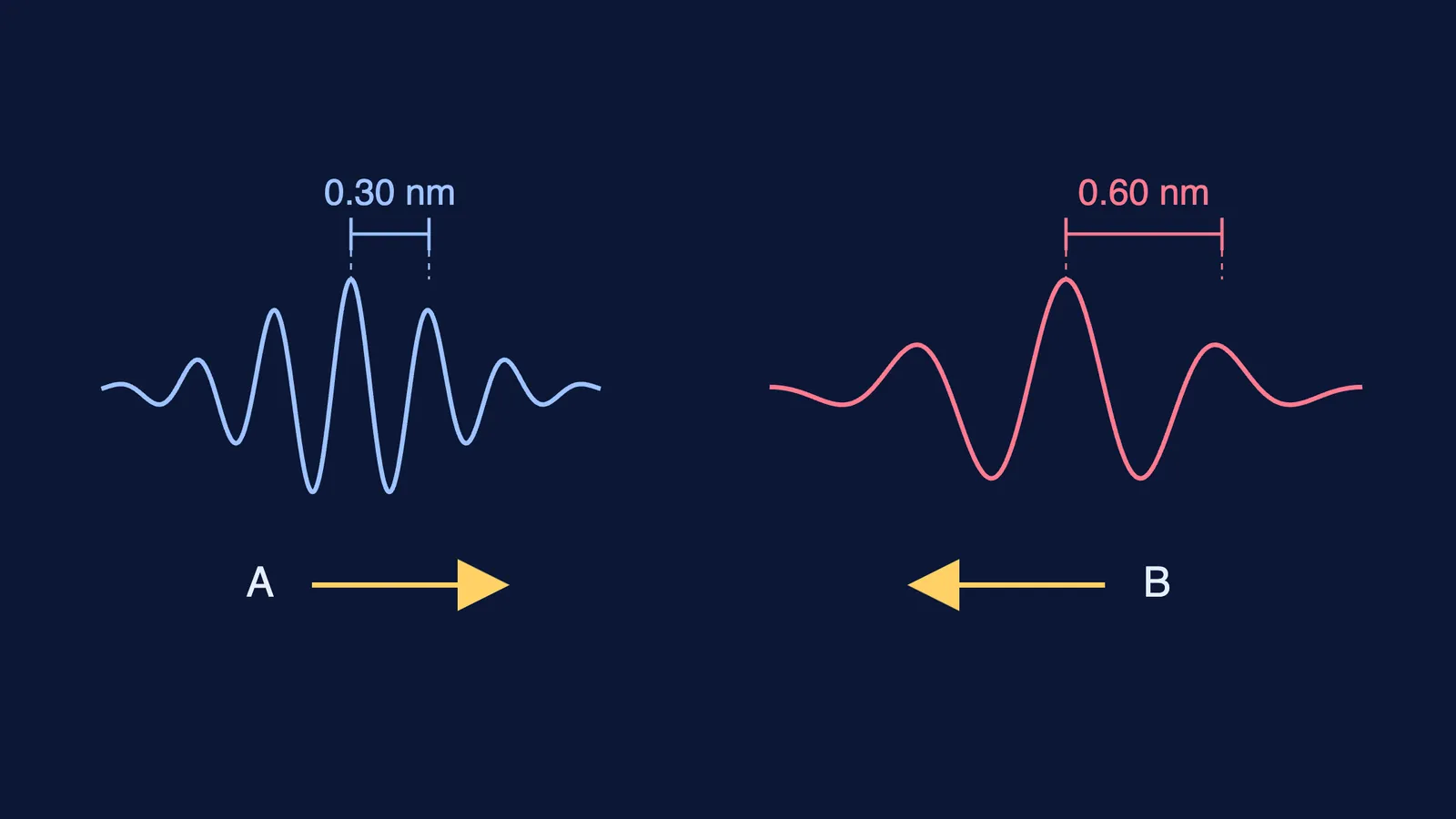
Q6 (medium). Particle A, with de Broglie wavelength 0.30 nm, moves head-on towards particle B, with de Broglie wavelength 0.60 nm. They collide and stick together. What is the de Broglie wavelength of the combined particle, in pm?
Answer: 600. Momentum is h/λ and is conserved as a vector. Taking A's direction as positive, p = h/0.30 − h/0.60 = h/0.60 (with λ in nm), so λ = 0.60 nm = 600 pm.
Trap: 200, adding the momenta as if both moved the same way.
Hard: can you combine two ideas in one answer?
Q7 (hard). Suppose, as the classical wave picture assumes, an electron in a metal absorbs light energy continuously, collecting all the light falling on a circle of radius 0.20 nm. The metal's work function is 2.5 eV and light of intensity 1.0 × 10⁻⁴ W/m² falls on it normally. How many hours would the electron need to gather enough energy to escape, to the nearest integer?
Answer: 9. Power collected = IA = 1.0 × 10⁻⁴ × π × (2.0 × 10⁻¹⁰)² ≈ 1.26 × 10⁻²³ W. Energy needed = 2.5 × 1.6 × 10⁻¹⁹ = 4.0 × 10⁻¹⁹ J. Time = 4.0 × 10⁻¹⁹/1.26 × 10⁻²³ ≈ 3.18 × 10⁴ s ≈ 8.8 h, which rounds to 9. NCERT Section 11.5 makes the same point: the wave picture predicts a delay of hours, while real emission is instantaneous.
Trap: 35, from taking 0.20 nm as the diameter (radius 0.10 nm), which quarters the area and gives about 35.4 h.
Q8 (hard). Light falls on a metal of work function 2.25 eV. The shortest de Broglie wavelength among the emitted photoelectrons is 0.70 nm. What is the wavelength of the light, in nm, to the nearest integer?
Answer: 233. The shortest de Broglie wavelength belongs to the fastest electron. K = h²/(2mλ²) = (6.63 × 10⁻³⁴)²/(2 × 9.1 × 10⁻³¹ × (0.70 × 10⁻⁹)²) ≈ 4.93 × 10⁻¹⁹ J ≈ 3.08 eV. The photon carries 3.08 + 2.25 = 5.33 eV, so λ = 1240/5.33 ≈ 232.6 nm, which rounds to 233.
Trap: 403, from 1240/3.08, forgetting to add the work function.
For mixed practice with options, try our Dual Nature JEE Main practice questions with full solutions.
How do you get the number right in dual nature?
Use 1240 eV nm only with wavelength in nm and energy in eV; switch to joules before using h, m and SI lengths together.
Subtract the work function before any ratio of energies or speeds (Q2, Q4, Q8).
Check the power: λ ∝ 1/p, λ ∝ 1/√K, and intensity from a point source ∝ 1/r².
Give momentum a sign before adding it (Q6).
Carry unrounded values (8.84 h, not 9) and round only the final answer to the nearest integer, as the bulletin asks.
Not sure which step went wrong? The Fermi Problem Library has worked problems with a step-by-step solver that explains the reasoning rather than printing an answer.


