

On this page
Start with our first set of differential equations JEE Main practice questions with solutions if you have not done it. These eight are harder, and most pair a differential equation with a second idea: maxima, conics or an integral equation.
What does JEE Main 2027 test in differential equations?
Unit 9 of NTA's Syllabus for JEE (Main) 2027 lists order and degree, separation of variables, and homogeneous and linear equations of the type dy/dx + p(x)y = q(x).
The JEE (Main) 2027 Information Bulletin gives Mathematics 20 multiple-choice questions and 5 numerical-value questions in Paper 1, with +4 for a correct answer, −1 for a wrong one and 0 for a blank. Picking the trap instead of the answer is a five-mark swing.
Medium: can you name the type before you solve?
Q1. The differential equation of the family y = ae^(2x) + be^(−3x), with a and b arbitrary constants, is: (A) y″ − y′ − 6y = 0 (B) y″ + y′ + 6y = 0 (C) y″ + y′ − 6y = 0 (D) y″ − 6y′ + y = 0
Answer: (C). Two constants mean order 2. Here y′ = 2ae^(2x) − 3be^(−3x) and y″ = 4ae^(2x) + 9be^(−3x), so y″ + y′ = 6ae^(2x) + 6be^(−3x) = 6y. Trap: (A) swaps the signs of the two exponents. Check: for e^(2x), 4 + 2 − 6 = 0; for e^(−3x), 9 − 3 − 6 = 0.
Q2. The differential equation of the family y² = 4c(x + √c), c > 0, has order and degree: (A) 1, 2 (B) 1, 3 (C) 2, 3 (D) 1, not defined
Answer: (B). One constant, so order 1. Differentiating, 2yy′ = 4c, so c = yy′/2. Substituting gives y² − 2xyy′ = 2yy′√(yy′/2), and squaring clears the root: (y² − 2xyy′)² = 2y³(y′)³. Trap: (D), but a root can be squared away; degree is undefined when the equation cannot be made a polynomial in the derivatives, as when y′ sits inside sin, log or an exponential. Check: the highest power of y′ is 3.
Q3. If dy/dx = y/x + cos²(y/x) for x > 0 and y(1) = π/4, then y(e) is: (A) tan⁻¹2 (B) eπ/4 (C) e tan⁻¹e (D) e tan⁻¹2
Answer: (D). Homogeneous: y = vx gives x dv/dx = cos²v, so sec²v dv = dx/x and tan v = ln x + C. At x = 1, v = π/4, so C = 1. At x = e, tan(y/e) = 2 and y = e tan⁻¹2. Trap: (A) is v, not y; you stopped before multiplying by x. Check: y = x tan⁻¹(1 + ln x) gives y′ = v + 1/(1 + tan²v) = v + cos²v.
Q4. If dy/dx = y(2 − y) and y(0) = 1, then y(ln 2) is: (A) 8/5 (B) 4/3 (C) 2 (D) 5/4
Answer: (A). Separate and use partial fractions: 1/(y(2 − y)) = (1/2)(1/y + 1/(2 − y)), so (1/2) ln(y/(2 − y)) = x + C, and y(0) = 1 gives C = 0. Then y/(2 − y) = e^(2x) = 4 at x = ln 2, so y = 8/5. Trap: (B) drops the 1/2 and solves y/(2 − y) = 2. Check: y = 2 − 2/(1 + e^(2x)) rises from 1 but never reaches 2.
Hard: can you mix differential equations with other chapters?
Q5. If dy/dx + 2y = e^(−x) and y(0) = 0, the greatest value of y for x > 0 is: (A) ln 2 (B) 1/4 (C) 1/2 (D) 1
Answer: (B). The integrating factor is e^(2x), so (ye^(2x))′ = e^x and y = e^(−x) + Ce^(−2x). y(0) = 0 gives C = −1. With t = e^(−x), y = t − t², greatest at t = 1/2, so y = 1/4. Trap: (A) is where the maximum occurs, not its value. Check: y′ = −e^(−x) + 2e^(−2x) = −1/2 + 1/2 = 0 at x = ln 2.
Q6. If sec²y dy/dx + tan y = x and y(0) = 0, then y(1) is: (A) 1/e (B) π/4 − 1/e (C) tan⁻¹(1/e) (D) tan⁻¹e
Answer: (C). Put u = tan y, so u′ + u = x. With integrating factor e^x, ue^x = (x − 1)e^x + C, so u = x − 1 + Ce^(−x), and u(0) = 0 gives C = 1. At x = 1, tan y = 1/e. Trap: (A) reports u instead of y. Check: at x = 0, tan y = 0 − 1 + 1 = 0, as given.
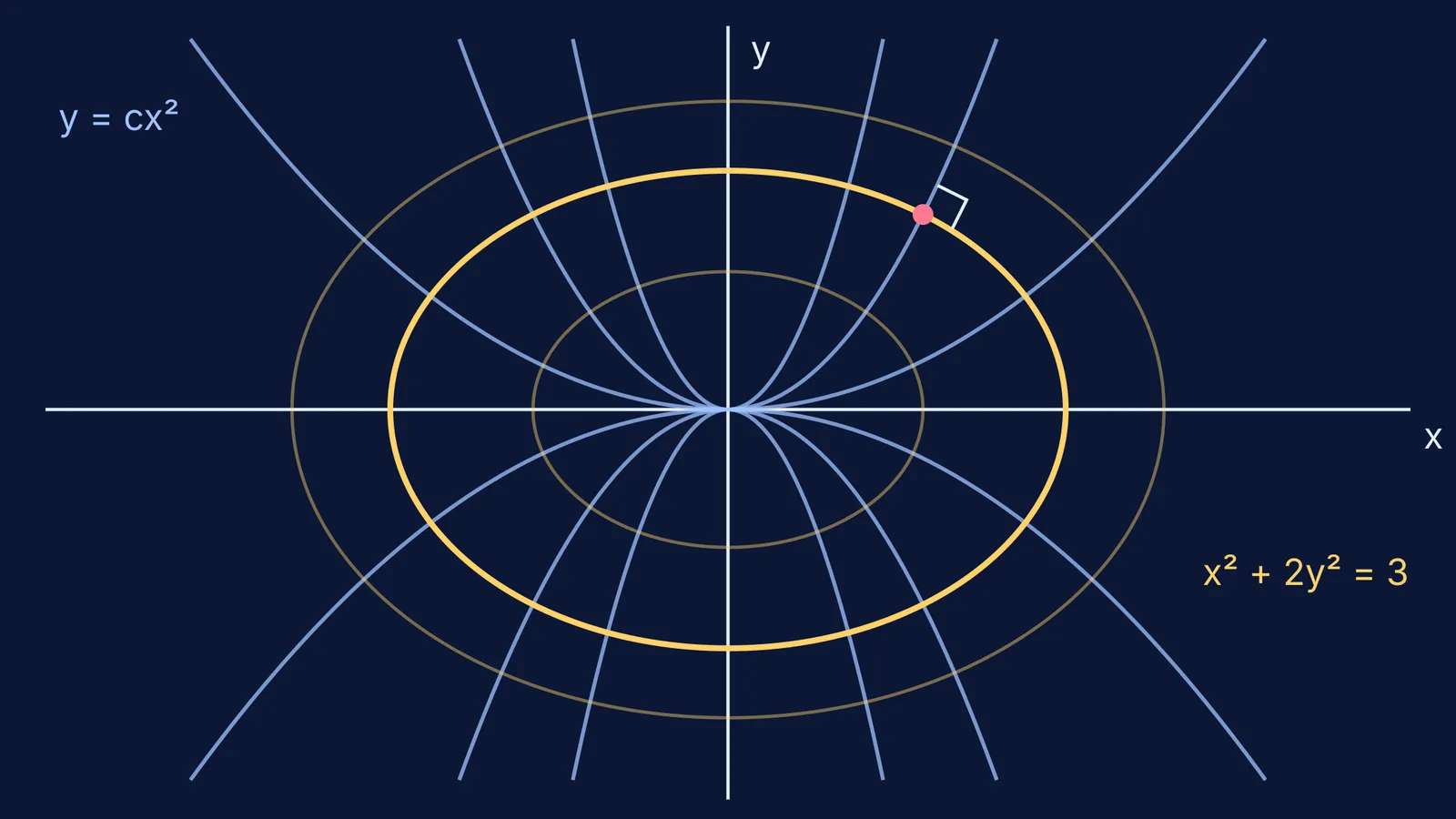
Q7. A curve through (1, 1) cuts every parabola y = cx² it meets at right angles. It is a conic with eccentricity: (A) 1/√2 (B) 1/2 (C) √(2/3) (D) √3
Answer: (A). Eliminating c = y/x² gives the parabolas' equation dy/dx = 2y/x. A perpendicular curve has slope −x/(2y), so 2y dy = −x dx and, through (1, 1), x² + 2y² = 3. That is the ellipse x²/3 + y²/(3/2) = 1, with e² = 1 − 1/2. Trap: (D) drops the minus sign and gets the hyperbola 2y² − x² = 1, eccentricity √3. Check: at (1, 1) the slopes 2 and −1/2 multiply to −1.
Q8. If f(x) = sin x + ∫ from 0 to x of f(t) dt, then f(π/2) is: (A) 1/2 (B) (e^(π/2) − 1)/2 (C) e^(π/2) (D) (e^(π/2) + 1)/2
Answer: (D). Differentiate: f′ = cos x + f, a linear equation. Putting x = 0 in the given equation gives the hidden condition f(0) = 0. With integrating factor e^(−x), f = (sin x − cos x)/2 + Ce^x, and f(0) = 0 gives C = 1/2. So f(π/2) = (e^(π/2) + 1)/2. Trap: (A) takes C = 0 because no condition is printed. Check: at π/2, cos x = 0, so f′ must equal f, and f′ = (e^x + cos x + sin x)/2 agrees.
How should you use this second set?
The Information Bulletin gives Paper 1 three hours for 75 questions, about 2.4 minutes each, so allow these eight 20 minutes.
Do all eight in one timed sitting, without notes.
Label each miss by its trap: lost factor, stopped early, wrong sign, or hidden condition.
A week later, change one number in each miss and solve it again.
For integer answers, try our differential equations JEE Main numerical value questions.
If you can follow a solution but could not have started it, the Fermi Problem Library has a step-by-step solver that explains the reasoning. Fermi Test Prep is our hub for JEE Main and Advanced preparation.


