

On this page
Turning filter paper into thread is one of the most popular CBSE Class 12 investigatory projects. You dissolve paper in a deep-blue copper–ammonia solution, squirt the thick liquid into dilute sulphuric acid, and pull out blue threads that wash white. The project joins two chapters you already study: coordination compounds, through the tetraamminecopper(II) complex, and biomolecules, through cellulose. This post explains the chemistry of each step, works out the amounts, and lists the safety points your teacher will look for.
What is cuprammonium rayon?
Rayon is regenerated cellulose. You take natural cellulose, dissolve it, and make it come back out of solution as a fibre. The chains are the same cellulose chains that were in the paper; only their shape and arrangement change. That is why rayon is classed as a semi-synthetic polymer, not a synthetic one like nylon, which is built from small monomers.
There are two classic routes, and they are easy to mix up:
Cuprammonium rayon (this project) dissolves cellulose in Schweizer's reagent, a solution of tetraamminecopper(II) hydroxide, and regenerates it in acid.
Viscose rayon treats cellulose with sodium hydroxide and carbon disulphide to make cellulose xanthate, which is then regenerated in acid.
Our post on copper sulphate's reactions with KI, KCN and ammonia names Schweizer's reagent and its link to artificial silk. Here is what the reagent actually does.
Why doesn't cellulose dissolve in water?
Cellulose is a long, straight chain of glucose units joined by β-1,4 glycosidic links. Each glucose unit carries three OH groups. Neighbouring chains line up and hydrogen-bond to each other along their whole length, so the chains pack into tough, ordered fibres. Water can hydrogen-bond to the surface, but it cannot pull the chains apart. Our post on starch, cellulose and glycosidic links shows why the β link gives such straight chains.
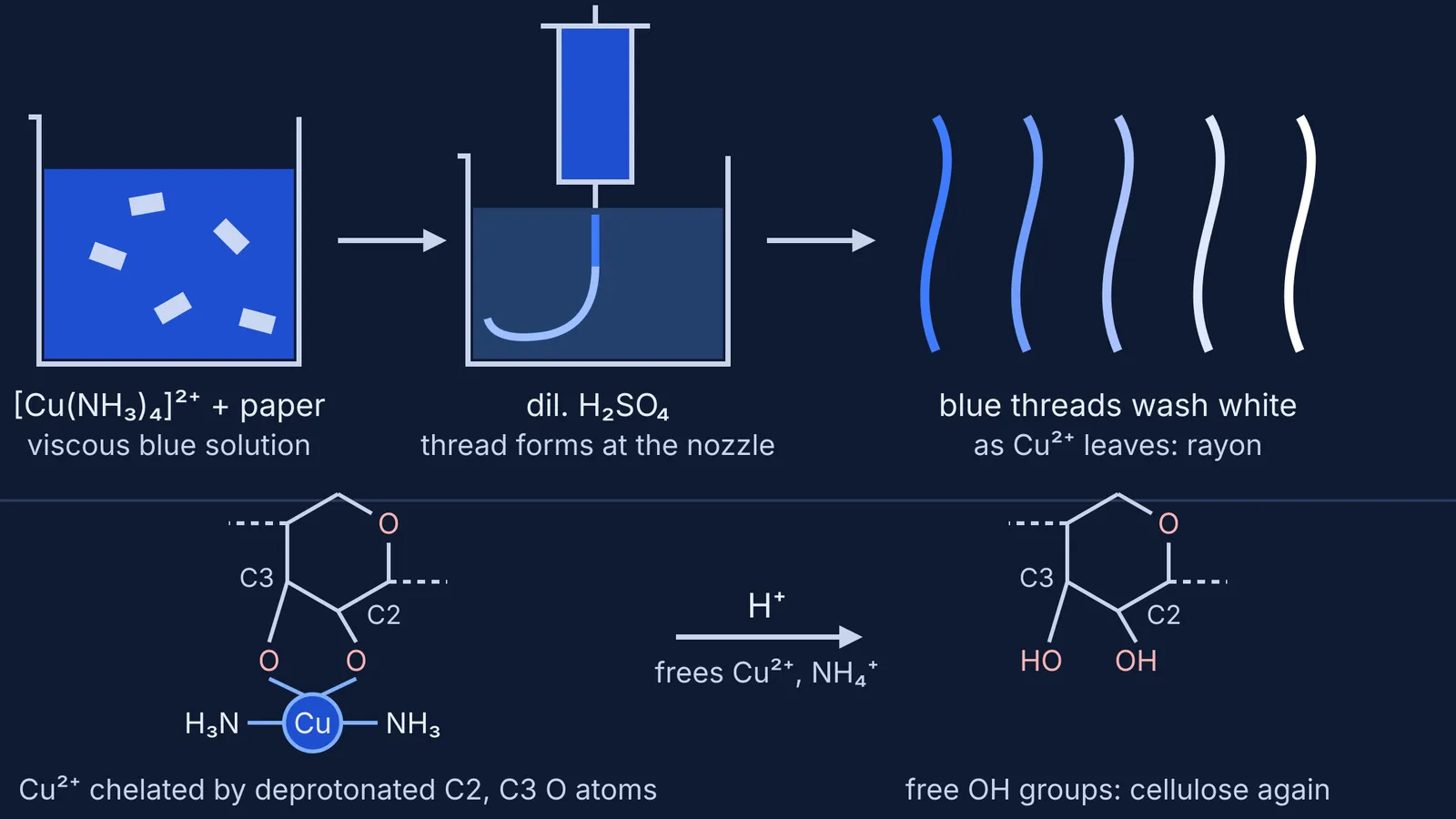
Ammonia on its own does not dissolve cellulose either. The copper does the work. In the strongly basic reagent, Cu²⁺ binds to the two neighbouring OH groups on C-2 and C-3 of a glucose unit after they lose their protons, forming a five-membered chelate ring (C–O–Cu–O–C). Once copper sits on the chains, they carry charge and can no longer hydrogen-bond to one another, so they spread out into solution. That is why the liquid becomes thick and viscous: it is full of long dissolved chains.
How do you make Schweizer's reagent?
Dissolve copper sulphate crystals, CuSO₄·5H₂O, in water.
Add sodium hydroxide solution slowly, with stirring, until no more pale blue precipitate forms: CuSO₄ + 2NaOH → Cu(OH)₂ + Na₂SO₄.
Filter and wash the precipitate with water to remove sodium sulphate.
Use the precipitate fresh and cold. On standing or warming, Cu(OH)₂ darkens to black CuO, which dissolves in ammonia far less readily.
Dissolve the moist precipitate in concentrated ammonia solution: Cu(OH)₂ + 4NH₃ → [Cu(NH₃)₄]²⁺ + 2OH⁻.
The deep-blue solution is tetraamminecopper(II) hydroxide. The complex is often written [Cu(NH₃)₄(H₂O)₂]²⁺, because two water molecules sit loosely above and below the square of ammonia ligands.
Why not just add ammonia to copper sulphate solution? You get the same blue complex, but you also get ammonium sulphate. The ammonium ions lower the pH, and the cellulose OH groups need a strongly basic solution to lose their protons and bind copper. Starting from washed Cu(OH)₂ keeps the reagent strongly basic.
Worked example: how much of each chemical do you need?
Suppose you start with 5.0 g of CuSO₄·5H₂O.
Moles of copper. Molar mass of CuSO₄·5H₂O ≈ 249.7 g mol⁻¹. Moles = 5.0 / 249.7 = 0.0200 mol of Cu²⁺.
Sodium hydroxide. Two OH⁻ per Cu²⁺, so 2 × 0.0200 = 0.0400 mol. Mass = 0.0400 × 40.0 = 1.60 g of NaOH.
Ammonia (minimum). Four NH₃ per Cu²⁺, so 4 × 0.0200 = 0.0800 mol.
Concentration of the bottle. 25% ammonia solution has a density of about 0.91 g mL⁻¹. One litre weighs 910 g and contains 0.25 × 910 = 227.5 g of NH₃. Divide by 17.03 g mol⁻¹: about 13.4 mol L⁻¹.
Volume. 0.0800 / 13.4 = 0.0060 L, about 6.0 mL.
So 6 mL is the bare stoichiometric minimum. In practice you use several times that. The excess keeps the complex fully formed and the solution strongly basic, which is what lets the paper dissolve.
How do the threads form in the acid?
Tear filter paper into small pieces and add them a few at a time to the reagent, stirring or shaking between additions. Stop when the liquid is thick, deep blue and free of visible fibres. This can take a long time, so be patient.
Draw the viscous solution into a syringe and push it out steadily under the surface of dilute sulphuric acid. A thread forms at the nozzle at once. Here is why:
The acid neutralises the ammonia and the hydroxide, so the copper loses its ligands: [Cu(NH₃)₄]²⁺ + 4H⁺ → Cu²⁺ + 4NH₄⁺.
The oxygen atoms bound to copper pick up protons again and become OH groups.
With the copper gone and the OH groups restored, the cellulose chains hydrogen-bond to each other once more and come out of solution as a solid strand.
The thread is blue at first because copper is still trapped inside it. Leave it in the acid, then rinse it in water, and it turns white as the Cu²⁺ diffuses out. What you hold at the end is cellulose again, the same polymer as the filter paper, in a new shape.
What safety points matter for this project?
Concentrated ammonia has a strong, choking smell and irritates the eyes, nose and lungs. Work in a fume cupboard or next to an open window, keep the bottle closed when you are not pouring, and do not lean over the beaker.
Goggles and gloves throughout. Sodium hydroxide solution and the ammonia reagent both damage eyes and skin.
The acid bath is dilute. If your teacher asks you to prepare it from concentrated acid, always add the acid slowly to water, never water to acid. Our post on why you add acid to water explains the heat.
Point the syringe into the bath and away from people; a blocked nozzle can spurt.
Copper waste should go into the container your lab provides, not down the sink.
What should your project report include?
A strong report states the aim, explains the theory (complex formation, dissolution and regeneration), lists materials and amounts, gives the procedure, and records what you saw at each stage: pale blue precipitate, deep-blue solution, thick liquid, blue thread, white fibre. Add the balanced equations, the precautions and a result. A simple extension is to compare freshly made Cu(OH)₂ with a sample left to stand, or filter paper with cotton wool. If the bonding in the copper complex is still unclear, the Concept Library has a lesson on each concept in coordination chemistry.
Quick checklist
Rayon is regenerated cellulose: semi-synthetic, not synthetic.
Schweizer's reagent is tetraamminecopper(II) hydroxide, made from fresh Cu(OH)₂ and excess ammonia.
Cu²⁺ binds the deprotonated C-2 and C-3 OH groups, so the chains stop hydrogen-bonding and dissolve.
Acid strips the ligands and copper, the OH groups return, and cellulose comes out as a thread.
5.0 g CuSO₄·5H₂O needs 1.60 g NaOH and at least 6 mL of 25% ammonia.
Ammonia in a fume cupboard, goggles on, and the acid bath dilute.


