

On this page
Many Class 10 students know the rule: always add acid to water. Fewer can explain it for full marks. The reason is a small piece of thermochemistry you can check with real numbers.
Why add acid to water and not water to acid?
The NCERT Class 10 science textbook says: "The process of dissolving an acid or a base in water is a highly exothermic one." It adds that "the acid must always be added slowly to water with constant stirring", because if water is added to a concentrated acid, "the heat generated may cause the mixture to splash out and cause burns", and "the glass container may also break due to excessive local heating" (NCERT, Acids, Bases and Salts).
The heat comes from hydration: sulphuric acid ionises in water, and the ions hold water molecules tightly around them, releasing energy. Tables published by D. N. Craig and G. W. Vinal of the US National Bureau of Standards show that diluting one mole of 100% sulphuric acid with a very large amount of water releases 23.54 kcal, about 98 kJ, at 25 °C (Craig and Vinal, 1940).
The part most answers miss: the total heat is the same whichever way you pour. What changes is how much liquid is there to soak it up at the moment the two meet.
What happens when you add water to concentrated acid?
Concentrated sulphuric acid has a density of about 1.84 kg/L, nearly twice that of water (sulphuric acid properties). Water poured onto it tends to sit on top, so the first drops meet a large excess of acid in a thin surface layer. The heat is released there, into very little mass.
The same 1940 tables put a number on it (Craig and Vinal). Mixing 1 mole of pure acid (98 g) with 1 mole of water (18 g) releases 23.54 − 16.72 = 6.82 kcal, about 28.5 kJ. The 84% acid that forms has a specific heat of about 0.44 cal per gram per °C, less than half that of water. If no heat escaped, the 116 g of mixture would warm by roughly 130 °C. Water still on the surface boils at 100 °C, and the steam bursts out carrying droplets of hot concentrated acid.
Worked example: the same acid, two orders
Here is the sum both ways, starting at 25 °C and ignoring heat lost to the beaker and air. All values are from Craig and Vinal.
Water into acid, at first contact: 1 mol of water meets 1 mol of acid. Heat 28.5 kJ, mass 116 g, specific heat 0.44 cal/g °C. Rise: about 130 °C.
Acid into water: 1 mol of acid ends up in 50 mol (900 g) of water, a 9.8% solution. Heat 23.54 − 5.78 = 17.76 kcal, about 74 kJ, more than in case 1. But it spreads through 999 g with a specific heat of 0.92 cal/g °C. Rise: about 19 °C.
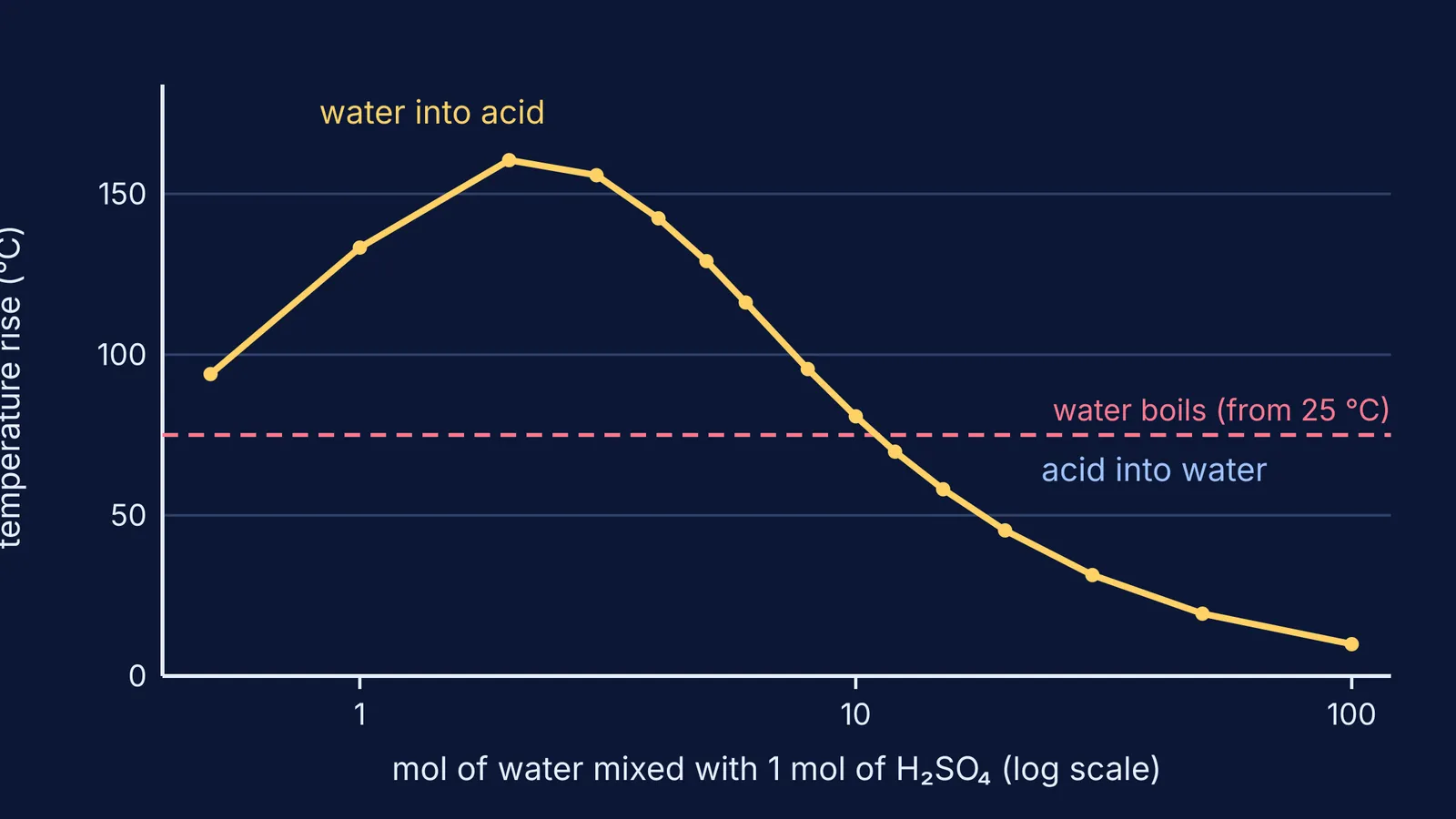
More heat in total, yet far below boiling, because the water is a large heat sink. The graph at the top of this post traces this from the same tables: the rise peaks near 160 °C at about 2 moles of water per mole of acid, then falls as more water is present. Pouring acid slowly into water, with stirring, keeps the mixture on the water-rich side of that curve. Real beakers lose heat to glass and air, so these figures are upper limits.
How do you write this as a Class 10 exam answer?
The NCERT question reads: "While diluting an acid, why is it recommended that the acid should be added to water and not water to the acid?" (NCERT). A complete answer names the process (exothermic), says what goes wrong the other way (a little water, a lot of acid, boiling, splashing, a cracked container) and says why the right way is safe (a large volume of water absorbs the heat).
Model answer: Dissolving a concentrated acid in water is a highly exothermic process. If water is added to the concentrated acid, the small amount of water is heated so strongly that it boils, and the mixture may splash out and cause acid burns. The glass container may also break due to excessive local heating. So the acid is always added slowly to water with constant stirring, so that the large amount of water absorbs the heat safely.
Where does this topic lead next?
The rest of the chapter is in our guide to acids, bases and salts in Class 10. Later, you can measure heats like this in the enthalpy of neutralisation and solution practical, and find a diluted acid's strength with mixing and diluting solutions.
If "exothermic" still feels fuzzy, the Fermi Concept Library gives every chemistry concept its own lesson. To practise heat calculations, the Fermi Problem Library has worked problems with a step-by-step solver that explains the reasoning rather than printing an answer.


