

On this page
You had chickenpox as a child and never caught it again. Decades later, a grandparent gets a painful band of blisters on one side of the body and the doctor says "shingles". Same virus, two different tricks: your immune system remembering, and the virus hiding.
Why does chickenpox usually happen only once?
Chickenpox is caused by the varicella-zoster virus (VZV), and it spreads fast: up to 90% of non-immune people who are close to someone with chickenpox also get infected, according to the US Centers for Disease Control and Prevention (CDC). The same CDC page says: "For most people, getting chickenpox once provides immunity for life." A second bout can happen, but it is uncommon.
The reason is immune memory. The first infection triggers a slow primary response, because the body must find and multiply the few B and T cells that recognise VZV. Some stay on as memory cells. If VZV returns, they usually respond fast enough to stop the illness before a rash appears. We walk through the timing in primary vs secondary immune response: why the second is faster, and the same logic explains how memory cells make vaccination work.
Where does the chickenpox virus go after you recover?
It does not leave. "Primary infection is followed by latency in ganglionic neurons," wrote Anne Gershon and colleagues in a 2015 review in Nature Reviews Disease Primers. During latency, they note, no virus particles are produced and there is no obvious damage to the neurons.
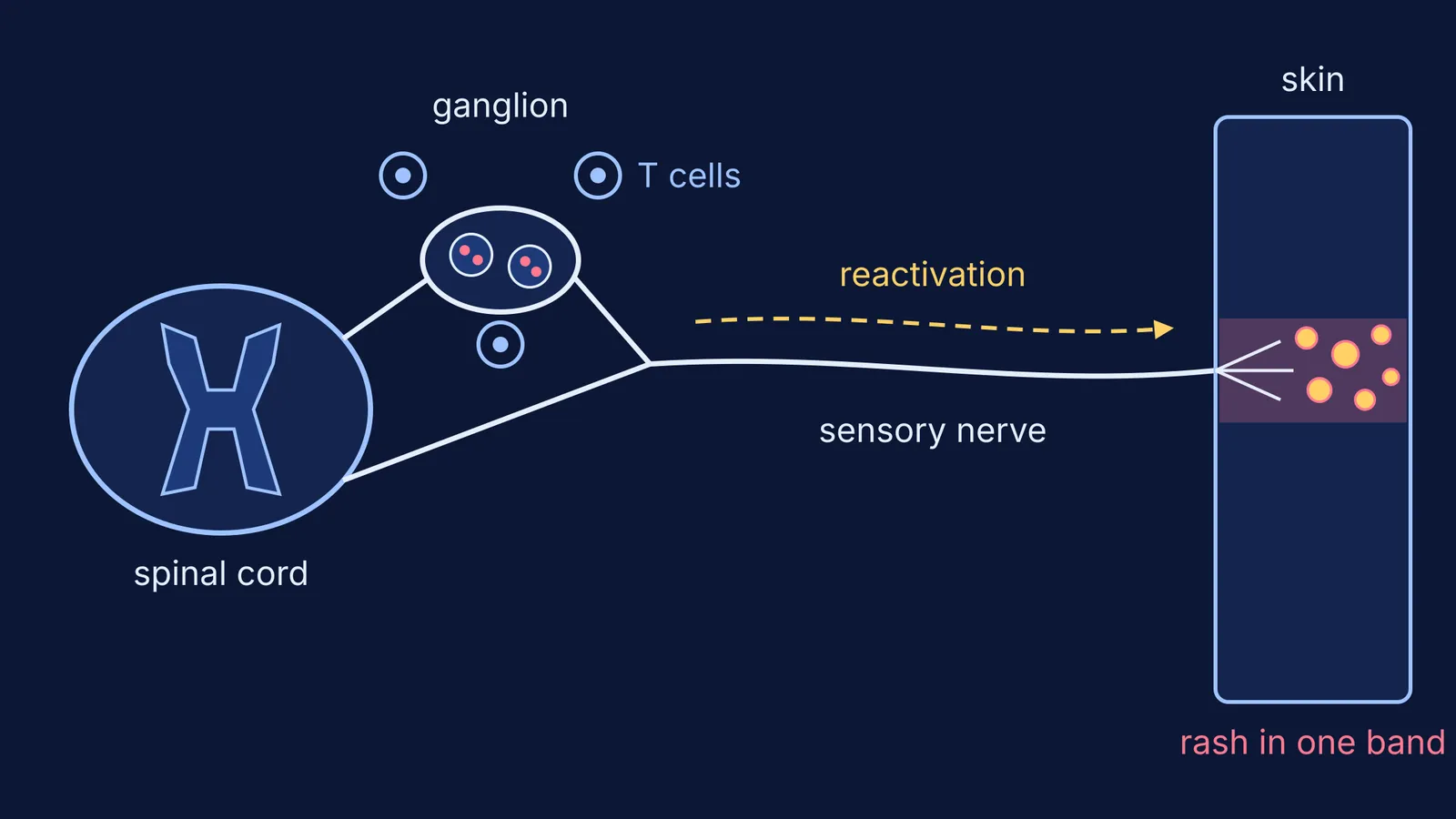
Ganglia are clusters of nerve-cell bodies outside the spinal cord and brain. The CDC's clinical overview of shingles says the virus remains dormant in the dorsal root ganglia, the sensory ganglia beside the spine. Their neurons send long fibres to the skin; the strip of skin served by one spinal nerve is a dermatome.
Latent does not mean gone. A 2018 review in Viruses by Daniel Depledge and colleagues calls it "a lifelong latent infection in ganglionic neurons" and describes the recent discovery of the VZV latency-associated transcript (VLT), a viral RNA linked to this hidden state.
Immune memory vs latency: what is the difference?
Students often mix these up because both last for decades. They belong to opposite sides:
Immune memory belongs to you. Memory B and T cells recognise VZV and react quickly, so you rarely get chickenpox twice.
Latency belongs to the virus. Viral DNA sits quietly inside nerve cells, making no new virus, so shingles stays possible.
The link is a stand-off. VZV-specific T cells keep the latent virus in check. The CDC clinical overview says a person's risk of shingles "increases as their VZV-specific cell-mediated immunity declines".
Why does shingles show up decades later?
Follow one person through it. Every quoted fact below is from the CDC clinical overview of shingles.
Childhood: chickenpox, with spots all over. Memory cells form, and the virus settles into sensory ganglia.
The quiet decades: no symptoms. Cell-mediated immunity keeps the virus down.
Later life: VZV-specific T-cell immunity weakens with age or illness. Risk of shingles "sharply increases after 50 years of age".
Reactivation: the virus multiplies in a ganglion and travels down that neuron's fibre to the skin. The rash appears in "one or two adjacent dermatomes" and "usually does not cross the body's midline".
That is why shingles is a band on one side of the body, not spots everywhere. Gershon's review adds that the inflammation and cell death can leave persistent nerve pain, called postherpetic neuralgia.
Shingles is common. About 1 in 3 people in the United States will have shingles in their lifetime, and most have it only once, though it can recur, says the CDC's shingles page. You cannot catch shingles from someone with shingles, but a person who has never had chickenpox or the chickenpox vaccine can catch chickenpox from them.
How do you write this as a five-mark answer?
If an immunity question asks you to explain this, use five one-line points:
Name the virus: the varicella-zoster virus (VZV) causes chickenpox as the primary infection.
Explain immunity: the primary response creates memory B and T cells; on re-exposure a fast secondary response follows, so a second bout is rare.
Explain latency: VZV persists in sensory (dorsal root) ganglion neurons without producing new virus.
Explain reactivation: when VZV-specific cell-mediated immunity falls, the virus multiplies and travels along the sensory nerve to the skin.
Link to the symptom: a rash in one dermatome, on one side of the body, is shingles (herpes zoster).
If humoral vs cell-mediated immunity still blurs, the Fermi Concept Library gives every biology concept its own lesson and its place in the map. For the neighbouring question, read active vs passive immunity, with IgA and colostrum, then write the five points from memory and check them against this list.


