

On this page
The centroid is the balance point of a flat shape. Cut the shape from thin card of even thickness and it would balance on a pin placed there. In calculus you find it with two integrals and one division, and you can check the answer with Pappus' theorem on solids of revolution. This post works two regions from start to finish and shows the check.
What is the centroid of a region?
OpenStax Calculus Volume 2, section 2.6 treats a flat region as a thin plate of constant density and notes that "the constant ρ cancels out" when the balance point is calculated. So the centroid depends only on the shape.
For a region under y = f(x), above the x-axis, from x = a to x = b, the OpenStax formulas (Theorem 2.12, with the density set to 1) are:
Area: A = ∫ f(x) dx from a to b
Moment about the y-axis: My = ∫ x f(x) dx
Moment about the x-axis: Mx = ∫ ½[f(x)]² dx
Centroid: x̄ = My / A and ȳ = Mx / A
Why the half in Mx? Slice the region into thin vertical strips. A strip of height f(x) and width dx has area f(x) dx, and its own balance point sits halfway up, at height f(x)/2. Multiply the two and you get ½[f(x)]² dx. If the idea of adding up strips still feels loose, see why integration gives area under a curve, in pictures.
One rule saves half the work. OpenStax states it as Theorem 2.11: "If a region R is symmetric about a line l, then the centroid of R lies on l."
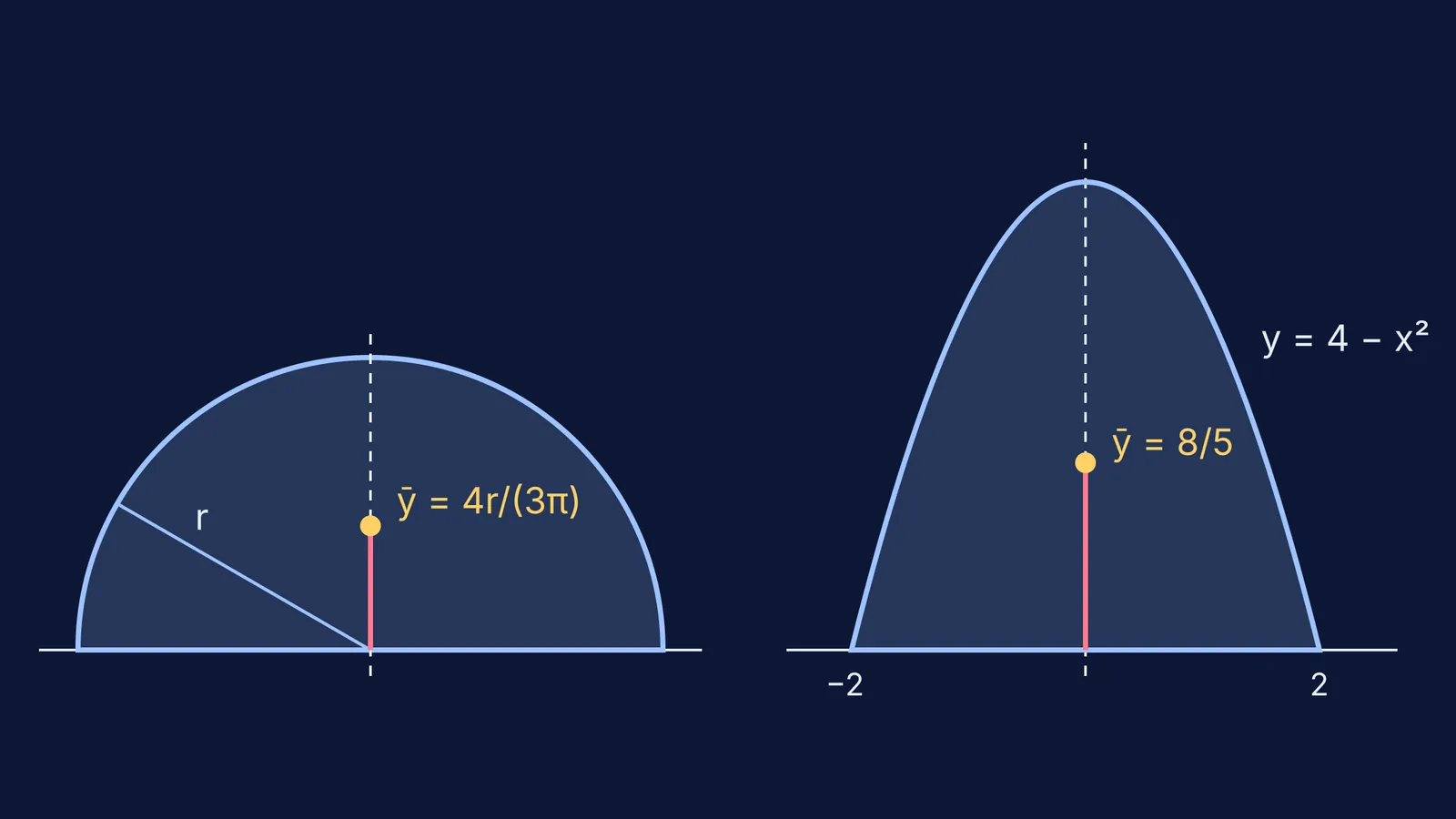
How do you find the centroid of a semicircle?
Take the upper half of a circle of radius r: f(x) = √(r² − x²), from x = −r to x = r.
Symmetry: the shape is symmetric about the y-axis, so x̄ = 0.
Area: A = πr²/2 (half a circle, no integral needed).
Moment: Mx = ∫ ½(r² − x²) dx from −r to r = ½(2r³ − 2r³/3) = 2r³/3.
Divide: ȳ = (2r³/3) ÷ (πr²/2) = 4r/(3π).
The centroid of a semicircular area is at ȳ = 4r/(3π), about 0.424r above the diameter, the same value given in the list of centroids on Wikipedia.
How do you find the centroid of a parabolic region?
This is Example 2.33 in the OpenStax section: the region under f(x) = 4 − x² from x = −2 to x = 2.
Symmetry: x̄ = 0.
Area: A = ∫ (4 − x²) dx from −2 to 2 = 16 − 16/3 = 32/3.
Moment: Mx = ∫ ½(4 − x²)² dx = ½ ∫ (16 − 8x² + x⁴) dx = ½(64 − 128/3 + 64/5) = 256/15.
Divide: ȳ = (256/15) ÷ (32/3) = 8/5.
The centroid is (0, 8/5), which matches the OpenStax answer. A second check: the Wikipedia list gives the centroid of a parabolic area as 3h/5 from the vertex. Here the vertex is at height 4, so ȳ = 4 − 12/5 = 8/5.
How does Pappus' theorem check your answer?
OpenStax (Theorem 2.14) states that when a region R is revolved around a line that does not cut through it, "the volume of the solid of revolution formed by revolving R around l is equal to the area of R multiplied by the distance d traveled by the centroid of R." In short, V = A × d. Pappus's centroid theorem on Wikipedia gives the same statement. We cover the history in Pappus' theorem: volume of a solid of revolution in one line.
Check 1, the semicircle. Spin it about its diameter and you get a sphere. The centroid travels a circle of length 2π × 4r/(3π) = 8r/3. Pappus gives V = (πr²/2) × (8r/3) = 4πr³/3, the volume of a sphere. The answer passes.
Check 2, the parabola. Take the right half (x from 0 to 2) and spin it about the y-axis. Its area is 16/3, and My = ∫ x(4 − x²) dx from 0 to 2 = 4, so x̄ = 4 ÷ (16/3) = 3/4. Pappus gives V = (16/3) × 2π × (3/4) = 8π. Now find the same volume by discs: x² = 4 − y, so V = ∫ π(4 − y) dy from 0 to 4 = 8π. The two methods agree.
What should you check before writing the final answer?
You divided by the area, not by the width b − a.
Mx has the half and the square: ½[f(x)]², not [f(x)]².
Between two curves, OpenStax uses ½([f(x)]² − [g(x)]²), not ½[f(x) − g(x)]².
The centroid lies on every line of symmetry.
It sits inside the region's bounding box, and on the heavier side.
If the region can be spun into a solid whose volume you know, run Pappus.
If a step in your own working will not come out, the Fermi Problem Library has worked problems with a step-by-step solver that explains the reasoning rather than printing an answer. If moments themselves feel shaky, the Fermi Concept Library gives each concept its own lesson and its place in the map.
Centroids sit on top of area integrals, so they are a natural next step after definite integrals and area for JEE Main.


