On this page
Spin a flat shape around a line and it sweeps out a solid: a rectangle makes a cylinder, a semicircle makes a sphere, a circle held away from the axis makes a doughnut. Working out these volumes usually means setting up an integral. Pappus of Alexandria found a shortcut that still saves time and catches mistakes.
What does Pappus' theorem say about volume?
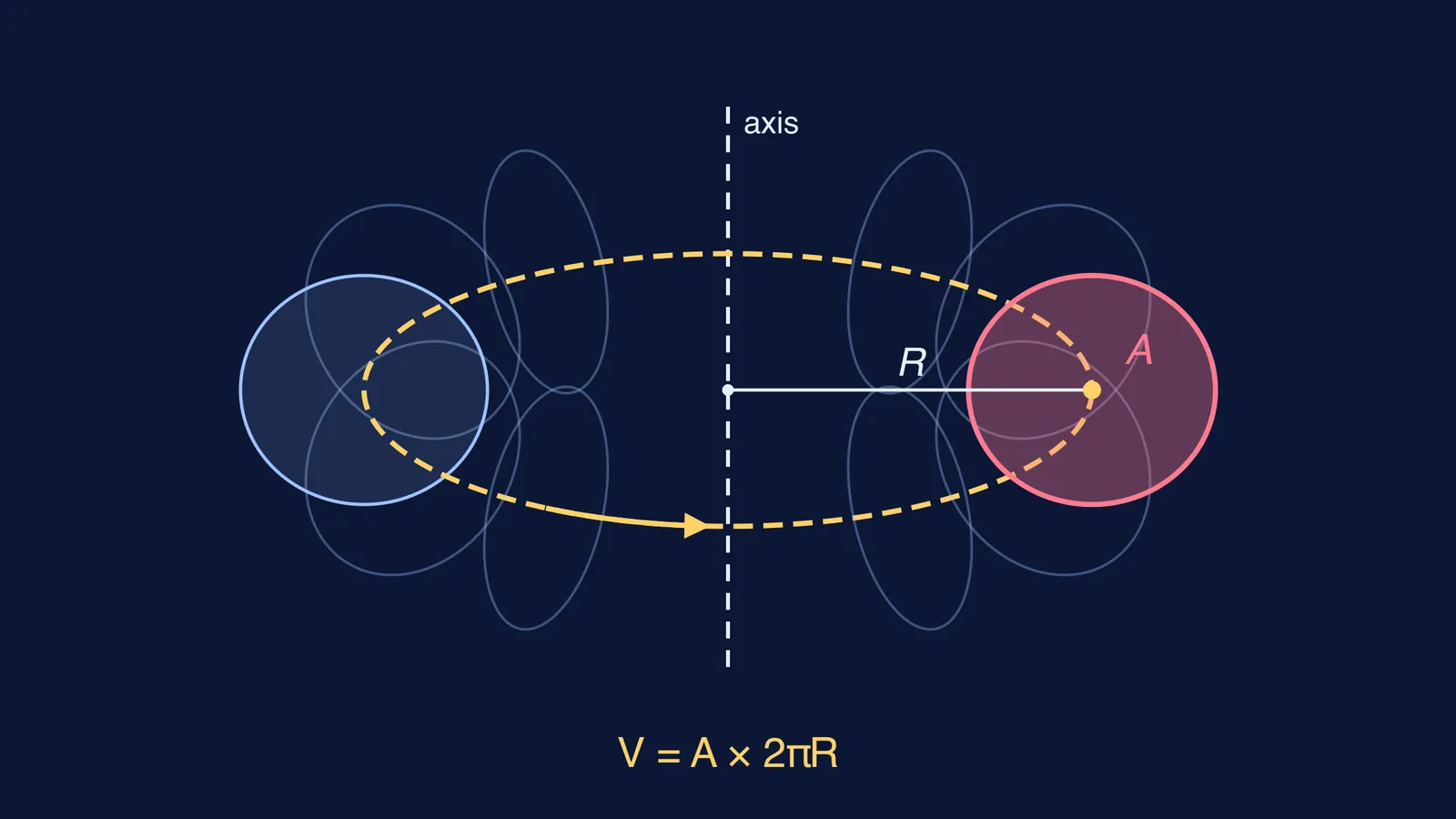
The volume of a solid of revolution equals the area of the generating shape multiplied by the distance its centroid travels (Wolfram MathWorld).
In symbols, V = A × d. For a full turn, a centroid at distance x̄ from the axis travels round a circle, so d = 2πx̄ and V = 2πx̄A.
There is a companion rule for surfaces: the surface area equals the length of the spinning curve multiplied by the distance its centroid travels (Pappus's centroid theorem, Wikipedia). Both need the axis to lie in the same plane as the shape and not cut through it. Touching the edge is fine.
Why it works: each tiny piece of area dA, at distance x from the axis, sweeps a ring of volume 2πx dA. Adding them gives 2π∫x dA. By the definition of the centroid, ∫x dA = x̄A. So the whole volume is 2πx̄A.
Who was Pappus, and why is it also called Guldin's theorem?
Pappus worked in Alexandria. His commentary on Ptolemy's Almagest shows that he saw the solar eclipse of 18 October 320, which dates that work to 320 (MacTutor History of Mathematics). His eight-book Mathematical Collection is thought to date from around 340, and the centroid result is proved in Book VII (same MacTutor source).
The idea came back in Europe much later. Johannes Kepler stated a special case for rings in 1615, Paul Guldin published it in 1640, and Pappus' own statement first appeared in print in 1659 (Wikipedia). That is why the rule often carries Guldin's name too. Historians have asked whether Guldin knew of Pappus' result when he published (MacTutor, above).
How do you use Pappus' theorem to find a volume?
Torus (doughnut). A circle of radius r = 2 cm, centre R = 5 cm from the axis. A = πr² = 4π cm², and the centroid travels 2πR = 10π cm. V = 40π² ≈ 395 cm³. In general V = 2π²Rr².
Cone. Spin a right triangle with legs r = 3 (perpendicular to the axis) and h = 4 (along the axis). A = 6, and the centroid sits r/3 = 1 from the axis, so it travels 2π. V = 12π, which matches (1/3)πr²h = (1/3)π(9)(4) = 12π.
Sphere, run backwards. Spin a semicircle of radius r about its diameter. You already know the result is a sphere of volume (4/3)πr³. Setting (πr²/2) × 2πȳ = (4/3)πr³ gives ȳ = 4r/(3π), the centroid of a semicircular disc, with no integration at all.
If spinning shapes in your head is the hard part, the Fermi Simulation Lab has interactive simulations for ideas that are easier to see than to read. Our post on how the disc method builds a solid of revolution shows the integral that Pappus lets you skip.
How does Pappus' theorem help check JEE answers?
The official JEE (Main) 2026 syllabus from NTA lists areas of regions bounded by simple curves under integral calculus, and centre of mass of a rigid body under rotational motion in physics. Volumes of revolution are not listed, so the main JEE use of Pappus is in reverse: checking centroid and centre-of-mass answers against volumes and surface areas you already trust.
A quick check routine:
Picture the shape spinning about a convenient line, usually one edge or a line of symmetry.
Name the solid or surface it makes and write down its known volume or area.
Divide by the shape's area (or the curve's length) and by 2π. That is the centroid's distance from the line.
Compare with your answer. A mismatch means a slip in the limits or the set-up.
Try it on a uniform semicircular wire of radius r. Spinning it about its diameter gives a sphere's surface, so πr × 2πȳ = 4πr², and ȳ = 2r/π. A quarter disc spun about one straight edge gives a hemisphere, so (πr²/4) × 2πx̄ = (2/3)πr³, and x̄ = 4r/(3π) again. These match the standard results in our guide to the centre of mass of a semicircular ring, disc and hemisphere.
For an unfamiliar region you still integrate to find the centroid; our post on sketching first, then integrating for areas under curves helps with that step. If your set-up keeps going wrong, the Fermi Problem Library has worked problems with a step-by-step solver that explains the reasoning rather than printing an answer.
Pick one shape from your current chapter and spin it on paper before your next mock.