

On this page
These four results turn up in JEE and board papers, usually inside a bigger problem: a cone stuck on a hemisphere, or a plate with a piece cut out. If you know where each comes from, you don't have to trust memory under pressure.
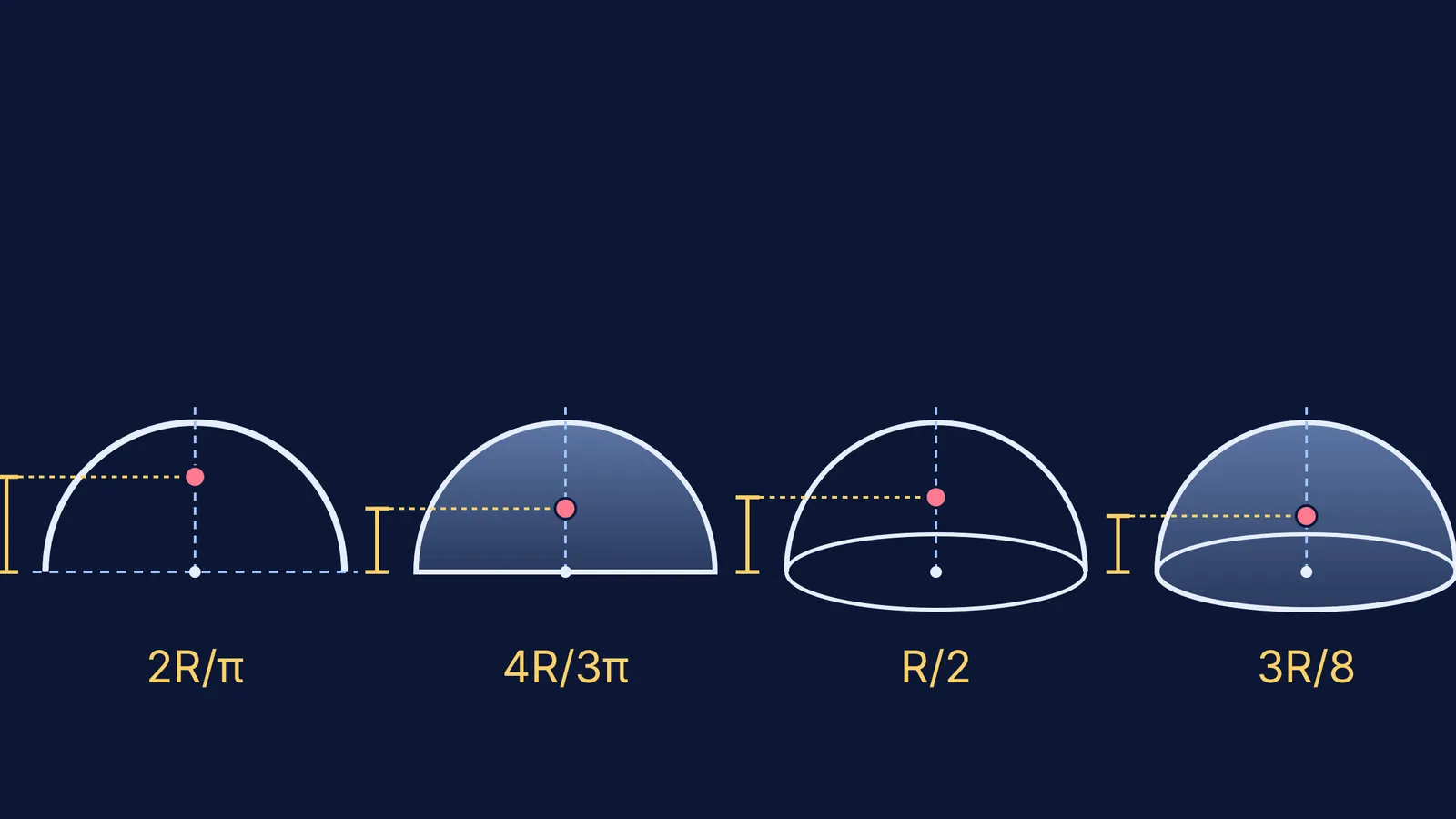
Where is the centre of mass of a semicircular ring, disc and hemisphere?
All four distances are measured from the centre of the flat edge (or flat face), along the axis of symmetry. Symmetry puts the centre of mass on that axis. The ring, disc and solid hemisphere values appear in this list of centroids, and Wolfram MathWorld gives the centroid of a solid hemisphere as 3R/8 from the flat face (MathWorld: Hemisphere). For a body of uniform density, the centre of mass and the centroid are the same point.
Semicircular ring (thin wire): 2R/π, about 0.637R
Semicircular disc (thin plate): 4R/3π, about 0.424R
Hollow hemisphere (thin shell): R/2
Solid hemisphere: 3R/8, or 0.375R
In each pair the hollow shape's centre of mass is higher, because filling it in adds mass near the base.
How do you derive 2R/π and 4R/3π?
Start from the definition. For a continuous body, the centre of mass is r_CM = (1/M)∫r dm, as set out in OpenStax University Physics, section 9.6.
Ring. Take a small piece of arc at angle θ from the diameter. Its length is R dθ, so its mass is dm = (M/π) dθ, and its height is y = R sin θ. Then y_CM = (1/M)∫ R sin θ (M/π) dθ from 0 to π, which is (R/π)[−cos θ] from 0 to π, or 2R/π.
Disc. Slice the half-disc into thin half-rings of radius r and width dr. Each has mass dm = (2M/R²) r dr and, from the ring result, a centre of mass at 2r/π. So y_CM = (1/M)∫ (2r/π)(2M r/R²) dr from 0 to R = (4/πR²)(R³/3) = 4R/3π.
Why is a hollow hemisphere R/2 and a solid one 3R/8?
Hollow hemisphere. Archimedes' hat-box theorem says any zone of a sphere between two parallel planes has the same area as the band of the wrapping cylinder between the same planes. So every slice of the shell of thickness dz has the same area, at any height. The mass is spread evenly from z = 0 to z = R, so the average height is R/2.
Solid hemisphere. Build it from thin hollow shells of radius r and thickness dr. Each has volume 2πr² dr and, from the shell result, a centre of mass at r/2. So y_CM = ∫ (r/2)(2πr² dr) from 0 to R, divided by the volume 2πR³/3, which gives (πR⁴/4)/(2πR³/3) = 3R/8.
The same slicing is how you find moment of inertia by integration.
How do you use them in composite-body problems?
Split the body into standard pieces. Treat a hole as negative mass.
Put the origin at the centre of the flat face and mark it.
Write each piece's mass and centre-of-mass position, with sign.
Combine: y_CM = (Σ m y)/(Σ m), subtracting a removed piece's mass in both top and bottom.
Check the answer lies between the pieces' own centres.
Worked example 1: a half-disc with a half-disc removed. From a uniform semicircular plate of radius R, a concentric semicircle of radius R/2 is cut out. Mass goes with area. The full plate has area πR²/2 at height 4R/3π. The removed part has area πR²/8 at height 4(R/2)/3π = 2R/3π.
y_CM = (πR²/2 × 4R/3π − πR²/8 × 2R/3π) / (πR²/2 − πR²/8) = (2R³/3 − R³/12) / (3πR²/8) = 14R/9π, about 0.495R.
Check: it lies between the disc value (0.424R) and the ring value (0.637R), as it should.
Worked example 2: the toy that balances at any tilt. A solid cone of radius R and height h is fixed on the flat face of a solid hemisphere of the same radius and material. The cone's centre of mass is h/4 above its base, from the same list of centroids. Take the origin at the centre of the flat face, upwards positive.
Hemisphere: mass (2/3)πR³ρ at −3R/8
Cone: mass (1/3)πR²hρ at +h/4
The numerator of y_CM is πR²ρ(h²/12 − R²/4). It is zero when h = √3R. Then the centre of mass sits at the centre of the flat face, which is the centre of the curved surface, so its height stays fixed as the toy rocks: neutral equilibrium at any tilt. With a shorter cone, it rights itself when pushed.
For how centre of mass then simplifies motion, see our guide to centre of mass problems, and for when a body's balance point is not its centre of mass, centre of gravity vs centre of mass.
If a composite problem keeps going wrong at the set-up stage, the Fermi Problem Library has worked problems with a step-by-step solver that explains the reasoning rather than printing an answer.


