

On this page
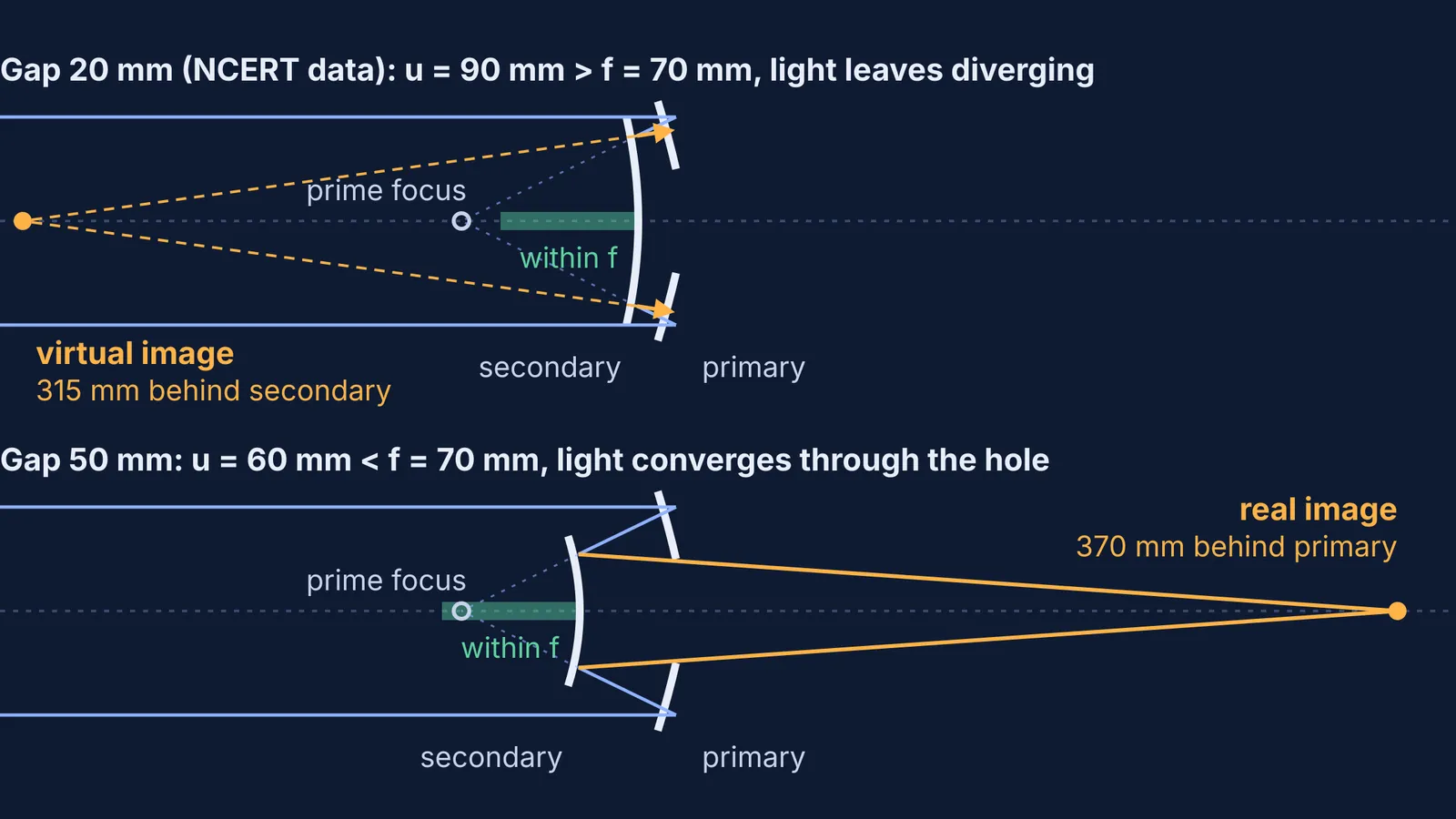
NCERT's Class 12 ray optics chapter has a short Cassegrain telescope question. A concave primary mirror has a radius of curvature of 220 mm. A convex secondary mirror of radius 140 mm faces it, 20 mm away. Light from a distant star falls on the primary. Where is the final image? The answer usually quoted is "315 mm from the secondary mirror". The distance is right. But if you finish the sign convention properly, that image lies on the far side of the secondary, out towards the sky, and it is virtual. With these numbers the telescope does not form a real image at all.
What does a Cassegrain telescope do?
The concave primary reflects starlight back towards its focus, the prime focus. Before the light gets there, a convex secondary sends it back through a hole in the primary to an eyepiece or camera behind it. Folding the light gives a long focal length in a short tube. Why mirrors beat lenses is covered in why reflecting telescopes beat refracting telescopes. This post is about the numbers.
Which sign convention should you use for two mirrors?
State it before any arithmetic, and apply it to each mirror separately:
Measure every distance from the pole of the mirror you are working on.
Distances measured along the direction of the light falling on that mirror are positive. Distances against it are negative.
A real image of a mirror forms in front of it, against the incident light, so a real image has negative v. A positive v means the image is behind the mirror and virtual.
The mirror formula is 1/v + 1/u = 1/f, with f = R/2.
The single-mirror rules are covered in sign convention for spherical mirrors. The only new step here is that the light changes direction at the primary, so the positive direction for the secondary is opposite to the one for the primary.
Worked example: where does the final image form?
Data: R₁ = 220 mm (concave primary), R₂ = 140 mm (convex secondary), separation d = 20 mm.
Primary alone. f₁ = −220/2 = −110 mm. The star is at infinity, so the primary would form its image at v₁ = −110 mm: 110 mm in front of the primary, towards the sky.
Where is the secondary? Only 20 mm in front of the primary. So the light meets the secondary while it is still converging, before it reaches the prime focus.
Object for the secondary. The light reflected from the primary now travels towards the sky. The point it is heading for is 110 − 20 = 90 mm beyond the secondary, along that direction. That point is a virtual object for the secondary: u₂ = +90 mm.
Focal length of the secondary. A convex mirror's centre of curvature is behind it, along the incident light, so f₂ = +140/2 = +70 mm.
Mirror formula. 1/v₂ = 1/f₂ − 1/u₂ = 1/70 − 1/90 = 20/6300. So v₂ = +315 mm.
Read the sign. v₂ is positive, so the image is 315 mm behind the secondary, on the sky side. That is 315 + 20 = 335 mm in front of the primary.
The distance, 315 mm, matches the usual answer. The sign says the light leaving the secondary is spreading out, as if it came from a point 335 mm out in front of the telescope. No light actually meets there. The final image is virtual.
Why is the image virtual?
A convex mirror makes light diverge more. It takes the converging beam from the primary and reduces its convergence by an amount set by its own focal length. The beam was converging towards a point 90 mm away. The mirror's diverging power, 1/70 mm⁻¹, is larger than the beam's convergence, 1/90 mm⁻¹. So after reflection the beam diverges.
You can see this as a rule. A convex mirror forms a real image of a virtual object only when the object is within its focal length: 0 < u < f. Here u = 90 mm and f = 70 mm, so u > f and the image is virtual. This is the one case where a convex mirror can make a real image at all, and why it needs converging light is explained in can a plane mirror or convex mirror form a real image.
There is a second way to check. Treat the two mirrors as an equivalent thin-lens pair, with the concave mirror as a converging element of focal length 110 mm and the convex one as a diverging element of 70 mm. The combined focal length F comes from 1/F = 1/110 − 1/70 + 20/(110 × 70) = −20/7700, so F = −385 mm. The system as specified is diverging overall. A diverging system cannot bring parallel starlight to a real focus.
When does a Cassegrain form a real image?
The prime focus must lie within f₂ of the secondary, beyond it along the light. With gap d, the virtual object distance is u₂ = f₁ − d, using the size of f₁. You need 0 < u₂ < f₂:
f₁ − d < f₂ gives d > f₁ − f₂ = 110 − 70 = 40 mm.
d < f₁ = 110 mm, or the secondary sits beyond the prime focus.
So with these two mirrors, any gap between 40 mm and 110 mm gives a real image behind the primary. At exactly 40 mm the light leaves the secondary parallel and the image is at infinity. NCERT's 20 mm is outside the working range.
What if the same mirrors are 50 mm apart?
Virtual object. u₂ = 110 − 50 = +60 mm. This is now less than f₂ = 70 mm.
Mirror formula. 1/v₂ = 1/70 − 1/60 = −10/4200. So v₂ = −420 mm.
Read the sign. Negative v: a real image 420 mm in front of the secondary, on the side the reflected light travels. Subtract the 50 mm gap: the image is 370 mm behind the primary, past the hole, where a camera or eyepiece can sit.
Magnification by the secondary. m₂ = −v₂/u₂ = −(−420)/60 = +7.
Effective focal length. 110 × 7 = 770 mm. The thin-lens check agrees: 1/F = 1/110 − 1/70 + 50/7700 = 10/7700, so F = +770 mm.
A note on accuracy: real Cassegrain secondaries are hyperbolic and real primaries are parabolic, to remove spherical aberration. The mirror formula treats them as spherical and works for rays close to the axis, which is all a board or JEE question expects.
If ray paths through two mirrors are hard to picture, the Simulation Lab has interactive simulations for ideas that are easier to see than read.
Quick checklist
Sign convention first, applied to each mirror from its own pole.
f₁ = −110 mm, f₂ = +70 mm (convex).
Prime focus 90 mm beyond the secondary, so u₂ = +90 mm, a virtual object.
v₂ = +315 mm: behind the secondary, virtual, 335 mm in front of the primary.
Real image only if f₁ − f₂ < d < f₁, here 40 to 110 mm.
At d = 50 mm: v₂ = −420 mm, real, 370 mm behind the primary, focal length 770 mm.


