

On this page
Ask any student which end of a C–O bond is negative and you will hear "oxygen", because oxygen is more electronegative. For most molecules with a C–O bond that is right. For carbon monoxide it is wrong. CO has a very small dipole moment, about 0.11 D, and its negative end is the carbon atom. This post shows how that was measured, why it happens, and what you should write when an exam question asks about it.
What is the dipole moment of carbon monoxide?
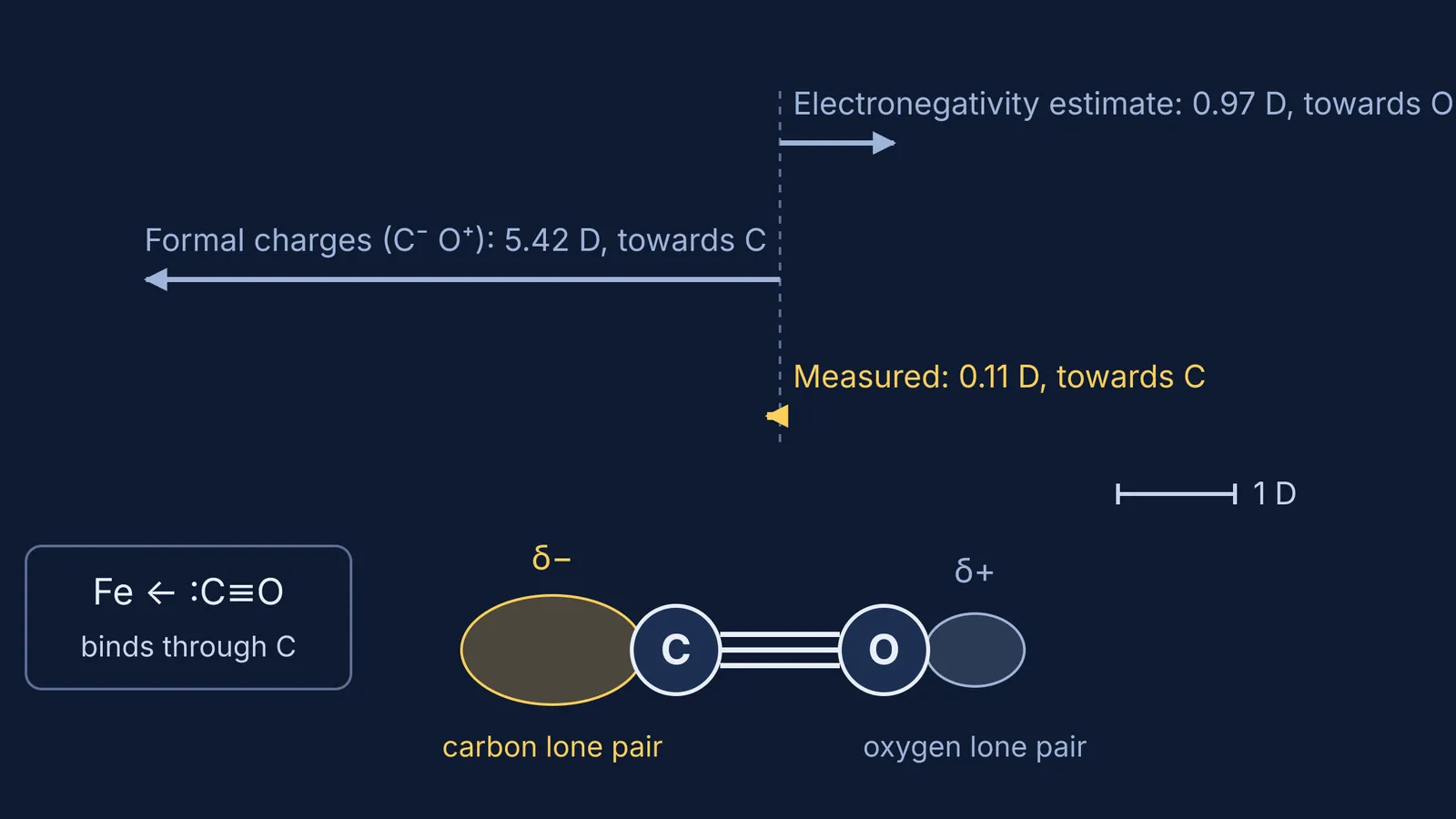
The dipole moment of CO in its ground state is 0.110 D. J. S. Muenter measured it from the Stark effect (the splitting of spectral lines in an electric field) as 0.10980 D (Muenter, J. Mol. Spectrosc. 55, 490, 1975). As the worked example below shows, that is about nine times smaller than an electronegativity estimate.
In this post, an arrow points from the positive end to the negative end, the usual chemistry convention. With that convention, CO's dipole arrow points from oxygen towards carbon: C⁻O⁺ in the usual shorthand.
Who showed that carbon is the negative end of CO?
The size of a dipole is easy to measure; its direction is not, because a molecule in an electric field responds the same way whichever end is negative. In 1958, Rosenblum, Nethercot and Townes compared the tiny magnetic moments of rotating CO molecules made with different isotopes of carbon and oxygen, and their data indicated a C⁻O⁺ polarity (Phys. Rev. 109, 400, 1958).
That result was not the end of the story. Questions were raised about how the 1958 data had been interpreted, a more accurate repeat of the magnetic measurements still could not settle the sign unambiguously, and early theoretical calculations even predicted the opposite polarity, C⁺O⁻. In 1977, Meerts, de Leeuw and Dymanus measured the electric and magnetic properties of three isotopic forms of CO together in a molecular beam and reported that they could determine "unambiguously the negative (C⁻O⁺) polarity" (Chem. Phys. 22, 319, 1977). That is the accepted answer today, and modern high-level calculations reproduce the small measured value (Scuseria and co-workers, J. Chem. Phys. 94, 6660, 1991).
Why does the electronegativity rule fail for CO?
Two effects pull in opposite directions and nearly cancel.
The bonding electrons lean towards oxygen. Oxygen (Pauling electronegativity 3.44) pulls the shared electrons of the triple bond towards itself more strongly than carbon (2.55) does. On its own, this would make oxygen the negative end.
Carbon's lone pair sits far out behind carbon. In :C≡O:, each atom has one lone pair. Oxygen's lone pair is held tightly and close to the nucleus. Carbon's is larger and more spread out, and it sticks out from the back of the molecule, away from the bond. A cloud of negative charge sitting far out on the carbon side moves the centre of negative charge towards carbon.
The second effect slightly wins, so the net dipole is tiny and points to carbon. One point to be careful about: this does not mean the carbon atom carries a large negative charge. Different ways of dividing up a molecule's electrons between atoms give different atomic charges, and some put a small positive charge on carbon. A dipole moment depends on where the whole charge cloud sits, and the lone pair's position, not an atomic charge, decides the sign here.
The formal charges in the accepted Lewis structure, C −1 and O +1 (worked out in our post on formal charge and Lewis structures), point in the right direction. As the worked example shows, they badly overstate the size.
Worked example: three predictions for CO's dipole
Use the bond length r(C–O) = 112.8 pm from the NIST Computational Chemistry Comparison and Benchmark Database, the electron charge e = 1.602 × 10⁻¹⁹ C and 1 D = 3.336 × 10⁻³⁰ C m. The method, μ = q × d, is the same one used in our post on percentage ionic character from dipole moment.
A full unit charge on each atom. μ = (1.602 × 10⁻¹⁹ C)(1.128 × 10⁻¹⁰ m) = 1.807 × 10⁻²⁹ C m. Divide by 3.336 × 10⁻³⁰: μ = 5.42 D. This is what the formal charges −1 and +1 would give if they were real charges.
The electronegativity estimate. The difference is Δχ = 3.44 − 2.55 = 0.89. Pauling's rough formula for fractional ionic character is 1 − e^(−Δχ²/4) = 1 − e^(−0.198) = 0.18, or about 18%. So the predicted dipole is 0.18 × 5.42 ≈ 0.97 D, with oxygen negative.
The measured value. μ = 0.110 D with carbon negative. The effective charge is 0.110 ÷ 5.42 ≈ 0.020, so the molecule behaves as if only about 2% of an electron charge had been moved from oxygen to carbon.
So the electronegativity estimate gets the direction wrong and the size about nine times too large, and the formal-charge picture gets the direction right but the size about fifty times too large.
If the vector picture of dipoles still feels shaky, the Concept Library gives each bonding idea its own lesson with its place in the map, so you can go back to bond dipoles before tackling exceptions like this one.
Why does CO bind to metals through carbon?
In metal carbonyls such as Ni(CO)₄ and in carboxyhaemoglobin, CO always bonds through carbon. The reason is the same lone pair that sets the dipole's sign. Carbon's lone pair is the highest-energy filled orbital of CO, it is large, and it points away from the molecule, so it is the electron pair CO donates to an empty metal orbital. Oxygen's lone pair is lower in energy and held closer, so it is a poor donor. The synergic σ-donation and π-back-bonding that follow are explained in our post on the structure of CO and its reducing action.
What should you write in a board or JEE/NEET answer?
If a question asks you to arrange dipole moments, CO is close to zero, smaller than HCl, H₂O or NH₃, though not exactly zero like CO₂.
If a question asks for the direction, write C⁻O⁺ and give the lone-pair reason in one sentence.
If a question asks why CO bonds to metals through carbon, answer with carbon's lone pair (σ-donation) and π-back-bonding. The tiny dipole is a symptom of where that lone pair sits, not the cause of the bonding.
In an ordinary "predict the polarity" question on other molecules, use electronegativity and shape as usual. CO is the exception, not a new rule.
If you are revising bonding for JEE Main or Advanced and want help spotting which textbook rules have exceptions like this, Fermi's AI tutor for JEE prep works through these questions with you.
Quick checklist
CO's measured dipole: about 0.11 D, negative end on carbon (C⁻O⁺).
First sign measurement: Rosenblum, Nethercot and Townes, 1958; settled unambiguously by Meerts, de Leeuw and Dymanus, 1977.
Electronegativity predicts about 0.97 D towards oxygen; formal charges predict 5.42 D towards carbon. Both are wrong in size.
The sign comes from carbon's spread-out lone pair, not from a large negative charge on carbon.
The same lone pair is why CO binds to metals and haem iron through carbon.


