

On this page
Carbon monoxide (CO) is a simple molecule, but its bonding makes it highly reactive. Unlike carbon dioxide, which is fully oxidised and stable, carbon monoxide is a powerful reducing agent and a crucial ligand in coordination chemistry. Both of these properties—its reducing action in metallurgy and its ability to bind to transition metals—can be explained by the arrangement of electrons in its triple bond.
What is the structure of carbon monoxide?
Carbon and oxygen are joined by a triple bond, making carbon monoxide the simplest carbon oxide. The measured bond length is 1.128 Å (Wikipedia), which is remarkably short and confirms the triple bond structure.
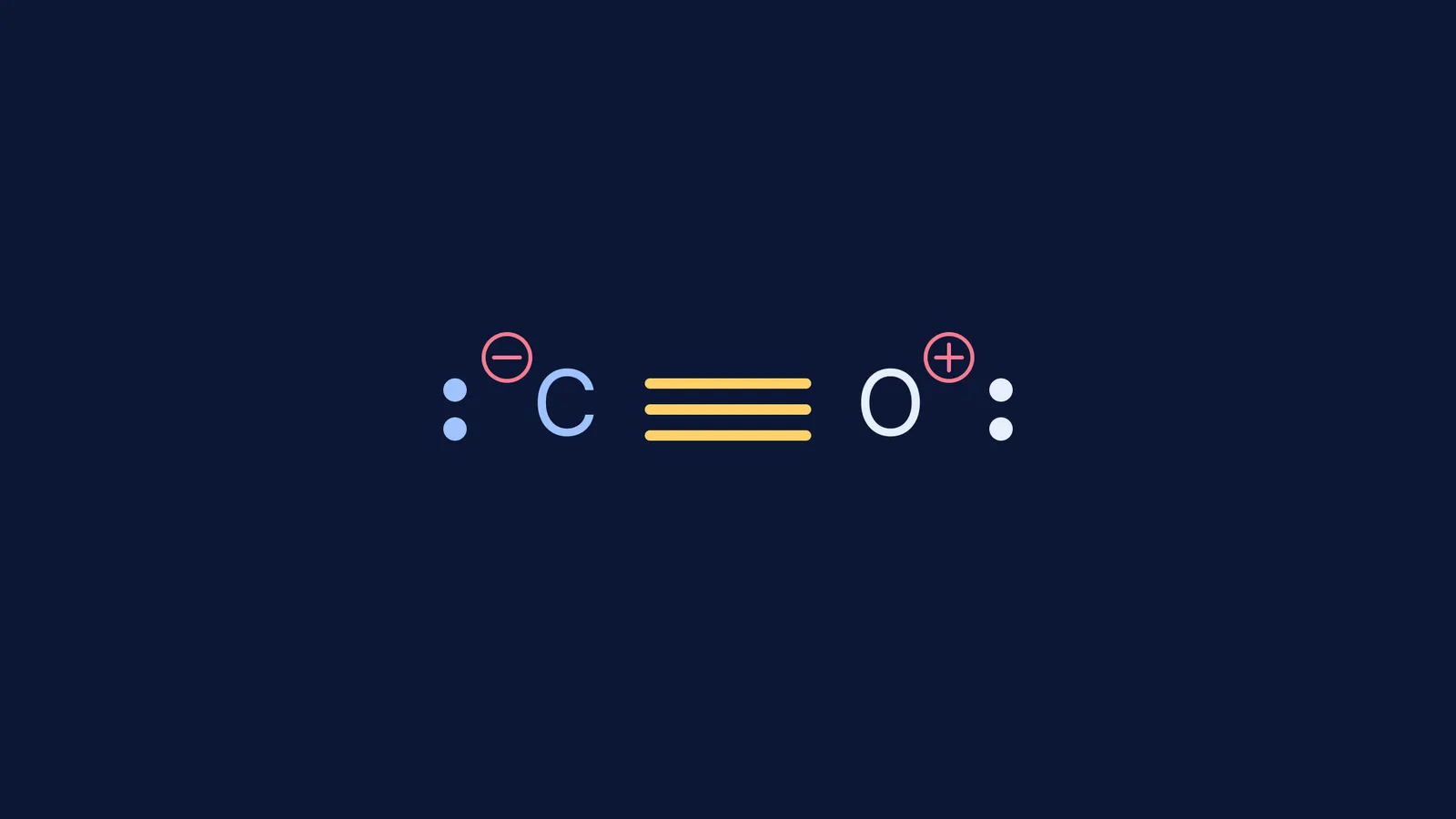
This bond consists of one σ (sigma) bond and two π (pi) bonds. Because carbon has four valence electrons and oxygen has six, they need to share electrons to complete their octets. One of the π bonds is a coordinate (dative covalent) bond, where both shared electrons originate from the oxygen atom.
When you draw the most stable resonance structure—a concept you also use when calculating the average bond order from resonance—both atoms have a full octet and a lone pair of electrons. However, this arrangement places a formal negative charge on the carbon atom and a formal positive charge on the oxygen atom (⁻:C ≡ O:⁺). The negative charge on carbon makes that end of the molecule highly reactive, which is why carbon monoxide almost always interacts with other substances through its carbon atom.
If you struggle to picture how electrons arrange themselves in molecules, the Fermi Concept Library maps out chemical bonding and molecular orbital theory.
Why does carbon monoxide act as a reducing agent?
Carbon monoxide is a strong reducing agent because it readily accepts another oxygen atom to become the more stable carbon dioxide (CO₂). This property is heavily exploited in metallurgy, particularly when extracting metals from their ores.
In a blast furnace, iron is extracted from hematite ore (Fe₂O₃) at temperatures up to 1200 °C (Wikipedia). While coke (solid carbon) is added to the furnace as fuel, it is the gaseous carbon monoxide that does the actual reducing. The carbon burns to form carbon dioxide, which then reacts with more hot coke to produce carbon monoxide gas.
The carbon monoxide then strips oxygen from the iron ore: Fe₂O₃(s) + 3CO(g) → 2Fe(s) + 3CO₂(g)
Why use carbon monoxide instead of just solid carbon? Because a gas can easily surround and penetrate the porous solid ore. A reaction between two solids (coke and iron ore) is much slower because they only react where their surfaces physically touch. You can practice balancing these metallurgical equations and finding the limiting reagents in the Fermi Problem Library.
How does carbon monoxide bind to metals as a ligand?
In coordination chemistry, carbon monoxide is called a carbonyl ligand (Wikipedia). It forms strong bonds with transition metals, creating complexes like nickel tetracarbonyl (Ni(CO)₄) and iron pentacarbonyl (Fe(CO)₅). It binds exclusively through the carbon atom, and the bond is unusually strong due to a two-way exchange of electrons known as synergic bonding.
First, the carbon atom donates its lone pair of electrons into an empty d-orbital on the metal, forming a σ bond. This donation increases the electron density on the metal.
To relieve this excess negative charge, the metal pushes electrons from its filled d-orbitals back into the empty π* (pi-antibonding) orbitals of the carbon monoxide molecule. This is called π-back-bonding. The two effects are synergic: the more the carbon donates, the more the metal back-bonds, locking the ligand tightly in place.
While this back-bonding strengthens the metal-carbon bond, it pushes electron density into an antibonding orbital on the CO molecule. This weakens the carbon-oxygen triple bond, causing it to stretch and vibrate at a lower frequency, which chemists can measure using infrared spectroscopy.


