

On this page
Here is a puzzle that trips up many Class 11 students. A capillary is the narrowest blood vessel in your body. The equation of continuity says a fluid speeds up where a pipe narrows. So blood should rush through capillaries. Instead, it is slowest there. Physics and biology are both right; the catch is one word: total.
What does the equation of continuity actually say?
For an incompressible fluid, the volume flowing past any point each second (the flow rate, Q) stays the same along the pipe, so A1v1 = A2v2, where A is cross-sectional area and v is average speed (OpenStax College Physics 2e, section 12.1). If you want the pipe-and-nozzle version first, read our explainer on the equation of continuity in pipes and nozzles.
The same textbook writes a branching version: n1A1v1 = n2A2v2, where n is the number of identical vessels sharing the flow. That extra n is the whole story. Blood leaving the aorta does not squeeze into one capillary. It spreads across billions of them side by side, so what matters is the combined area nA, not the area of one tube.
How slow is blood in capillaries? A worked example
These inputs come from Example 12.3 in OpenStax College Physics 2e: a flow rate of 5.0 L/min, an aorta radius of 10 mm, a capillary diameter of 8.0 μm and a capillary blood speed of about 0.33 mm/s. Work through it with a pencil; each step is one line.
Flow rate in SI units: Q = 5.0 × 10⁻³ m³ ÷ 60 s = 8.33 × 10⁻⁵ m³/s.
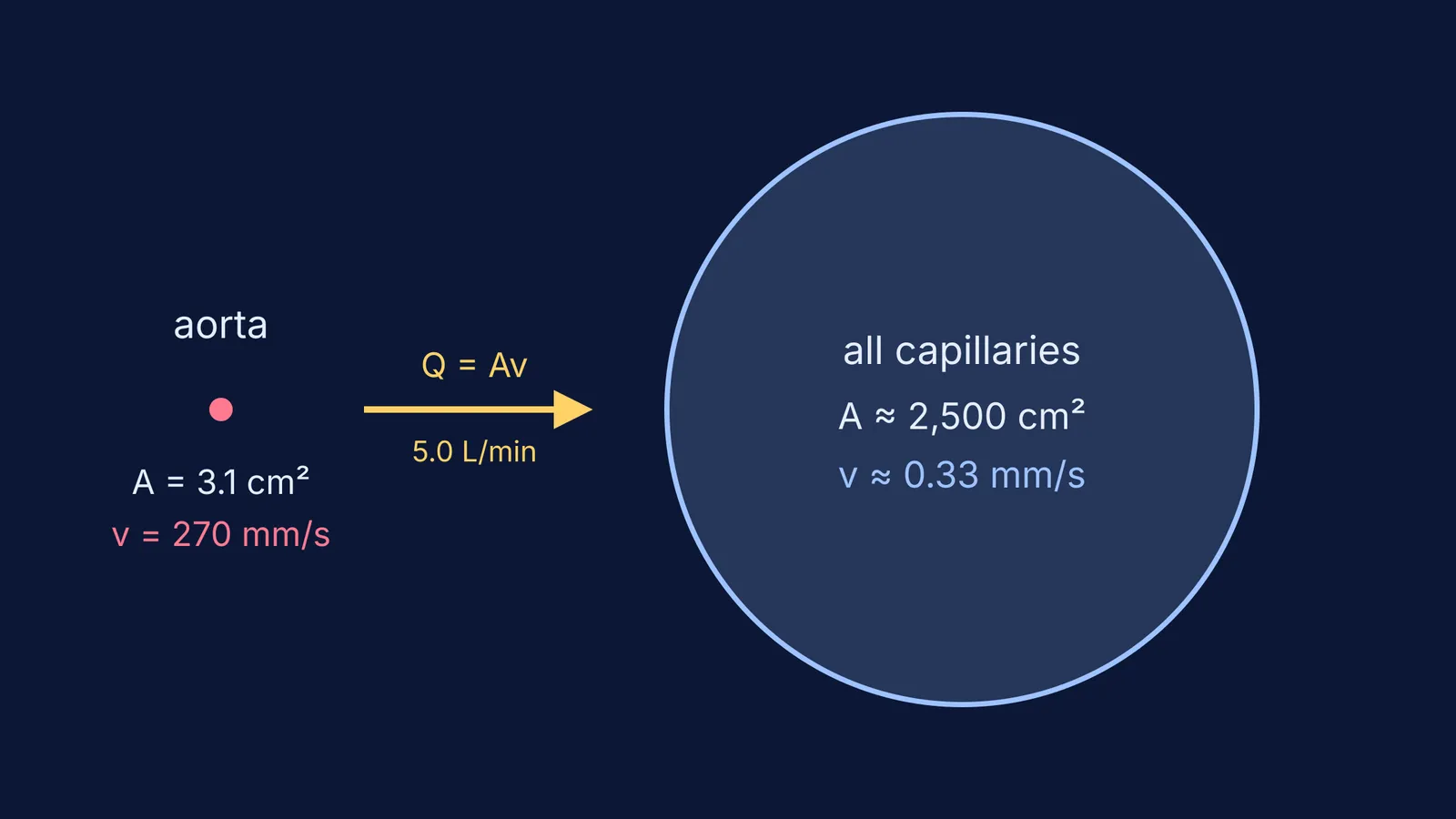
Aorta area: A1 = πr² = π × (0.010 m)² = 3.14 × 10⁻⁴ m², about 3.1 cm².
Aorta speed: v1 = Q ÷ A1 = 8.33 × 10⁻⁵ ÷ 3.14 × 10⁻⁴ = 0.27 m/s, the figure OpenStax gives.
Total capillary area that carries the same Q at 0.33 mm/s: A2 = Q ÷ v2 = 8.33 × 10⁻⁵ ÷ 3.3 × 10⁻⁴ = 0.25 m², about 2,500 cm².
Area of one capillary (radius 4.0 μm): a = π × (4.0 × 10⁻⁶ m)² = 5.0 × 10⁻¹¹ m².
Number of capillaries: n = A2 ÷ a = 0.25 ÷ 5.0 × 10⁻¹¹ ≈ 5 × 10⁹, matching the textbook's 5.0 × 10⁹.
Now compare the two ends. The capillaries together have about 800 times the aorta's cross-section (0.25 ÷ 3.14 × 10⁻⁴ ≈ 800), and the blood in them moves about 800 times slower (0.27 ÷ 0.00033 ≈ 800). That is continuity doing exactly what it promises. In OpenStax's words, the speed in the capillaries "is considerably reduced relative to the speed in the aorta due to the significant increase in the total cross-sectional area at the capillaries."
The textbook also checks the answer against biology: active muscle has about 200 capillaries per mm³, which for 20 kg of muscle gives roughly 4 × 10⁹ capillaries, close to the calculated count.
If you get stuck at the unit conversion or the branching step, the Fermi Problem Library has worked problems with a step-by-step solver that explains the reasoning rather than printing an answer.
Why is slow blood flow in capillaries useful?
Capillaries are where oxygen, nutrients and wastes cross between blood and tissue. OpenStax Anatomy and Physiology 2e, section 20.2 notes that the total cross-sectional area of the capillary beds "is far greater than any other type of vessel" and that the slow flow "allows more time for exchange processes to occur." The physics sets the speed; the biology puts it to work. For how capillaries differ in structure from the vessels on either side, see artery vs vein vs capillary.
Keep speed separate from pressure. Pressure along the circuit is a different question, tied to resistance in the vessels; we plot it in why blood pressure drops from arteries to veins.
Where do students go wrong on this question?
Putting the area of one capillary into A1v1 = A2v2. Use the total area of all capillaries, or use n1A1v1 = n2A2v2.
Reading "narrowest vessel" as "fastest flow". Speed is high where the total area is small, not where one tube is thin.
Mixing units. 1 m² = 10⁴ cm², and the OpenStax capillary speed of 0.33 mm/s is 3.3 × 10⁻⁴ m/s.
Forgetting that blood flow pulses with each heartbeat. The textbook uses average speeds, which is why the v carries a bar over it.
A good exam answer fits in two sentences: capillaries have the largest total cross-sectional area, so by A1v1 = A2v2 blood moves slowest there; the slow flow gives time for exchange. To revise the idea in its wider setting, use the Fermi Concept Library, where every concept in physics, chemistry, biology, mathematics and computing has its own lesson.


