

On this page
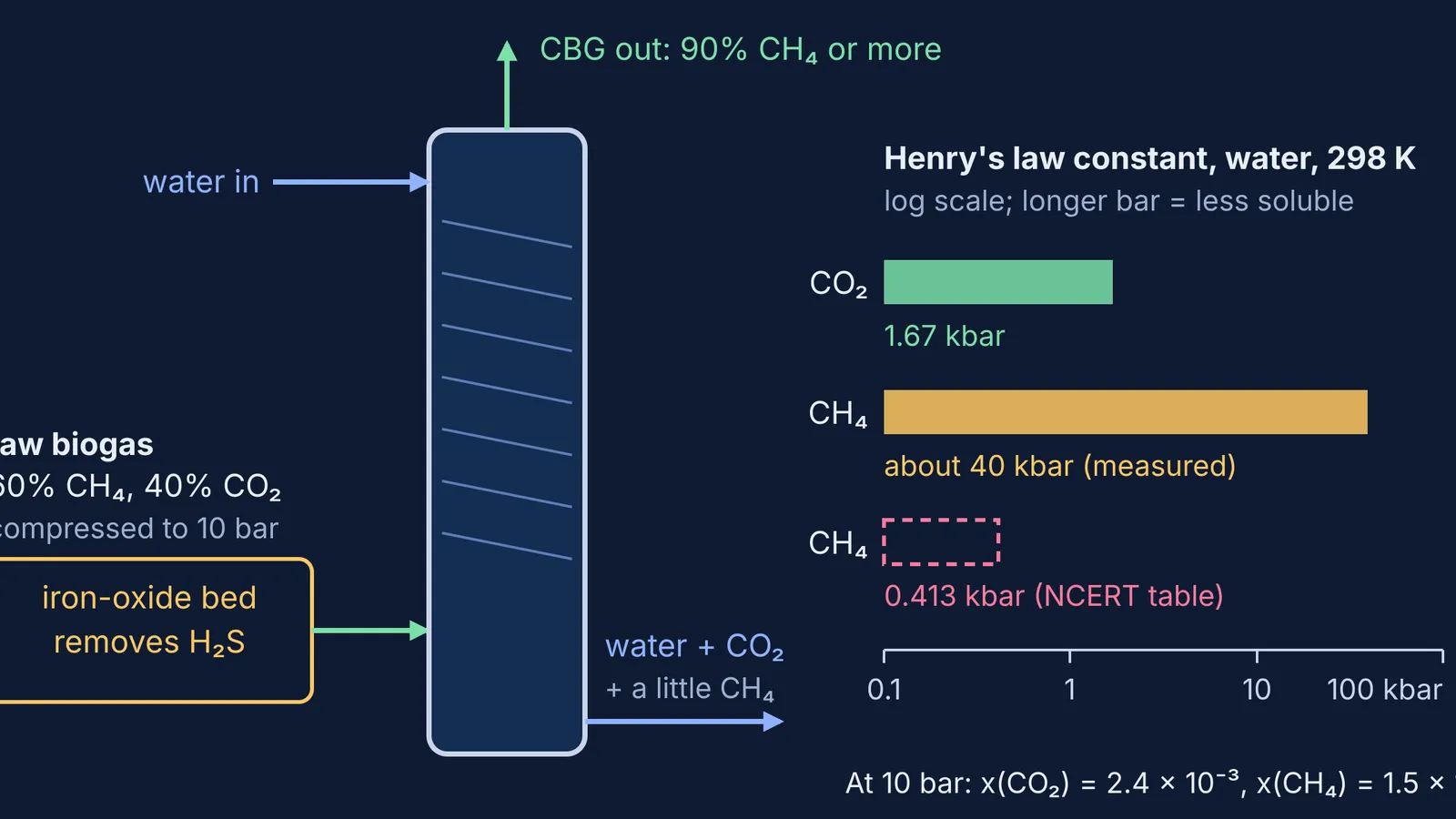
Raw biogas from a gobar gas plant is a mixture: roughly 55–65% methane, most of the rest carbon dioxide, with traces of hydrogen sulphide and water vapour. India's SATAT scheme pays for plants that clean biogas up into compressed biogas (CBG), which can replace CNG. The most common clean-up method is surprisingly simple: press the gas to about 10 bar and push it up a tall column against a stream of falling water. CO₂ dissolves; methane mostly does not. The reason is one line of Class 12 chemistry, Henry's law.
What are SATAT and CBG?
SATAT (Sustainable Alternative Towards Affordable Transportation) was launched by the Ministry of Petroleum and Natural Gas on 1 October 2018. It set a target of 15 million tonnes of CBG a year from 5,000 plants by 2023 (PIB, 2021). That target was a plan, not a result: far fewer plants were running by then. In November 2023 the government also announced a CBG blending obligation for city gas companies, voluntary until 2024-25 and then mandatory, starting at 1% of CNG and piped-gas use in 2025-26 and rising in steps after that.
CBG sold for vehicles must meet the Bureau of Indian Standards specification IS 16087. Its 2016 edition requires at least 90% methane, and a 2025 revision has since been issued, so check the current text for the exact limits.
How does a water scrubber separate CO₂ from methane?
Henry's law, in NCERT's form, is p = K_H × x. Here p is the gas's partial pressure, x its mole fraction in the water, and K_H the Henry's law constant. Rearranged, x = p ÷ K_H, so the smaller K_H is, the more soluble the gas. For a refresher, see Henry's law and the solubility of gases.
At 298 K, K_H for CO₂ is about 1.67 kbar (NCERT's table gives this value, and it matches handbook data). For methane, measured solubility gives a K_H of about 40 kbar. So CO₂ is roughly 24 times more soluble than methane at the same partial pressure.
Raising the total pressure raises each partial pressure (Dalton's law), so more of each gas dissolves, but the water still carries away mostly CO₂. The same idea, two gases with different K_H sharing one water sample, explains why air dissolved in water is richer in oxygen.
Is NCERT's Henry's law constant for methane wrong?
It appears to be. NCERT's Table 1.2 (Class 12, Solutions) lists methane at 298 K as 0.413 kbar. That would make methane about four times more soluble than CO₂, which is not what measurements show.
The Sander compilation of Henry's law constants, which collects values from many measurements and reviews, gives methane a solubility constant of about 1.4 × 10⁻⁵ mol m⁻³ Pa⁻¹ at 298 K. That is 1.4 × 10⁻³ mol L⁻¹ at 1 bar. Divide by about 55.3 mol of water per litre: x ≈ 2.5 × 10⁻⁵ at 1 bar, so K_H = 1 ÷ (2.5 × 10⁻⁵) bar ≈ 40 kbar. The same compilation gives about 3.3 × 10⁻⁴ for CO₂, which works out to 1.68 kbar and agrees with NCERT.
Two checks support the larger value. Argon, in the same NCERT table at 40.3 kbar, has almost exactly the same measured solubility as methane in the compilation. And 41.3 kbar, the table's number with the decimal point moved two places, would fit the data well. We cannot say how the slip happened; for real calculations use about 40 kbar. For an exam question that gives you 0.413 kbar, use the value printed in the question.
Worked example: how much water does a scrubber need?
Take raw biogas that is 60% CH₄ and 40% CO₂ by volume, ignoring H₂S and water vapour. For gases, volume % equals mole %. The scrubber works at 10 bar and 25 °C. Use K_H(CO₂) = 1.67 kbar and K_H(CH₄) = 40 kbar.
Partial pressures. p(CO₂) = 0.40 × 10 = 4 bar. p(CH₄) = 0.60 × 10 = 6 bar.
Mole fractions in the water. x(CO₂) = 4 ÷ 1670 = 2.4 × 10⁻³. x(CH₄) = 6 ÷ 40,000 = 1.5 × 10⁻⁴.
Per kg of water. One kg of water is 1000 ÷ 18.02 = 55.5 mol. Dissolved CO₂ ≈ 55.5 × 2.4 × 10⁻³ = 0.133 mol. Dissolved CH₄ ≈ 55.5 × 1.5 × 10⁻⁴ = 0.0083 mol.
Moles in 100 m³ of raw gas. At 25 °C and 1 bar, one mole of gas takes about 24.8 L. So 100,000 ÷ 24.8 = 4,034 mol in total: 1,614 mol CO₂ and 2,420 mol CH₄.
Water needed. To take up all the CO₂: 1,614 ÷ 0.133 ≈ 12,100 kg, about 12 tonnes of water.
Methane lost. That water also dissolves 12,100 × 0.0083 ≈ 100 mol CH₄, about 4% of the methane.
This is an idealised, one-stage estimate. Real columns are counter-current, and plants depressurise the used water in a flash tank, send the released gas (rich in methane) back to the compressor, and then strip the CO₂ with air so the water can be reused.
Now redo step 3 with NCERT's 0.413 kbar. x(CH₄) = 6 ÷ 413 = 0.0145, or about 0.82 mol per kg of water. The 12 tonnes of water would then "dissolve" about 9,900 mol of methane, four times more than the 2,420 mol in the gas. The scrubber would remove methane, not CO₂. Real scrubbers work, so the table value cannot be right.
What does upgrading gain? Taking methane's heat of combustion as about 802 kJ/mol (water as vapour), raw gas at 60% methane gives about 0.60 × 802 ÷ 24.8 ≈ 19 MJ per m³ at 25 °C and 1 bar. Gas at 95% methane gives about 31 MJ per m³, much closer to natural gas. Our post on why CNG is a cleaner fuel explains what happens when that methane burns.
How is H₂S removed before scrubbing?
H₂S is toxic and corrodes engines and steel, so it is usually removed first, often on a bed of iron oxide. The reaction is usually written as Fe₂O₃ + 3H₂S → Fe₂S₃ + 3H₂O. This step is not redox: iron stays +3 and sulphur stays −2. The bed is then regenerated in air, 2Fe₂S₃ + 3O₂ → 2Fe₂O₃ + 6S, which is redox: sulphur goes from −2 to 0 and oxygen from 0 to −2. Real beds form mixtures of iron sulphides.
H₂S content varies a lot between plants. As an illustration, take a plant making 500 m³ of biogas a day with 0.2% H₂S: that is 1 m³, or 1,000 ÷ 24.8 = 40.3 mol, which is 40.3 × 34.08 g ≈ 1.37 kg of H₂S a day. It needs 40.3 ÷ 3 = 13.4 mol of Fe₂O₃, about 2.15 kg a day, before regeneration. H₂S is poisonous even at low levels, so none of this belongs in a home experiment. To practise Henry's law problems like these step by step, try the Fermi Problem Library, a step-by-step solver that explains the reasoning.
Quick checklist
Henry's law: x = p ÷ K_H, so a larger K_H means a less soluble gas.
K_H at 298 K: CO₂ about 1.67 kbar, CH₄ about 40 kbar, so CO₂ is about 24 times more soluble.
NCERT's 0.413 kbar for methane disagrees with measured data by about a factor of 100.
At 10 bar, about 12 t of water scrubs 100 m³ of 60 : 40 biogas, losing about 4% of the methane before recycling.


