On this page
A line crosses a circle in at most two points; two ellipses can cross in four. One rule, Bézout's theorem, explains both and tells you how many solutions to expect before you solve.
What does Bézout's theorem say?
The degree of a curve is the highest total power in its equation: a line has degree 1, every conic (circle, parabola, ellipse, hyperbola) has degree 2, and y = x³ has degree 3. MathWorld states the theorem simply: in general, two algebraic curves of degrees m and n intersect in m·n points and cannot meet in more unless they share a component (Wolfram MathWorld).
The careful version adds the fine print. The curves must have no common component, and the m·n points are counted with multiplicity, including points at infinity and points with complex coordinates (Wikipedia: Bézout's theorem). The same article records that Isaac Newton essentially stated the result for plane curves (as early as 1665, and in his proof of Lemma 28 in the Principia of 1687), that Étienne Bézout published the general theorem in 1779 in Théorie générale des équations algébriques, and that Jean-Pierre Serre gave a purely algebraic definition of multiplicity only in 1958.
How many points do a line and a conic meet in?
Bézout predicts 1 × 2 = 2. Take the circle x² + y² = 25 and work through three lines.
Line y = x + 1. Substitute: x² + (x + 1)² = 25, so x² + x − 12 = 0 and x = 3 or x = −4. Two real points: (3, 4) and (−4, −3).
Line y = 5. Substitute: x² = 0, a repeated root at x = 0. The line touches the circle at (0, 5), and a tangent point counts twice. That is multiplicity, and it is the same idea as a double root of a quadratic.
Line y = 6. Substitute: x² = −11, so x = ±i√11. Two points, both with complex coordinates. The line misses the circle on paper but still meets it in the algebra.
Each time the quadratic has exactly two roots, counted properly, which is why JEE tangency questions come down to a zero discriminant. Our post on the condition for two curves to touch works through that test, and complex roots of a quadratic with no x-intercept shows what the case y = 6 looks like on a graph.
Why do two conics meet in four points?
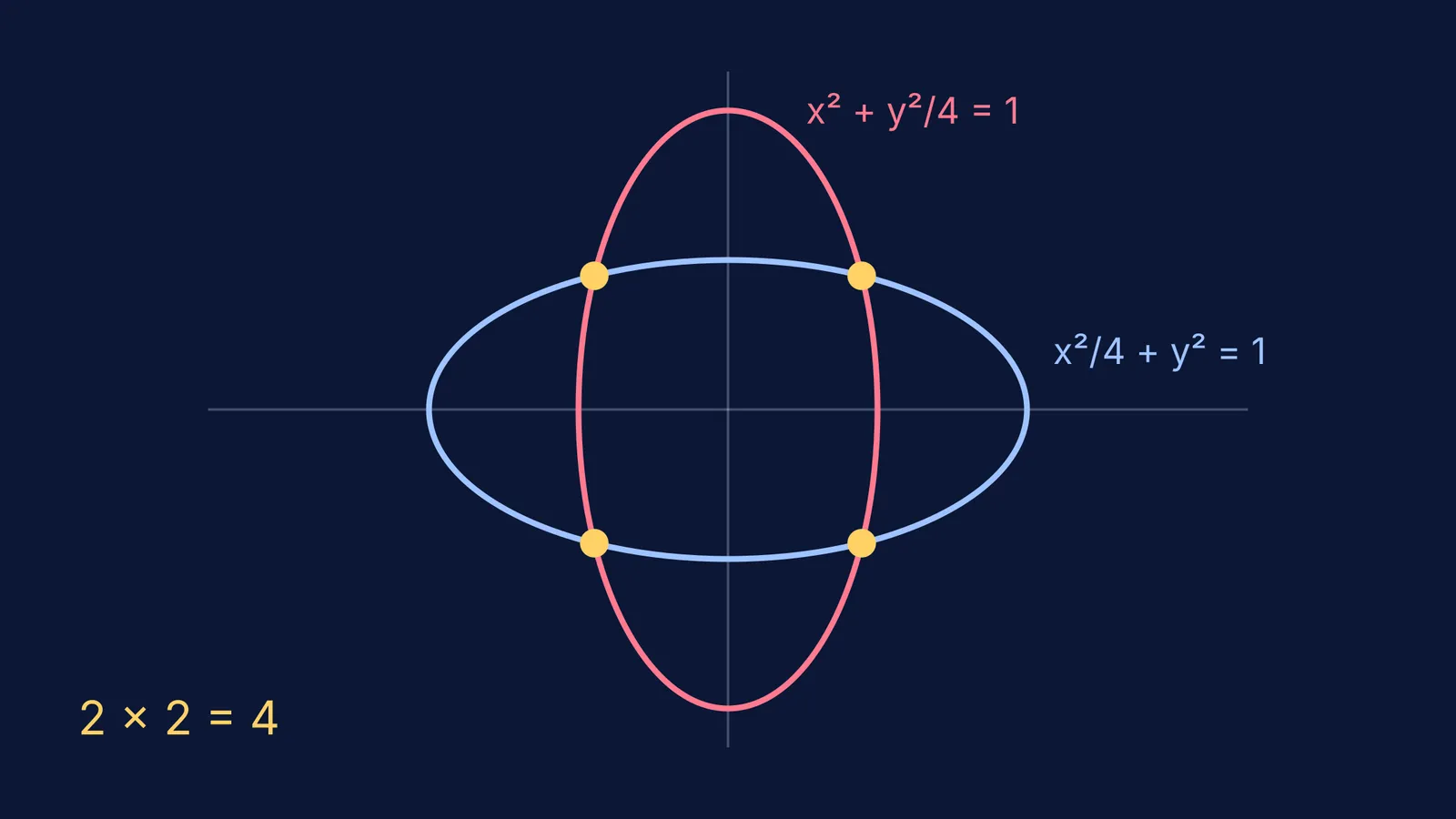
For two conics Bézout predicts 2 × 2 = 4. The ellipses x²/4 + y² = 1 and x² + y²/4 = 1 in the picture above show all four. Subtracting one equation from the other gives x² = y², and substituting back gives x² = 4/5, so the meeting points are (±2/√5, ±2/√5), four in all.
Two conic sections generally meet in four points, some of which may coincide (Wikipedia: Bézout's theorem), so a quartic from two conic equations is expected, not a mistake.
Where are the missing points when curves meet less often?
Two circles never cross in more than two real points, yet Bézout predicts four. The two missing points sit at infinity and have complex coordinates.
To see points at infinity, write each point as (x : y : z), with ordinary points having z = 1 and points at infinity having z = 0. The parallel lines x + y = 1 and x + y = 3 become x + y = z and x + y = 3z. Subtracting gives z = 0, so they meet at the single point at infinity (1 : −1 : 0), as 1 × 1 = 1 requires.
Every circle passes through the same two circular points at infinity, (1 : i : 0) and (1 : −i : 0) (Wikipedia: circular points at infinity). Those are the two extra points for any pair of circles. For concentric circles x² + y² = z² and x² + y² = 4z², subtracting gives 3z² = 0, so all the meeting happens at infinity at those two points, each counted twice: still 4.
How can you use Bézout's theorem in an exam?
Use it as a check before and after you solve.
Before solving, multiply the degrees. That is the most real meeting points you can get, so a line and a parabola can never meet in three.
If you find fewer real points, look for a repeated root first (a tangent), then a negative discriminant (complex points).
If the leading terms cancel when you subtract, as with parallel lines or two circles, some points have gone to infinity.
If everything cancels, the curves share a component and the count is infinite.
If multiplicity or points at infinity still feel hazy, the Fermi Concept Library covers every concept in mathematics, and the Fermi Problem Library has a step-by-step solver that explains the reasoning. For the one-variable version of the same idea, read our post on the fundamental theorem of algebra.