On this page
A common tangents-and-normals question gives two curves with an unknown constant and asks for the value that makes them touch. A common slip is to set the slopes equal and stop. Here is the full condition, and one problem solved two ways so each method checks the other.
What does it mean for two curves to touch each other?
Two curves are tangent at a point P if both contain P and they share the same tangent line at P (Wolfram MathWorld, Tangent Curves). Wikipedia agrees: two curves are tangent at a point if they have the same tangent there, and orthogonal if their tangents are perpendicular (Wikipedia, Tangent).
For y = f(x), the tangent at x = a passes through (a, f(a)) with slope f'(a) (OpenStax Calculus Volume 1, section 3.1). A line is fixed by a point and a slope, so y = f(x) and y = g(x) touch at x = a when:
f(a) = g(a), so they share the point.
f'(a) = g'(a), so they share the slope there.
If the slopes at a meeting point are negative reciprocals, the curves cut orthogonally; otherwise you find the angle between two curves from the two tangents.
How do you find k so that y = x² + k touches y = 2x?
Method 1: equal slopes, then a common point.
Slopes: for y = x² + k, dy/dx = 2x. For y = 2x, dy/dx = 2.
Set them equal: 2x = 2, so x = 1. Any contact must happen at x = 1.
Common point: at x = 1 the line gives y = 2 and the parabola gives y = 1 + k.
Set these equal: 1 + k = 2, so k = 1.
The curves touch at (1, 2). The slope condition found where contact could happen; only the point condition fixed k.
Method 2: the discriminant.
Where the curves meet, their y values are equal: x² + k = 2x, which rearranges to x² − 2x + k = 0.
A quadratic with discriminant zero has exactly one real root, and that root is repeated (Brilliant, Quadratic Discriminant). A repeated root means two meeting points have merged into one: touching, in algebra.
Here a = 1, b = −2 and c = k, so the discriminant is b² − 4ac = 4 − 4k. Setting 4 − 4k = 0 gives k = 1. The equation becomes x² − 2x + 1 = 0, that is (x − 1)² = 0, so x = 1 twice and y = 2. Both methods agree on k = 1 and the point (1, 2).
What happens when k is not 1?
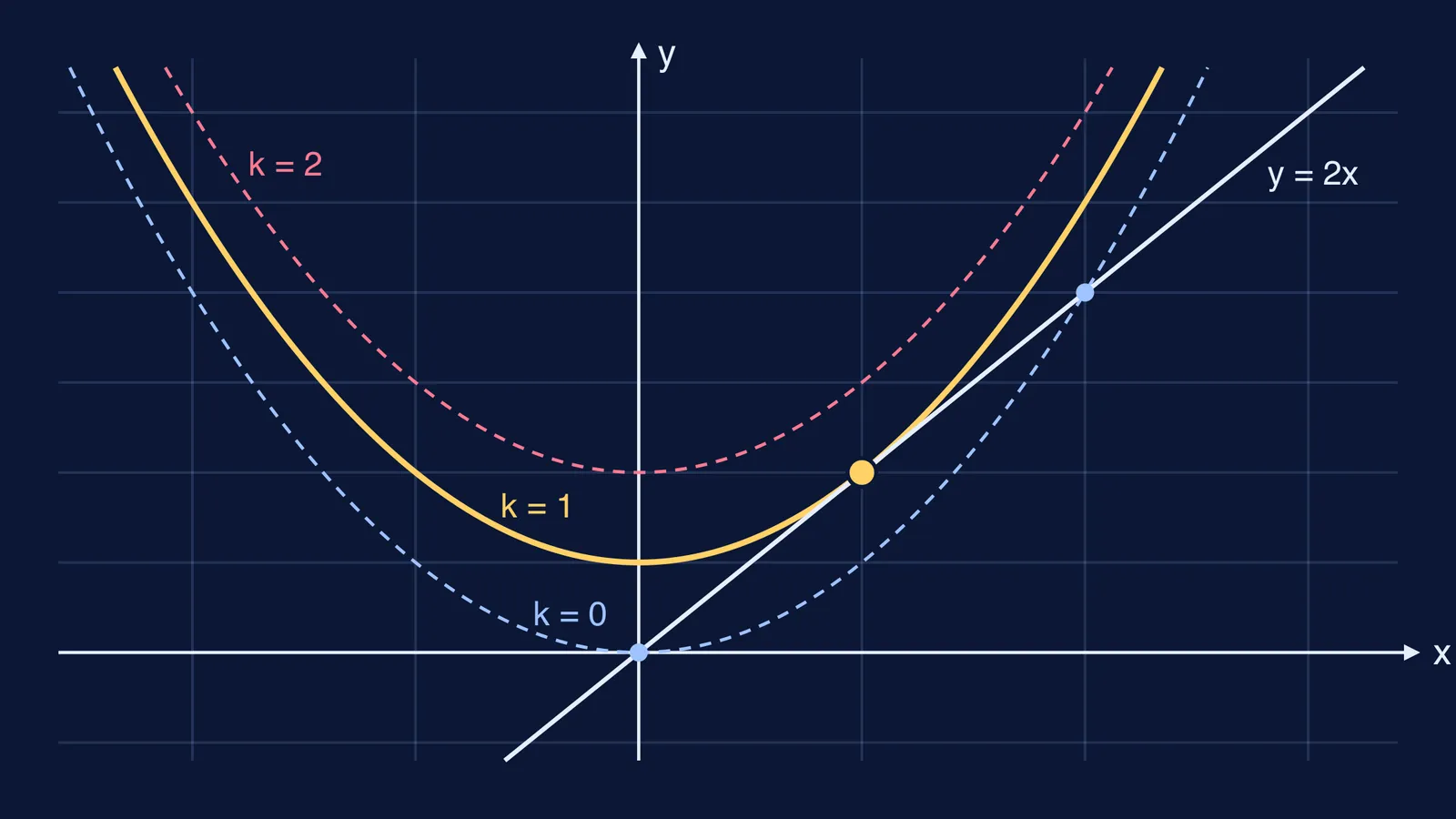
The discriminant 4 − 4k sorts every case, as the diagram above shows.
k less than 1: the discriminant is positive, so the line cuts the parabola at two points. For k = 0, x² − 2x = 0 gives x = 0 and x = 2, the points (0, 0) and (2, 4).
k = 1: the discriminant is zero, so the line touches the parabola at (1, 2).
k greater than 1: the discriminant is negative, so the curves never meet. For k = 2, x² − 2x + 2 = 0 has discriminant −4.
This also exposes the slopes-only trap. Take k = 3. The slopes still match at x = 1, but the parabola is at (1, 4) and the line at (1, 2). Parallel tangents, no contact.
Which method should you use in an exam?
Use the discriminant when eliminating y leaves a quadratic, as it does for a line and a parabola or a line and a circle. The same idea sits behind the shortcut for a tangent to a parabola in slope form.
Use equal slopes plus a common point for everything else, such as two parabolas or a cubic and a line. It works for any pair of differentiable curves and gives the contact point directly.
Two cautions keep the discriminant honest:
One meeting point is not always touching. The vertical line x = 3 meets y = x² + k once but crosses it; elimination gives no quadratic at all.
A line can touch a cubic at one point and cross it at another, so look for a repeated root, not "only one root".
A short routine for any "find k so the curves touch" question:
Write both derivatives.
Set them equal and solve for x.
Put that x into both equations and set the y values equal to find k.
If eliminating y gives a quadratic, confirm with the discriminant.
Substitute k back and check that the y values and slopes match at the contact point.
If you keep landing on a wrong k, the Fermi Problem Library has worked problems with a step-by-step solver that explains the reasoning rather than printing an answer, so you can see which condition you skipped. If the idea of a tangent line itself feels shaky, the Fermi Concept Library gives it its own lesson and its place in the map.