

On this page
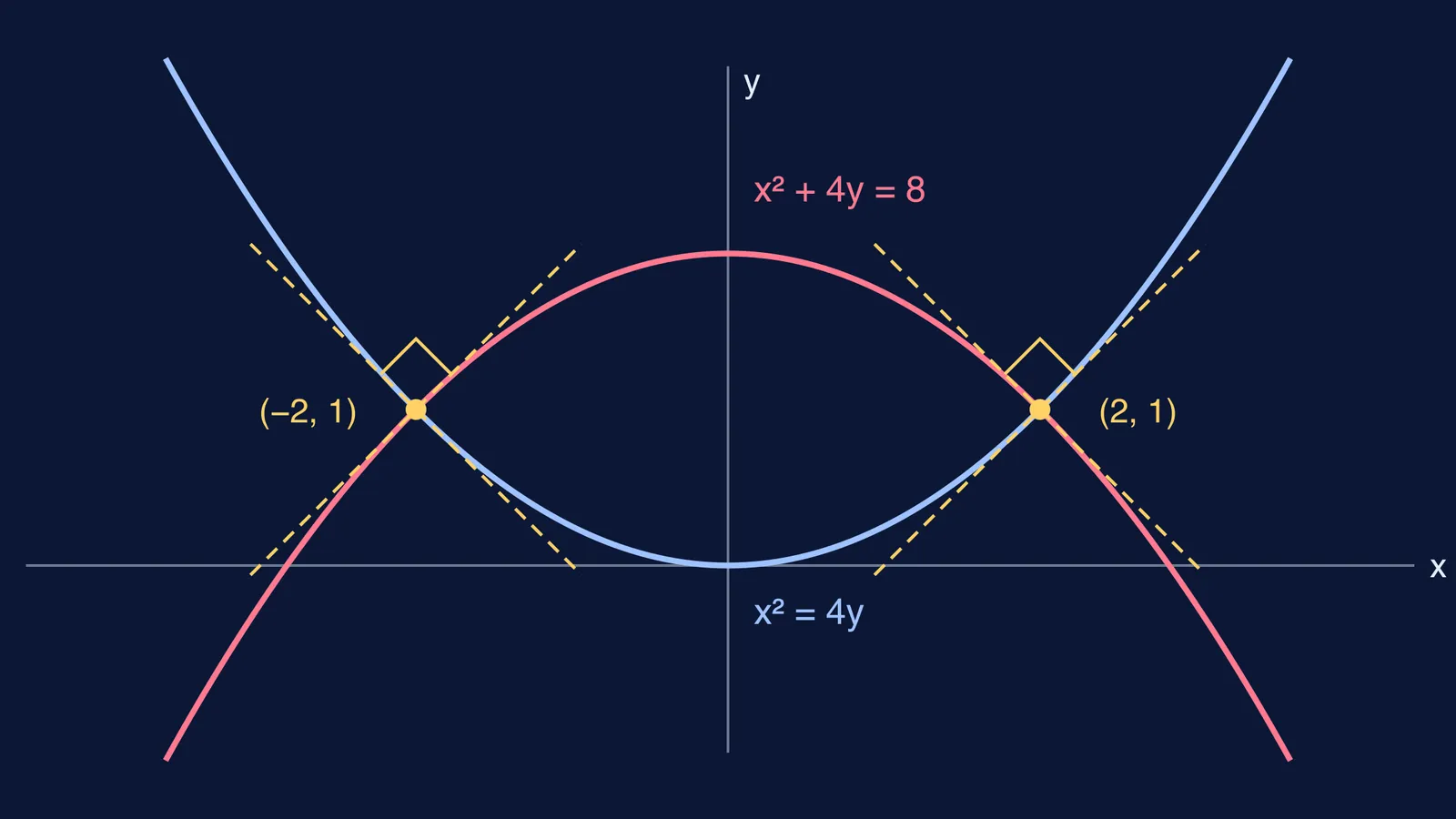
"Show that the curves cut orthogonally" is a four-step proof: find where the curves meet, find each tangent's slope there, multiply, and check that you get −1. The usual slips are skipping a meeting point and missing a vertical tangent, so we cover both, using the pair x² = 4y and x² + 4y = 8.
What does it mean for two curves to cut orthogonally?
Two intersecting curves are orthogonal when they are perpendicular at their intersection (Wolfram MathWorld). A curve bends, so "perpendicular" here means the tangent lines at the meeting point are perpendicular.
That turns a curve question into a line question. NCERT's Class 11 chapter on straight lines proves that two non-vertical lines are perpendicular if and only if their slopes satisfy m₁m₂ = −1 (NCERT Class 11 Mathematics, Chapter 9). For the reasoning behind that rule, see our explainer on why the product of slopes of perpendicular lines is −1.
How do you show two curves cut orthogonally?
Solve the two equations together to get every point of intersection.
Differentiate each curve to get dy/dx; implicit differentiation is fine.
Put each intersection point into both derivatives to get m₁ and m₂ at that point.
Show that m₁m₂ = −1 at every point. If a tangent is vertical, use the check in the next section instead.
Does x² = 4y cut x² + 4y = 8 orthogonally?
Step 1: intersection. Substitute 4y = x² into the second equation: x² + x² = 8, so x = 2 or x = −2, and y = x²/4 = 1. The curves meet at (2, 1) and (−2, 1).
Step 2: slopes. For x² = 4y, differentiate both sides: 2x = 4 dy/dx, so m₁ = x/2. For x² + 4y = 8: 2x + 4 dy/dx = 0, so m₂ = −x/2.
Step 3: at (2, 1). m₁ = 1 and m₂ = −1, so m₁m₂ = −1.
Step 4: at (−2, 1). m₁ = −1 and m₂ = 1, so m₁m₂ = −1 again.
The tangents are perpendicular at both meeting points, so the curves cut orthogonally. Steps 3 and 4 also fit in one line: m₁m₂ = (x/2)(−x/2) = −x²/4 = −1, since x² = 4 at both points.
What if one tangent is vertical?
The m₁m₂ = −1 rule is only for non-vertical lines. A vertical tangent has no slope, so there is no product to form, yet the curves can still meet at a right angle.
Take y² = 4x and x² = 4y. Substituting y = x²/4 into the first gives x⁴/16 = 4x, so x = 0 or x = 4, and the curves meet at (0, 0) and (4, 4).
At (0, 0): for y² = 4x, dy/dx = 2/y breaks down at y = 0, so flip it: dx/dy = y/2 = 0, and the tangent is the vertical line x = 0. For x² = 4y, dy/dx = x/2 = 0, so the tangent is the horizontal line y = 0. Vertical meets horizontal: orthogonal at the origin.
At (4, 4): the slopes are 2/4 = 1/2 and 4/2 = 2, so m₁m₂ = 1, not −1. With tan θ = |(m₁ − m₂)/(1 + m₁m₂)|, tan θ = (3/2)/2 = 3/4, so the curves cross at about 37° here.
So this pair is orthogonal at one point only, and "the curves cut orthogonally" would be false for it. For the tan θ step, see the tan θ formula for the angle between two lines.
Try it yourself: x = y² and xy = k
Show that these curves cut at right angles when 8k² = 1. Hint: they meet where y³ = k, with slopes 1/(2y) and −y/x. Set the product to −1 and replace x with y² to get y² = 1/2; then k² = y⁶ = 1/8.
If your slope comes out wrong, the Fermi Problem Library has worked problems with a step-by-step solver that explains the reasoning rather than printing an answer, so you can see where your line went off.
Is this still on the JEE syllabus?
The 2026-27 reprint of NCERT's Class 12 chapter Application of Derivatives goes straight from rate of change (section 6.2) to increasing and decreasing functions (section 6.3), with no section on tangents and normals (NCERT Class 12 Mathematics Part I, Chapter 6). The JEE Main 2026 syllabus lists the applications of derivatives as rate of change, increasing and decreasing functions, and maxima and minima (NTA, Syllabus for JEE (Main) 2026). The JEE Advanced 2026 syllabus does list "Tangents and normals" and derivatives of implicit functions under differential calculus (JEE (Advanced) 2026 syllabus).
So if JEE Advanced is your target, keep this method ready; the same slope idea drives finding orthogonal trajectories of a family of curves. Syllabi can change, so confirm with the official syllabus for your exam year.
If a tangent's slope as dy/dx still feels shaky, start with the derivative lesson in the Fermi Concept Library, then run the four steps on x² = 4y and x² + 4y = 8 without looking.


