

On this page
Curves don't have one fixed direction, so how can two of them meet at an angle? You zoom in on the point where they cross. Close up, each curve looks like its tangent line, so you measure the angle between those two lines. You only need three things for that: the meeting point, the two slopes there, and one formula from Class 11.
What is the angle between two curves?
The angle between two intersecting curves is defined as the angle between their tangents at the point of intersection (Wikipedia: Angle).
The slope of a tangent comes from the derivative. The NCERT Class 12 chapter Application of Derivatives says the derivative can be used to find the equations of the tangent and normal to a curve at a point. Once you have the two slopes, the curve problem turns into a straight-line problem.
The NCERT Class 11 chapter Straight Lines (section 9.2.3) gives the acute angle θ between two lines with slopes m₁ and m₂ as tan θ = |(m₂ − m₁)/(1 + m₁m₂)|, valid when 1 + m₁m₂ ≠ 0. The same chapter gives the obtuse angle as 180° − θ, and says two non-vertical lines are perpendicular exactly when m₁m₂ = −1.
How do you find the angle between two curves, step by step?
Solve the two equations together to find every point where the curves meet.
Differentiate each curve to get dy/dx.
Put each intersection point into both derivatives to get m₁ and m₂ at that point.
Work out tan θ = |(m₁ − m₂)/(1 + m₁m₂)|, then θ = tan⁻¹ of that value.
Because of the absolute value, it doesn't matter which curve you call the first one. You get the same acute angle either way.
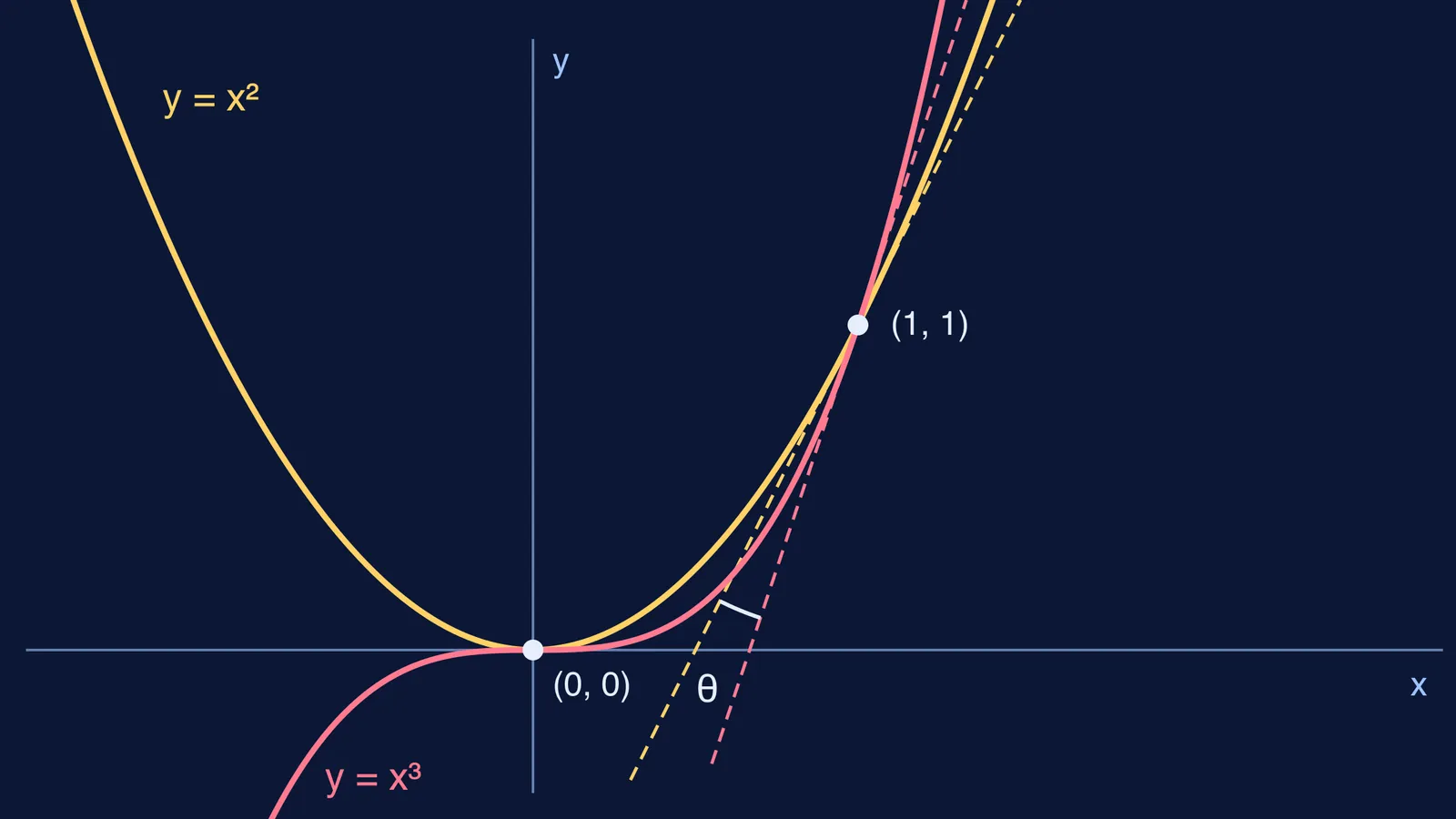
Worked example: what is the angle between y = x² and y = x³?
Step 1: Find where they meet. Set x² = x³. Rearranging gives x³ − x² = 0, so x²(x − 1) = 0 and x = 0 or x = 1. The intersection points are (0, 0) and (1, 1).
Step 2: Differentiate. For y = x², dy/dx = 2x. For y = x³, dy/dx = 3x².
Step 3: At (0, 0). m₁ = 2(0) = 0 and m₂ = 3(0)² = 0. Then tan θ = |0/1| = 0, so θ = 0°. Both curves have the x-axis as their tangent here. They touch rather than cross at an angle.
Step 4: At (1, 1). m₁ = 2(1) = 2 and m₂ = 3(1)² = 3. So tan θ = |(2 − 3)/(1 + 2 × 3)| = |−1/7| = 1/7.
Answer: At (1, 1), θ = tan⁻¹(1/7), which is about 8.1° (about 0.142 radians). At (0, 0), the angle is 0°.
What if 1 + m₁m₂ = 0 or a tangent is vertical?
The formula has two blind spots. Check for them before you start working it out.
1 + m₁m₂ = 0: the denominator is zero. This is the perpendicular condition from the NCERT Straight Lines chapter linked above, so the curves meet at 90°. Curves like this are said to cut orthogonally.
A vertical tangent: that slope is undefined, so the formula can't be used. Work with inclinations instead. If the other tangent makes an acute angle α with the x-axis, the acute angle between the two tangents is 90° − α. If both tangents are vertical, the angle is 0°.
Equal slopes: tan θ = 0, so the curves touch at that point, as y = x² and y = x³ do at the origin.
Which mistakes should you check for?
Dividing x² = x³ by x² and losing the root x = 0. Factorise instead.
Using dy/dx as a formula without substituting the point.
Forgetting the absolute value and then reporting a negative or obtuse angle when the question asked for the acute one.
Stopping at tan θ = 1/7 when the question asks for θ. Write θ = tan⁻¹(1/7).
Mixing degrees and radians in the final line.
If you followed the steps and still got a different answer, the Fermi Problem Library has worked problems with a step-by-step solver that explains the reasoning rather than printing an answer, so you can find the exact step where yours went wrong.
Try one yourself
Find the angle between y = x² and x = y² at each point where they meet. Work it out before reading on.
If the slope of a tangent still feels like a rule you're following blindly, go back to the idea behind it first. The Fermi Concept Library covers every concept in mathematics, each with its own lesson, so you can rebuild derivatives and slopes before taking on the next set of tangent problems.


