

On this page
These eight original JEE Main-style questions follow our first atoms and nuclei JEE Main practice set and test what it skipped: isotones, nuclear force, Bohr's frequency rule, series wavelengths, de Broglie waves, the orbit as a current loop and fusion.
Unit 18 of the NTA Syllabus for JEE (Main) - 2027 covers the Bohr model, the hydrogen spectrum, composition and size of the nucleus, mass defect, binding energy, fission and fusion, but not radioactive decay law. The rationalised NCERT Chapter 13, Nuclei (Reprint 2026-27) treats decay only qualitatively, so nothing here uses decay law or half-life.
How should you use this practice set?
Give yourself 16 minutes for all eight, solutions covered.
Q5 is numerical-value: write an integer, no options.
For each miss, write the trap in your own words.
New to the chapter? Start with how to prepare atoms and nuclei for JEE Main first.
From NCERT Chapter 12, Atoms: En = −13.6/n² eV, rn ∝ n², and the photon frequency is set by hν = Ei − Ef. Where a question needs it, take h = 4.136 × 10⁻¹⁵ eV s, from the NIST value of the Planck constant in eV.
Easy: do you know the definitions?
Q1 (easy). Which pair of nuclides are isotones?
(A) ¹²C and ¹⁴N (B) ³¹P and ³²S (C) ³⁵Cl and ³⁷Cl (D) ⁴⁰Ar and ⁴⁰Ca
Answer: (B). Isotones share N = A − Z: phosphorus-31 has 31 − 15 = 16 neutrons and sulphur-32 has 32 − 16 = 16. Trap: (D) has the same A, which makes them isobars; (C) are isotopes.
Q2 (easy). Statement I: inside a nucleus, the nuclear force between two protons is strong enough to outweigh their Coulomb repulsion. Statement II: the nuclear force between two nucleons stays attractive however close they come.
(A) Both statements are true (B) I is true, II is false (C) I is false, II is true (D) Both are false
Answer: (B). NCERT section 13.5: the nuclear force is much stronger than the Coulomb force, but below about 0.8 fm it turns strongly repulsive. Trap: (A).
Q3 (easy). According to Bohr's model, the frequency of the light emitted when a hydrogen atom drops from n = 2 to n = 1 is
(A) the revolution frequency in the n = 2 orbit, 8.2 × 10¹⁴ Hz (B) the revolution frequency in the n = 1 orbit, 6.6 × 10¹⁵ Hz (C) (E2 − E1)/h, 2.5 × 10¹⁵ Hz (D) the average of the two revolution frequencies, 3.7 × 10¹⁵ Hz
Answer: (C). By Bohr's third postulate, ν = (−3.4 + 13.6)/(4.136 × 10⁻¹⁵) ≈ 2.47 × 10¹⁵ Hz. NCERT stresses that the revolution frequency is not connected to the spectral-line frequency. Trap: (A), the classical expectation.
Medium: can you compare orbits and lines?
Q4 (medium). Lines ending on n = 1 form the Lyman series; lines ending on n = 2 form the Balmer series. The ratio of the longest Lyman wavelength to the longest Balmer wavelength is
(A) 5/27 (B) 27/5 (C) 1/4 (D) 5/36
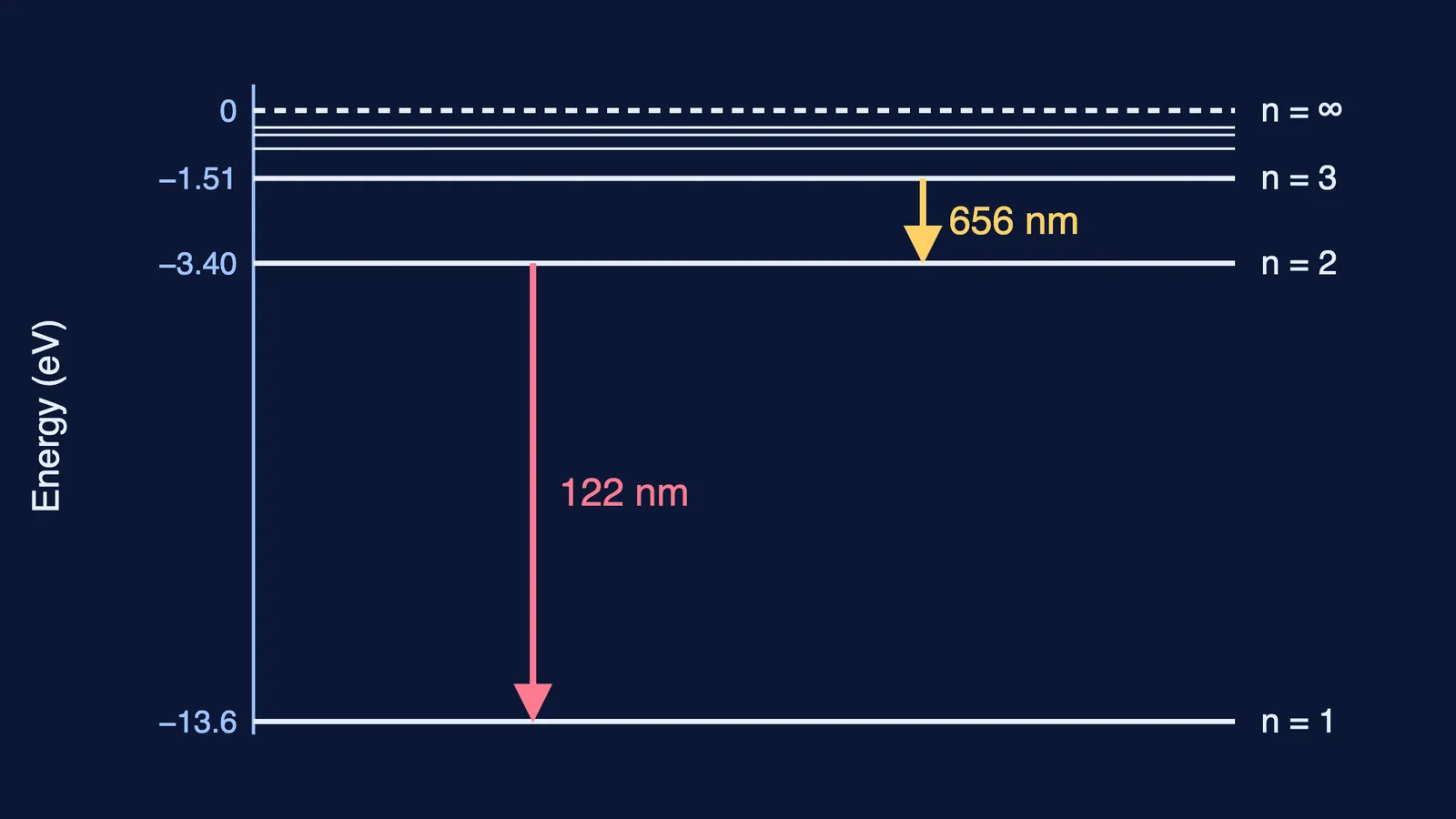
Answer: (A). The longest wavelength comes from the smallest jump: 2 → 1 gives 13.6(1 − 1/4) = 10.2 eV, and 3 → 2 gives 13.6(1/4 − 1/9) = 1.89 eV. Since λ ∝ 1/ΔE, the ratio is 1.89/10.2 = 5/27 (122 nm to 656 nm). Trap: (C) is the ratio of the series limits, the shortest wavelengths.
Q5 (medium, numerical). In the Bohr model, how many times larger is the electron's frequency of revolution in the n = 1 orbit than in the n = 3 orbit?
Answer: 27. Speed goes as 1/n and radius as n², so f = v/2πr goes as 1/n³, giving 3³ = 27. Trap: answering 9, which uses the radius alone and forgets that the speed also falls.
Q6 (medium). Take the Bohr radius as 0.0529 nm. The de Broglie wavelength of the electron in the n = 3 orbit of hydrogen is about
(A) 0.33 nm (B) 1.0 nm (C) 3.0 nm (D) 0.11 nm
Answer: (B). NCERT's standing-wave condition is 2πrn = nλ, with rn = n²a0. So λ = 2πn a0 = 2π × 3 × 0.0529 ≈ 0.997 nm. Trap: (C) forgets to divide the circumference by n. For the derivation, see Bohr's quantisation from de Broglie waves.
Hard: can you chain two ideas?
Q7 (hard). Treating the orbiting electron as a current loop, the ratio of the magnetic field at the nucleus for n = 1 to that for n = 2 is
(A) 4 (B) 8 (C) 32 (D) 2
Answer: (C). The current is I = ef, with f ∝ 1/n³, and the field at the centre of a loop is B = μ0I/2r, with r ∝ n². So B ∝ n⁻⁵ and the ratio is 2⁵ = 32. Trap: (B) counts the fall in current but forgets that the loop also grows.
Q8 (hard). Consider the fusion reaction ²H + ⁶Li → 2 ⁴He. Atomic masses: ²H 2.014102 u, ⁶Li 6.015123 u, ⁴He 4.002603 u; 1 u = 931.5 MeV/c², N_A = 6.022 × 10²³ mol⁻¹, 1 MeV = 1.602 × 10⁻¹³ J. The energy released per gram of a fuel that is one ²H atom for each ⁶Li atom is about
(A) 2.7 × 10¹¹ J (B) 1.1 × 10¹² J (C) 4.5 × 10¹³ J (D) 2.7 × 10⁵ J
Answer: (A). Mass defect = 2.014102 + 6.015123 − 2(4.002603) = 0.024019 u, so Q ≈ 22.4 MeV per reaction. Electron masses cancel, four on each side. One gram of fuel holds 6.022 × 10²³/8.029 ≈ 7.50 × 10²² reaction pairs, giving 7.50 × 10²² × 22.4 × 1.602 × 10⁻¹³ ≈ 2.7 × 10¹¹ J. Trap: (B) divides by the deuterium mass alone. The masses match the AME2020 atomic mass evaluation; 2.7 × 10¹⁴ J per kilogram is the same order as NCERT's 10¹⁴ J for fission of 1 kg of uranium.
What should you do after this set?
Sort your misses: definitions (Q1 to Q3), scaling with n (Q4 to Q7) or mass-energy bookkeeping (Q8). Rework that kind for two days, then retry both sets.
If you keep choosing the right formula but the wrong method, the Fermi Problem Library has worked problems with a step-by-step solver that explains the reasoning rather than printing an answer.


