

On this page
Eight original atoms and nuclei numerical-value questions, easy to hard, each with an integer answer, a worked solution and the likely wrong number. New to the chapter? Read how to prepare atoms and nuclei for JEE Main.
How are numerical-value questions marked in JEE Main 2027?
The JEE (Main) 2027 information bulletin gives Physics 20 MCQs in Section A and 5 numerical-value questions in Section B. A correct Section B answer earns +4 and a wrong one −1. Answers are rounded off to the nearest integer, using the constants given in the question.
Every question fits Unit 18 of the JEE (Main) 2027 syllabus. Radioactivity is not listed, so nothing here uses decay law or half-life.
From NCERT Chapter 12, Atoms, a one-electron ion has En = −13.6Z²/n² eV and rn = n²a0/Z. From Chapter 13, Nuclei (Reprint 2026-27), R = R0A^(1/3) with R0 = 1.2 fm, and 1 u = 931.5 MeV/c². Take hc = 1240 eV nm, from the NIST Planck constant in eV, and e²/4πε0 = 1.44 MeV fm, the fine-structure constant times ħc. Masses below match the AME2020 atomic mass evaluation.
Easy: can you use the core formulas?
Q1 (easy). A nucleus has a radius 5/4 times that of copper-64. Taking R = R0A^(1/3), what is its mass number?
Answer: 125. A ∝ R³, so A = 64 × (5/4)³ = 64 × 125/64 = 125.
Trap: 80, which scales A linearly with the radius (64 × 5/4) and forgets the cube.
Q2 (easy). In a Be³⁺ ion (Z = 4), the electron's kinetic energy is 3.40 eV. Its orbit radius is how many times the Bohr radius a0?
Answer: 16. In a Bohr orbit the kinetic energy equals |En| = 13.6Z²/n², so n² = 13.6 × 16/3.40 = 64 and n = 8. Then rn = n²a0/Z = 64a0/4 = 16a0.
Trap: 64, which uses the hydrogen formula rn = n²a0 and drops the 1/Z.
Q3 (easy). What is the minimum energy, in eV to the nearest integer, needed to excite a Li²⁺ ion (Z = 3) from its ground state to its first excited state?
Answer: 92. ΔE = 13.6 × 3² × (1 − 1/4) = 13.6 × 9 × 0.75 = 91.8 eV, so 92.
Trap: 31, which scales by Z instead of Z².
Medium: can you track sizes, masses and charges?
Q4 (medium). Taking R0 = 1.2 fm and the mass of a nucleon as 1.66 × 10⁻²⁷ kg, what is the radius of a sphere of nuclear matter of mass 1.0 kg, in nanometres, to the nearest integer?
Answer: 1013. The sphere holds A = 1.0/(1.66 × 10⁻²⁷) = 6.02 × 10²⁶ nucleons, so R = R0A^(1/3) = 1.2 × 10⁻¹⁵ × 8.446 × 10⁸ m = 1.013 × 10⁻⁶ m, or 1013 nm.
Trap: 1634, which finds the density with the 4π/3 and then drops it when solving R³ = M/ρ.
Q5 (medium). Atomic masses: ¹²C 12.000000 u, ¹³C 13.003355 u, neutron 1.008665 u; 1 u = 931.5 MeV/c². The energy needed to remove one neutron from a carbon-13 nucleus is x × 10⁻² MeV. Find x to the nearest integer.
Answer: 495. ¹³C → ¹²C + n. Mass defect = 12.000000 + 1.008665 − 13.003355 = 0.005310 u, and 0.005310 × 931.5 = 4.946 MeV, so x = 494.6 ≈ 495.
Trap: 747, carbon-13's average binding energy per nucleon (7.47 MeV in AME2020), not the cost of the last neutron.
Q6 (medium). Just after fission, two fragments, Z = 56, A = 141 and Z = 36, A = 92, are at rest as touching spheres with R = R0A^(1/3), R0 = 1.2 fm. Taking e²/4πε0 = 1.44 MeV fm, what is their Coulomb potential energy, in MeV, to the nearest integer?
Answer: 249. The centres are d = 1.2(5.205 + 4.514) = 11.66 fm apart. U = 1.44 × 56 × 36/11.66 = 2903/11.66 = 248.9 MeV.
Trap: 465, which uses only the larger fragment's radius as the separation.
Hard: can you chain two steps?
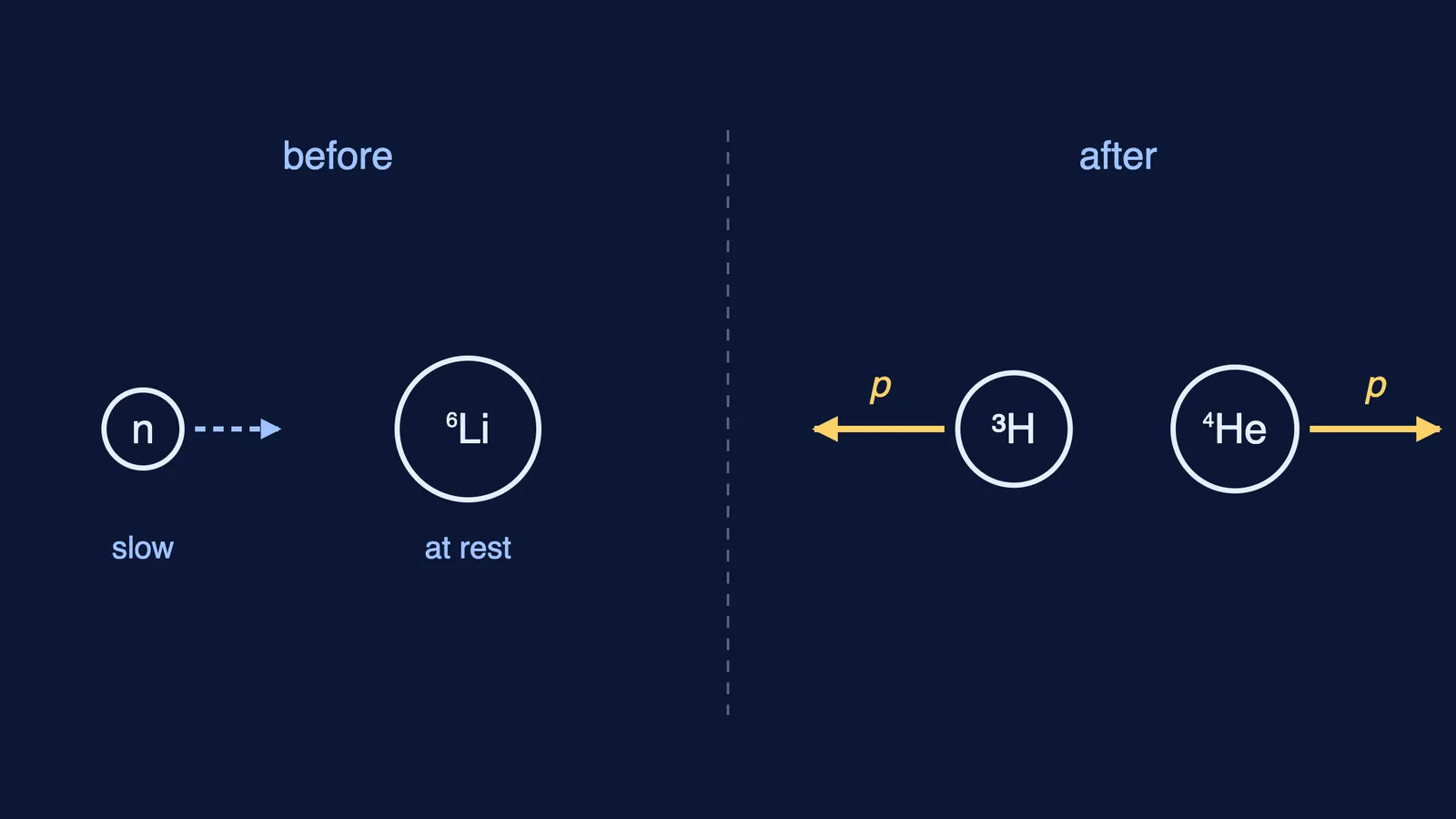
Q7 (hard). A slow neutron (negligible kinetic energy) is absorbed by a lithium-6 nucleus at rest: n + ⁶Li → ³H + ⁴He. Masses: neutron 1.008665 u, ⁶Li 6.015123 u, ³H 3.016049 u, ⁴He 4.002603 u (atomic masses). The triton's kinetic energy is x × 10⁻² MeV. Find x to the nearest integer.
Answer: 273. Q = (1.008665 + 6.015123 − 3.016049 − 4.002603) × 931.5 = 0.005136 × 931.5 = 4.784 MeV; the electrons cancel, three on each side. With almost zero initial momentum, the products have equal and opposite momenta, so K = p²/2m splits Q in inverse ratio to mass: the triton gets 4/7 of Q, 2.734 MeV, so x ≈ 273. Exact masses give 2.728 MeV, the same integer.
Trap: 239, which splits Q equally, as if the products had equal masses.
Q8 (hard). For a one-electron ion of charge Ze, take vn = (Z/n)v0, rn = n²a0/Z and En = −13.6Z²/n² eV, where v0 and a0 belong to the hydrogen ground state. In one excited state the electron moves at 2v0 in an orbit of radius 1.5a0. It then drops to n = 2. What wavelength is emitted, in ångström, to the nearest integer?
Answer: 182. The speed gives Z = 2n, so the radius is n²/2n = n/2 = 1.5, giving n = 3 and Z = 6: the ion is C⁵⁺. The 3 → 2 photon carries 13.6 × 36 × (1/4 − 1/9) = 68.0 eV, so λ = 1240/68.0 = 18.24 nm = 182 Å.
Trap: 1094, which scales the energy by Z instead of Z².
How to get the number right
Convert to the unit in the stem first: Q4 wants nanometres, Q8 ångström, Q5 and Q7 the x in x × 10⁻² MeV.
Use the constants given, not more precise ones you know.
Keep signs straight: Bohr energies are negative; kinetic energy and energy supplied (Q3, Q5) are positive.
Check powers of Z and A: energies go as Z², radii as 1/Z, nuclear radii as A^(1/3).
Round only the final value to the nearest integer.
Right formula, wrong method? The Fermi Problem Library has worked problems with a step-by-step solver that explains the reasoning rather than printing an answer.
For multiple-choice practice, try our atoms and nuclei JEE Main practice questions with solutions.


