

On this page
A baby born with a small, soft tail sounds like a myth, but doctors have documented it in medical journals. It is the textbook example of an atavism, and it sits right next to a term students often confuse it with: vestigial organ. Here is how to tell them apart, and why both point to the same conclusion.
What is atavism in biology?
An atavism is a trait from a distant ancestor that reappears in a rare individual, even though the parents and recent ancestors do not show it. Developmental biologist Brian K. Hall's 1984 review in Biological Reviews explains atavisms as the result of local changes in how an organ develops in the embryo, such as altered cell death, tissue interactions and growth (Hall, 1984). His point was that the embryo does not lose the basic ability to build an old structure; normally that ability stays switched off.
How is atavism different from a vestigial organ?
A vestigial structure is a genetically determined structure that has lost most or all of its ancestral function in a species, such as the human appendix (Biology LibreTexts). The difference comes down to who has it:
Vestigial: almost everyone in the species has it, in reduced form. Your tailbone is one.
Atavistic: almost no one has it. It turns up in an occasional individual and looks like the full ancestral version.
For more examples of the first kind, see our guide to vestigial organs in humans and what they show.
Is a human tail an atavism?
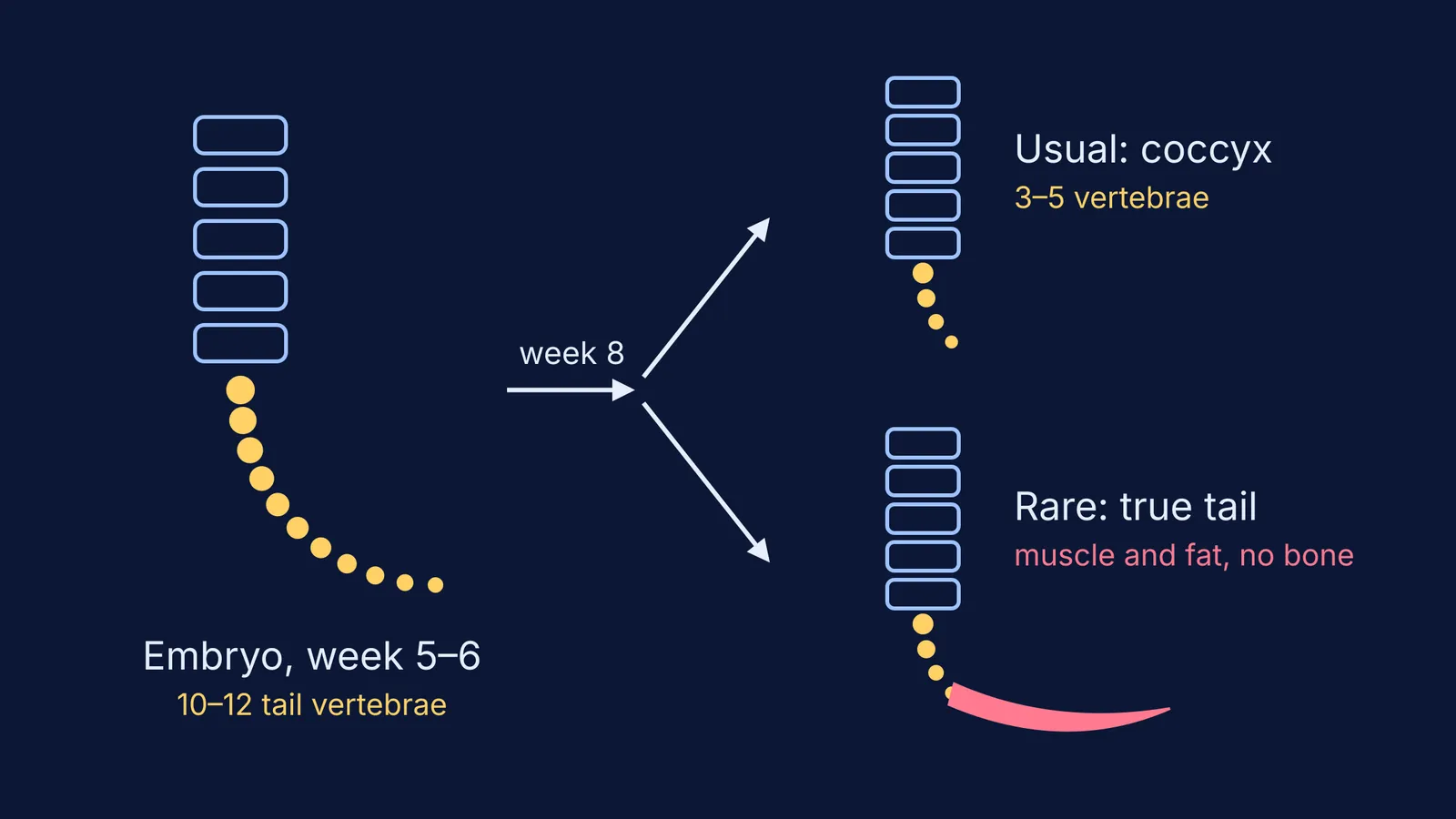
A true human tail is. Every human embryo grows a tail: during the 5th to 6th week it has a tail with 10 to 12 vertebrae, and by 8 weeks the tail has disappeared, according to a report of six cases in the Journal of Indian Association of Pediatric Surgeons. What normally remains is the coccyx, made of only 3 to 5 tail vertebrae; the ancestors of apes and humans are thought to have lost the external tail about 25 million years ago, when their lineage split from Old World monkeys (Xia et al., Nature, 2024). That 2024 study suggests that an inserted stretch of DNA, an Alu element, in the TBXT gene changes how the gene is spliced and may have helped the tail disappear; mice engineered to make both versions of the gene had shortened tails or none at all.
The same case report says a true tail arises from the last remnant of the embryonic tail and contains fat, connective tissue, muscle, blood vessels and nerves, covered by skin, but no bone, cartilage or spinal cord (Mukhopadhyay et al., 2012). A 1984 review in Human Pathology summarised 33 earlier reported cases and separated true tails from "pseudotails", lumps on the lower back that only look like tails (Dao and Netsky, 1984).
Why are extra nipples called atavistic?
Extra nipples, called polythelia, occur in between 0.22% and 5.6% of people and most often lie along the milk lines that run from the armpits to the groin (Pan African Medical Journal, 2019). Pathologists at Weill Cornell Medicine titled their 2025 study of 131 such lesions "an atavistic lesion", and found breast tissue in 77.6% of the 107 they examined under the microscope (Al Assaad et al., 2025). The extra nipple usually appears along a line where nipple tissue can form, not at a random spot.
Why is atavism evidence for shared ancestry?
An atavism is never a random new body part. A rare human tail is built from the leftover embryonic tail, at the base of the spine, as in our tailed primate relatives. That only makes sense if the instructions for a tail are still in our genome and our development, inherited from tailed ancestors and normally kept switched off. The same logic links atavisms to homologous organs and divergent evolution and to embryological evidence from Haeckel and von Baer.
A three-question test for any example
Ask these in order:
Do nearly all members of the species have it, in reduced form? If yes, it is vestigial.
Is it rare, absent in the parents, and does it match a structure a distant ancestor had? If yes, it is an atavism.
Does it only look ancestral but have the wrong tissue or position? Then it is neither, like a pseudotail.
Worked through: coccyx (vestigial), appendix (vestigial), true tail in one baby (atavism), extra nipple on the milk line (atavism), a lump on the lower back that only looks like a tail (pseudotail, neither).
If homologous, vestigial and atavistic still blur together, the Fermi Concept Library gives each biology concept its own lesson and its place in the map, so you can see how they connect. Try the three-question test on wisdom teeth next.


