

On this page
When you study evolution for your biology exams, you will encounter the debate over embryological evidence. Looking at how an embryo develops can reveal a species' evolutionary history. But historically, scientists disagreed on exactly what those embryos were showing us. Do we literally replay long stages of evolution in the womb, or do we simply start from the same basic blueprint as other animals?
The debate between Ernst Haeckel and Karl Ernst von Baer remains a core part of the NCERT Class 12 syllabus. Understanding the difference between their views will stop you from losing marks on tricky multiple-choice questions, and it will give you a clearer picture of how evolution actually works.
What is Haeckel's embryological evidence for evolution?
Ernst Haeckel, a 19th-century zoologist, proposed that embryology provides strong support for evolution. His core idea is famously summarised by the phrase "ontogeny recapitulates phylogeny"—meaning the development of an individual (ontogeny) replays the evolutionary history of its species (phylogeny).
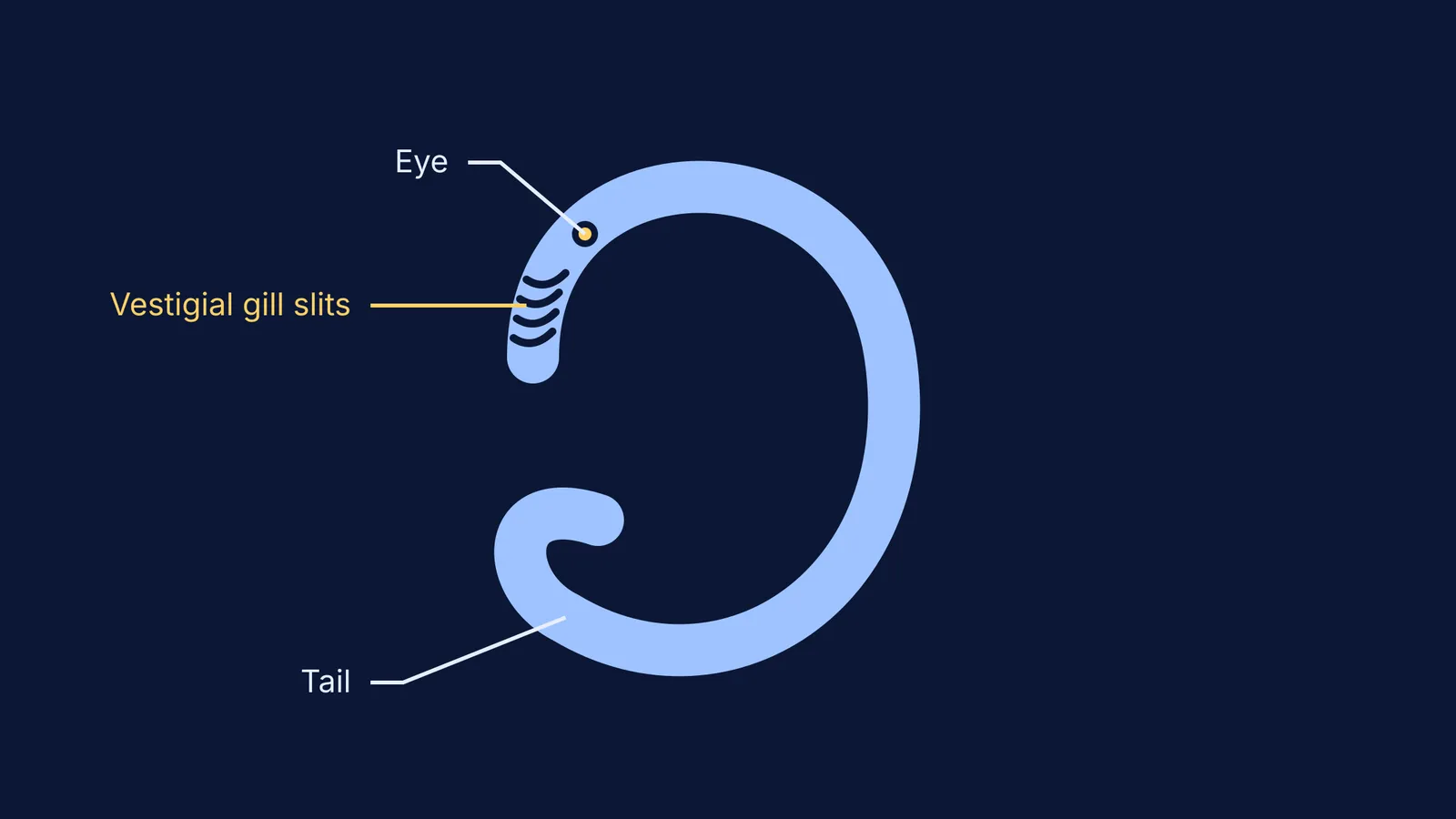
To support this, Haeckel pointed to certain features during the embryonic stage that are common to all vertebrates but are absent in adults. For example, the embryos of all vertebrates, including humans, birds, and reptiles, develop a row of vestigial gill slits just behind the head. Because these structures only go on to become functional breathing organs in adult fish, Haeckel believed this proved human embryos were temporarily "reliving" a fish-like ancestor stage before moving on to a mammalian stage.
Haeckel's drawings of embryos side-by-side became famous and were printed in textbooks for many years. He argued that the younger the embryo, the further back in evolutionary time you were looking.
Why did von Baer reject Haeckel's theory?
While the shared features across vertebrate embryos were real, Haeckel's interpretation was flawed. Karl Ernst von Baer, a prominent pioneer of embryology, conducted careful studies and firmly disproved Haeckel's proposal.
Von Baer noted that embryos never pass through the adult stages of other animals. A human embryo with pharyngeal arches (what Haeckel called gill slits) does not look like an adult fish; it looks like a fish *embryo*. Instead of repeating adult forms, embryos of different species start with a similar, general plan and then diverge into their specific, specialised forms.
For instance, those pharyngeal arches in a human embryo never develop into functional gills. Instead, they remodel into parts of the lower jaw, the hyoid bone in the neck, and the bones of the middle ear. The shared structures are evidence of a common starting point, not a sequence of adult ancestral forms.
Just as the theories of Darwin and Wallace gave us a clear mechanism for natural selection, von Baer gave us a clearer mechanism for embryonic development: common ancestry leads to shared early blueprints.
How do you tackle this topic for exams?
For exams like NEET, questions on this topic test whether you know who said what, and why the earlier theory was rejected. Here is a quick framework to lock this into your memory:
The Proponent: Remember that Ernst Haeckel proposed the idea based on shared embryonic features (like vestigial gill slits) that disappear in adults.
The Phrase: Link Haeckel to "ontogeny recapitulates phylogeny" (even if NCERT keeps it simpler, it often appears in exam options).
The Critic: Remember that Karl Ernst von Baer disproved the theory.
The Reason: Memorise von Baer's exact counter-argument: embryos never pass through the *adult* stages of other animals.
Understanding the nuance between "sharing an embryonic plan" and "replaying an adult stage" requires you to trace how a single structure evolves. If you need to visualise these relationships, the Fermi Concept Library maps out every topic in evolution. Rather than just reading the names of scientists, you can explore how anatomical structures diverge across species, with an AI tutor that explains the reasoning step by step.
Next time you review the embryological evidence of evolution, remember the core distinction: shared embryonic traits prove we have a common ancestor, but we do not repeat our ancestors' adult lives before we are born.


