

On this page
A sea squirt starts life looking more like a chordate than it ends it. If you are revising Animal Kingdom for Class 11 or NEET-UG, that one fact explains a line NCERT fits into a single sentence, and a common exam question: why is metamorphosis in ascidians called retrogressive?
Why is metamorphosis in ascidians called retrogressive?
NCERT says chordates are fundamentally characterised by a notochord, a dorsal hollow nerve cord and paired pharyngeal gill slits, and adds that they have a post-anal tail (NCERT Class 11 Biology, Chapter 4). The same chapter says that in Urochordata the notochord is present only in the larval tail.
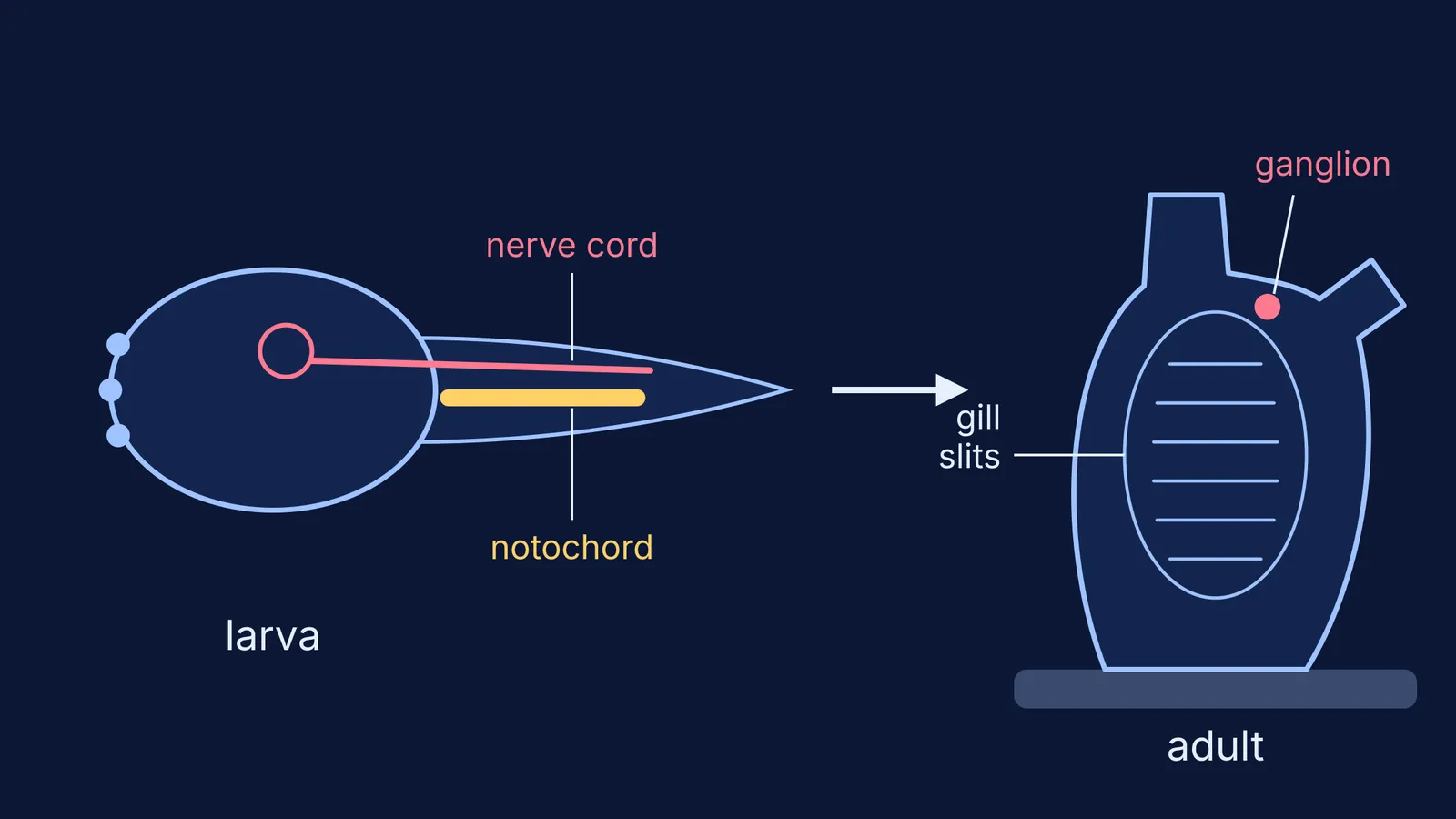
Retrogressive metamorphosis is a change from larva to adult in which advanced larval characters are lost and the adult ends up simpler, as these zoology lecture notes on urochordates explain. In typical metamorphosis, animals develop more complex features. The ascidian goes the other way: an active tadpole with a notochord, a dorsal neural tube and sense organs becomes a sessile, filter-feeding sac.
What does the sea squirt larva lose, and what does it keep?
Ascidians are sessile filter feeders that develop through a swimming, yolk-fed tadpole larva, according to a 2026 study in PLOS One on *Ciona intestinalis*. The same paper notes that the larval central nervous system of *Ciona* consists of fewer than 100 neurons and 250 glial cells. After a short swimming period, the larva settles and becomes sessile.
The tail is removed largely by programmed cell death. A 2002 study in Development showed that tail regression in *Ciona* involves caspase-dependent apoptosis that runs as a wave from the tail tip; when fertilised eggs were treated with a caspase blocker, 30% of larvae failed to metamorphose. A 2024 paper in Scientific Reports adds that tail regression also depends on tissue contraction and cell migration, and, consistent with earlier studies, reports that tunic, epidermal and muscle cells in the tail undergo apoptosis.
The nervous system is rebuilt rather than simply thrown away. Tracking cells through metamorphosis, a 2011 study in Nature found that most of the larval central nervous system, except the tail nerve cord, is kept and recruited to form the adult's; most larval neurons disappear, and some support cells (ependymal cells) turn into adult neurons.
Here is the balance sheet:
Lost: the tail, the notochord, the tail nerve cord, most larval neurons, and the swimming lifestyle.
Kept or built: the pharynx with gill slits (stigmata) and endostyle, which the lecture notes point to as the adult's remaining chordate features, plus a small adult nerve ganglion.
How is Urochordata different from Cephalochordata?
NCERT groups both as protochordates and says both are exclusively marine (NCERT Chapter 4). The key difference is where the notochord is and how long it lasts:
Urochordata (Tunicata): notochord only in the larval tail, lost in the adult. Examples: *Ascidia*, *Salpa*, *Doliolum*.
Cephalochordata: notochord extends from head to tail and persists throughout life. Example: *Branchiostoma* (Amphioxus or lancelet).
A memory hook: uro- means tail, cephalo- means head. The tunicate keeps its notochord in the tail and only as a larva; the lancelet runs it all the way to the head and never gives it up. For the full picture of that lifelong rod, read our explainer on why Amphioxus keeps its notochord for life.
Does retrogressive mean sea squirts are primitive?
Not in the evolutionary sense. The simple adult reflects a settled way of life, not distance from us. A 2006 analysis in Nature of 146 nuclear genes found that tunicates, not cephalochordates, are the closest living relatives of vertebrates. Vertebrates lose their notochord too, but NCERT notes it is replaced by a vertebral column in the adult, as we explain in notochord vs vertebral column.
How should you write this in an exam?
For a two or three mark answer, use this four-step frame:
Define: metamorphosis in which the larva has advanced features that the adult loses.
Larva: free-swimming tadpole with notochord in the tail, dorsal hollow nerve cord and gill slits.
Adult: tail, notochord and tail nerve cord are lost; it becomes sessile and filter-feeding, keeping the pharyngeal gill slits.
Contrast: in Cephalochordata (*Branchiostoma*) the notochord runs head to tail and persists for life.
Check your answer against three common slips: writing that the adult ascidian has a notochord, calling Amphioxus a urochordate, and forgetting that gill slits survive into the adult.
If the basic chordate features themselves feel fuzzy, start with our guide to the fundamental features of chordates. The Fermi Concept Library covers every concept in biology, each with its own lesson and its place in the map, so you can revisit Urochordata alongside the rest of Chordata. When you want to test yourself, the Fermi Problem Library has worked problems with a step-by-step solver that explains the reasoning rather than printing an answer.


