

On this page
You have probably heard it on a family WhatsApp group: broilers grow so fast because they are injected with hormones. The poultry science points elsewhere, to breeding and feed, and the biology of chicken growth hormone explains why injections would be a poor way to get a bigger bird.
Why do broiler chickens grow so fast?
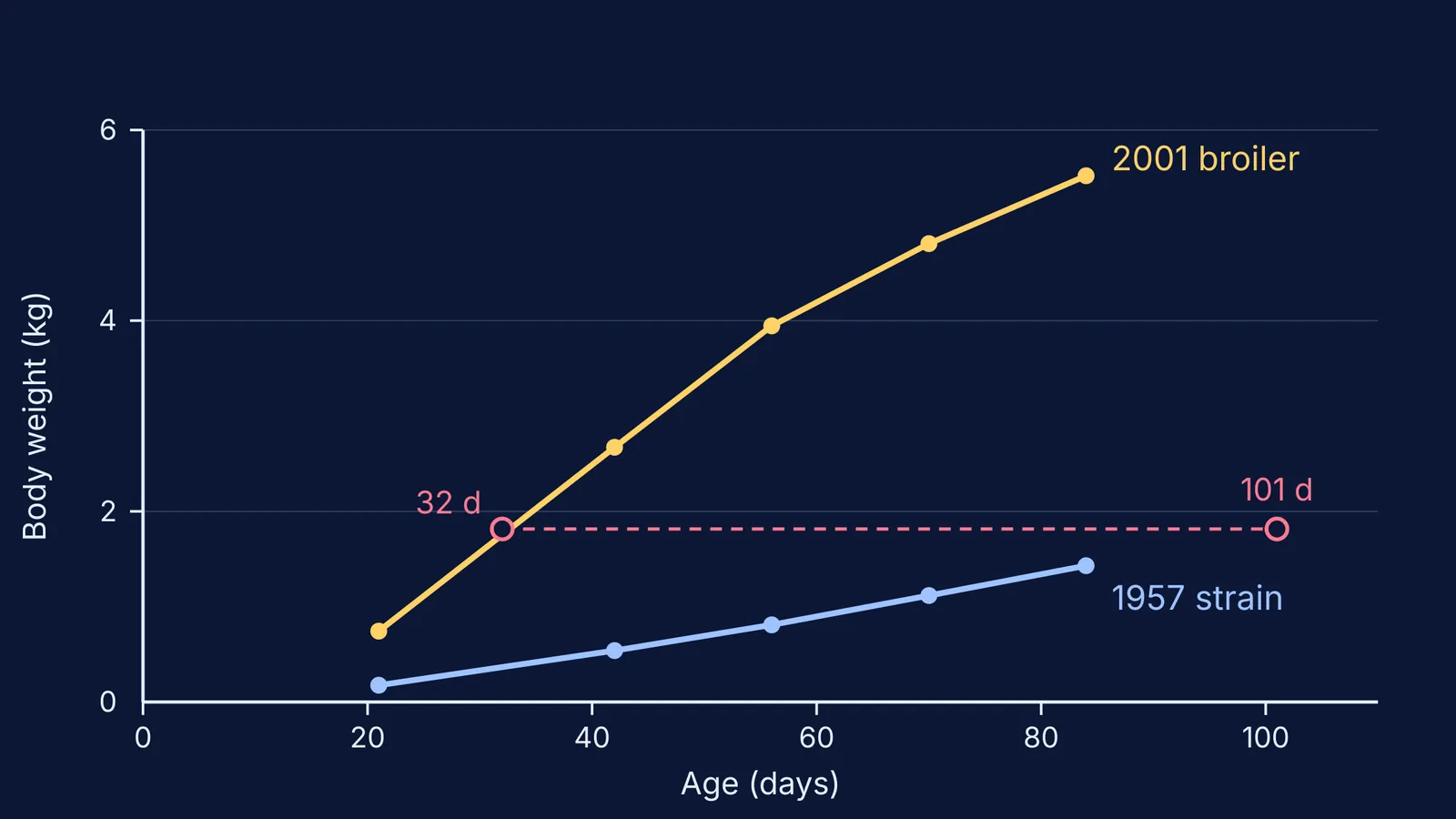
The clearest evidence comes from raising old and modern chickens side by side. In a 2003 study in Poultry Science, Havenstein, Ferket and Qureshi compared a 1957 strain fed a 1957-style diet with a modern Ross 308 broiler fed a 2001 diet.
The modern bird was estimated to reach 1,815 g at 32 days, while the 1957 strain on 1957 feed would not have reached that weight until 101 days (Havenstein et al., 2003).
The same study lets you separate the effect of genes from the effect of feed. At 42 days, the modern broiler weighed 2,672 g on 2001 feed and 2,126 g on 1957 feed. The 1957 strain weighed 578 g on 2001 feed and 539 g on 1957 feed (Havenstein et al., 2003). Feed helped both, but genes made the far bigger difference.
A later study by Zuidhof and colleagues found the same pattern. From 1957 to 2005, broiler growth increased by over 400%, with a 50% reduction in feed conversion ratio (Zuidhof et al., 2014, Poultry Science).
This is artificial selection: for decades, breeders chose the fastest-growing, most efficient birds as parents of the next generation (see our explainer on natural vs artificial selection).
How much feed does a modern broiler need compared with a 1957 chicken?
Using the feed conversion figures from the Havenstein study, the modern bird reached 1,815 g with a feed conversion of 1.47, and the 1957 bird would have needed a feed conversion of 4.42 to reach the same weight.
Modern bird: 1.47 × 1.815 kg ≈ 2.7 kg of feed.
1957 bird: 4.42 × 1.815 kg ≈ 8.0 kg of feed.
The 1957 bird eats roughly three times as much feed and takes 69 more days. Breeding and feed explain that gap without any hormone.
Would a hormone injection even work in a chicken?
Scientists have actually tried it. In a 1989 study in the Journal of Nutrition, Cogburn and colleagues gave three-week-old broilers a daily injection of chicken growth hormone for 14 days. The hormone raised growth hormone levels in the blood but failed to increase body weight gain and did not change feed efficiency, and the natural hormone made the birds fatter.
Timing matters too. A 1988 study by Vasilatos-Younken and colleagues90255-9) found that growth hormone given into a vein in pulses every 90 minutes improved feed efficiency, while a continuous infusion significantly impaired it. To get those pulses, the birds had surgically fitted catheters attached to a tether, which is nothing like a working farm.
Mixing it into feed would not help either: growth hormone is a protein, so the gut digests it, the same reason insulin is injected, not taken orally. For what the hormone does in people, see growth hormone, dwarfism and gigantism.
A 2016 review in Trends in Food Science & Technology by Esquivel-Hernandez and colleagues sums it up: growth hormones are not used in chickens because they are too expensive, they do not promote growth in poultry, and their use is illegal in many countries.
What do FSSAI rules say about hormones in chicken?
In India, the Food Safety and Standards (Contaminants, Toxins and Residues) Regulations, 2011 set the rules. Regulation 2.3.2(2) lists drugs that are not permitted at any stage of production of meat, poultry, eggs, milk and aquaculture, and the list includes steroids, stilbenes and clenbuterol (FSSAI compendium, version IX, 3 February 2026). The same list also bans antimicrobials such as colistin and chloramphenicol, so the rules cover antibiotic residues as well as hormones.
How can you check a claim like this yourself?
Use this five-step check on any food rumour, with the broiler case as the worked answer.
What exactly is claimed? Broilers are injected with growth hormones.
Is there a simpler explanation with data? Yes: breeding and feed explain a 32-day versus 101-day gap (Havenstein et al., 2003).
Has anyone tested the claimed mechanism? Yes: daily injections did not increase weight gain (Cogburn et al., 1989).
What does the regulator say? FSSAI lists steroids and stilbenes as not permitted in poultry.
What is left to ask? Whether antibiotics were used responsibly, and how the chicken is handled and cooked.
If a relative forwards the rumour, you could reply: "Chickens grow fast because they have been bred for it for decades. Scientists tried injecting growth hormone and the birds did not grow faster. Antibiotic residues and hygiene are the better questions to ask."
If a step from Class 11 or 12 biology feels shaky, the Fermi Concept Library gives every biology concept its own lesson, and Fermi's AI tutor can work through a claim like this with you, deciding whether to explain, ask or show.


