

On this page
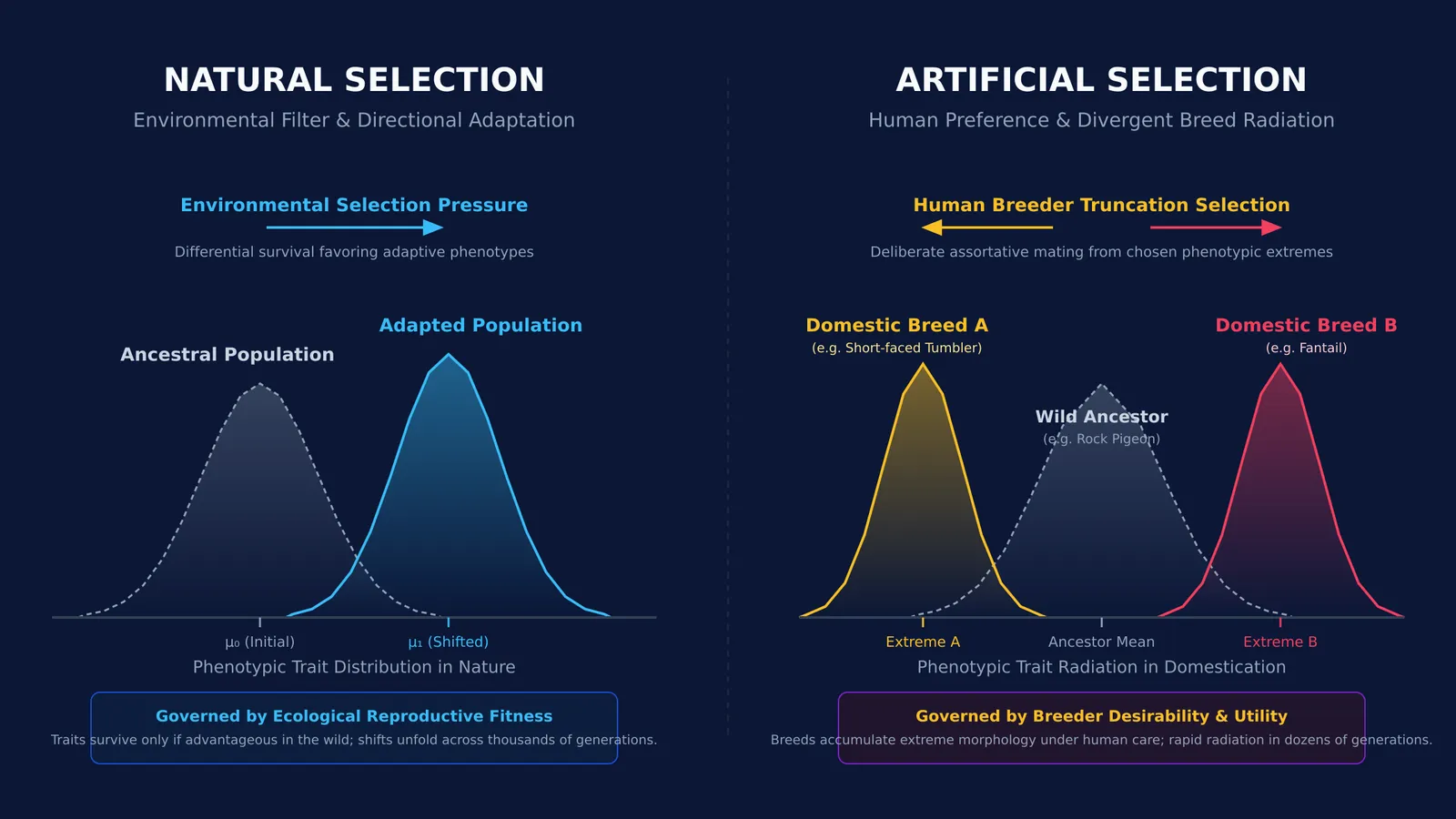
Biological evolution relies on differential reproductive success, but the driving force behind that reproduction separates selection into two distinct modes. In natural selection, environmental conditions such as predation, climate shifts, resource scarcity, and disease determine which organisms survive and pass on their genes. In artificial selection, also known as selective breeding, human choices dictate which individuals mate based on desirable agricultural, aesthetic, or functional traits. While natural selection operates continuously across wild ecosystems, artificial selection occurs inside human-managed farms, lofts, and kennels.
The critical biological distinction lies in the target of selection. Charles Darwin captured this contrast in Chapter 4 of his 1859 book *On the Origin of Species*, observing that human breeders act on external, visible characters that suit human desires, whereas nature preserves variations based strictly on how useful they are to the organism. Artificial selection regularly accumulates extreme anatomical traits that would prove fatal in the wild, such as flightless poultry or flat-faced dog breeds prone to respiratory failure.
Why did Charles Darwin use pigeon breeding to explain natural selection?
When Darwin began writing to convince naturalists and the Victorian public of evolution, natural selection posed a conceptual challenge: it unfolds across thousands of generations and cannot be observed during a single human lifetime. To make the process tangible, Darwin turned to domestic pigeons. In Chapter 1 of *On the Origin of Species*, he documented how pigeon fanciers had produced staggering physical variety from one wild ancestor: the rock pigeon (*Columba livia*). English carrier pigeons possessed elongated beaks, short-faced tumblers had miniature beaks, pouters inflated spherical crops, and fantails displayed 30 to 40 tail feathers instead of the 12 to 14 feathers typical of wild rock pigeons.
Darwin argued that if human breeders could remodel beaks, crop size, and plumage in a few centuries by accumulative selection, nature acting over geological epochs could produce the entire tree of life. Modern genomics confirms Darwin's insight. In a study published in *Science*, Michael D. Shapiro and colleagues sequenced 36 domestic pigeon breeds alongside wild *Columba livia*, confirming their common descent and identifying a single shared mutation in the *EphB2* gene responsible for reversed head-crest feathers.
If you are exploring how ancestral populations diversify across ecological niches, the Fermi Concept Library covers every concept across biology and genetics, each with its own lesson and its place in the map.
What are classic examples of artificial and natural selection?
Beyond pigeons, canine breeding highlights the speed and morphological reach of artificial selection. Domestic dogs (*Canis lupus familiaris*) descend from the grey wolf, yet selective breeding has generated extraordinary skeletal diversity. In a study published in *Science*, Nathan B. Sutter and colleagues analyzed canine genomes and found that a single variant of the *IGF1* gene on chromosome 15 accounts for small stature across all small dog breeds.
Agricultural crops display the same selective transformation. In an RNA-sequencing study of 224 accessions published in *Molecular Biology and Evolution*, Makenzie E. Mabry and colleagues demonstrated how farmers molded wild cabbage ancestors into distinct vegetables: terminal buds yielded cabbage, lateral buds produced Brussels sprouts, arrested flower buds created broccoli, sterile flowers formed cauliflower, and broad leaves produced kale.
Natural selection operates on identical genetic variation, but the selective filter is ecological survival. The classic textbook example is industrial melanism in the peppered moth (*Biston betularia*). When industrial soot darkened English woodlands, dark-winged moths gained camouflage against predators, while pale moths were eaten. In a six-year field study published in *Biology Letters*, Laurence M. Cook and colleagues analyzed 4,864 released moths and confirmed that bird predation drove a daily selection coefficient of approximately 0.1 against dark moths after clean-air laws restored pale lichens.
How do you distinguish natural from artificial selection in exam questions?
Exam questions in NEET-UG and Class 12 biology often require students to classify evolutionary scenarios. When reviewing Darwin and Wallace's 1858 papers on natural selection and evolution and Hardy-Weinberg equilibrium for NEET, evaluate how the selective pressure operated using this four-step framework:
Identify the selective agent: If human preference directs reproduction based on yield, aesthetics, or docile temperament, it is artificial selection. If environmental factors like predators, drought, or pathogens govern survival, it is natural selection.
Check ecological fitness: If the favoured trait reduces survival in the wild without human care, it reflects artificial breeding. Natural selection consistently preserves traits that support survival and reproduction in the wild.
Assess the timeframe: Artificial selection operates across tens or hundreds of generations through deliberate culling. Natural selection generally acts across thousands of generations, though intense pressures like antibiotics can produce rapid adaptation.
Read the population curve: Wild populations often display stabilising, directional, and disruptive selection curves that balance trade-offs. Artificial selection operates as aggressive directional truncation, breeding only from chosen extremes.
When working through genetics problems, pedigrees, or allele frequency shifts, the Fermi Problem Library provides worked problems with a step-by-step solver that explains the underlying reasoning rather than just printing an answer.


