

On this page
A fighter jet flies level at 1.5 km altitude at 720 km/h and passes directly over an anti-aircraft gun. The gun fires shells at 600 m/s. Which way should the gun point to hit the plane, and how high would the pilot have to fly to be safe? This is a standard Class 11 motion-in-a-plane problem. Its trick is simple: aim so that the shell keeps pace with the plane sideways, and the rest is a one-dimensional vertical motion question. Throughout, we ignore air drag and take g = 10 m/s², as the textbook version does.
Why must the shell's horizontal velocity equal the plane's?
The gun fires at the instant the plane is directly overhead, so the shell and the plane start on the same vertical line. After that:
The plane moves at a constant 200 m/s horizontally and does not move vertically.
The shell's horizontal velocity stays constant, because nothing pushes it sideways once drag is ignored. Its vertical velocity falls by 10 m/s every second.
For the two to meet at some time t, their horizontal positions must match: (shell's horizontal speed) × t = 200 × t. That only works if the shell's horizontal speed is exactly 200 m/s. If it is smaller, the shell falls behind the plane. If it is larger, the shell runs ahead of it. With an exact match, the shell stays directly under the plane for its whole flight, and the hit happens the moment the shell reaches 1.5 km.
It also helps to look from the cockpit. In the plane's frame, the shell's horizontal velocity is 200 − 200 = 0, so the pilot sees the shell rise straight up towards the plane. The same relative-velocity idea decides whether two projectiles meet in the air; see the relative motion test for two projectiles colliding midair.
Compare this with the monkey and hunter problem. There the target falls with the same g as the bullet, so you aim straight at it. Here the target does not fall but moves sideways, so you aim ahead of it. The reverse case, a bomb released from a moving plane, also keeps the plane's 200 m/s horizontally and stays right below it as it falls; that is covered in where a bomb dropped from a moving aeroplane lands.
At what angle should the gun be fired?
Let θ be the angle of the barrel from the vertical. The horizontal component of the muzzle velocity is then 600 sin θ, and the vertical component is 600 cos θ.
First convert the plane's speed: 720 km/h = 720 × 1000 ÷ 3600 = 200 m/s.
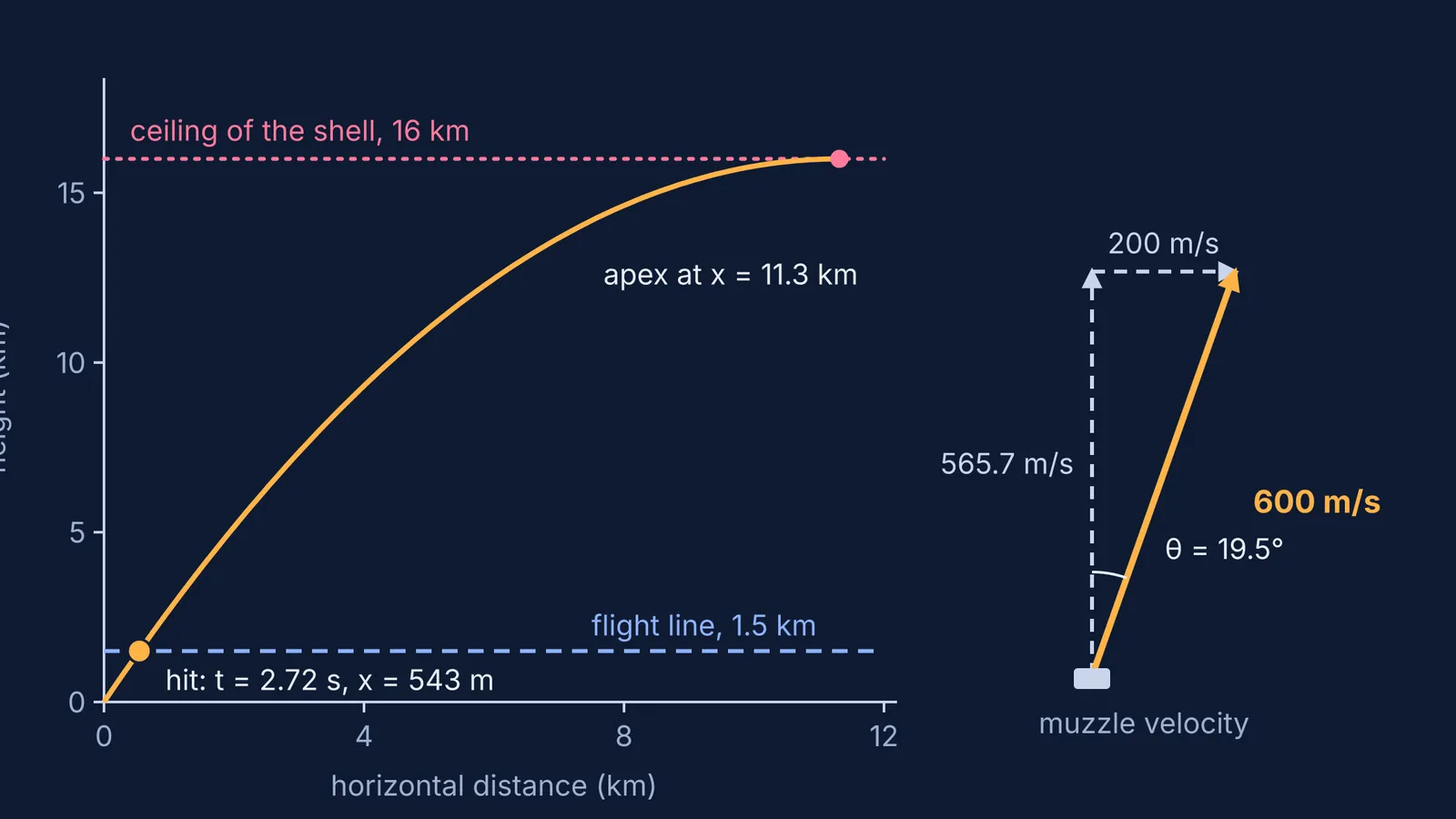
Matching the horizontal speeds: 600 sin θ = 200, so sin θ = 1/3 and θ = 19.5° from the vertical. The barrel tilts forward, in the direction the plane is flying.
The same direction can be written as 70.5° above the horizontal. Both answers are correct as long as you say which reference line you used. Most mistakes here come from measuring θ from the vertical and then writing the horizontal component as 600 cos θ.
Notice that the plane's height did not enter the aim at all. The angle depends only on the ratio of the two speeds.
Worked example: aim, time and point of impact
Problem. A fighter flies level at 1.5 km at 720 km/h and passes directly over a gun with muzzle speed 600 m/s. Find the firing angle, the time to impact and where the hit happens. Take g = 10 m/s².
Convert units. v = 720 km/h = 200 m/s; height h = 1500 m.
Aim. 600 sin θ = 200, so θ = sin⁻¹(1/3) = 19.5° from the vertical (70.5° from the horizontal).
Vertical component. 600 cos θ = √(600² − 200²) = √320000 = 565.7 m/s.
Time to reach 1.5 km. Use y = (vertical component) × t − ½gt²: 1500 = 565.7t − 5t², or 5t² − 565.7t + 1500 = 0. The discriminant is 565.7² − 4 × 5 × 1500 = 320000 − 30000 = 290000, whose square root is 538.5. The smaller root is t = (565.7 − 538.5) ÷ 10 = 2.72 s.
Where it hits. In 2.72 s both the shell and the plane move 200 × 2.72 = 543 m forward of the gun.
Check. The shell's vertical speed at impact is 565.7 − 10 × 2.72 = 538.5 m/s, still upward, so this is the shell on its way up. Units: m/s × s gives m, and m ÷ (m/s) gives s.
The larger root, 110.4 s, is the shell coming back down through 1.5 km. In a vacuum it would still be under the plane then, but the first crossing is the one that counts.
What is the minimum altitude at which the pilot is safe?
The aim is fixed by the horizontal match, so the vertical launch speed is fixed at 565.7 m/s. The highest the shell can climb with that vertical speed is
H = (u cos θ)² ÷ 2g = 565.7² ÷ 20 = 16,000 m = 16 km.
A neater form is H = (u² − v²) ÷ 2g = (360000 − 40000) ÷ 20 = 16 km. If the plane flies above 16 km, the shell is still directly below it when it stops rising, and then it falls back. So the minimum safe altitude is 16 km, or about 16.3 km if you use g = 9.8 m/s².
The formula H = (u² − v²) ÷ 2g shows something useful: a faster plane is safe at a lower altitude.
Plane at 100 m/s: safe above (360000 − 10000) ÷ 20 = 17.5 km.
Plane at 200 m/s: safe above 16 km.
Plane at 300 m/s: safe above (360000 − 90000) ÷ 20 = 13.5 km.
Plane at 600 m/s or more: sin θ would have to be 1 or more, so the gun can never hit it by firing when the plane is overhead.
Is this how real anti-aircraft guns work?
No. Air drag on a fast shell is large, so real shells slow down quickly, both horizontally and vertically. A real shell with this muzzle speed would fall well short of 16 km, and its horizontal speed would not stay at 200 m/s, so it would also drop behind the plane. Real gunners also fire before the plane is overhead and allow for the time of flight. Treat this problem as a clean kinematics exercise, not as real ballistics.
If you find it hard to picture why the shell stays directly under the plane, try launching projectiles at different angles in the Fermi Simulation Lab and watch how the horizontal motion is unaffected by gravity.
Quick checklist
Convert 720 km/h to 200 m/s before anything else.
Match horizontal speeds: u sin θ = v, with θ measured from the vertical.
θ = 19.5° from the vertical, which is 70.5° from the horizontal.
Hit time comes from 1500 = 565.7t − 5t²; take the smaller root, 2.72 s.
Safe altitude is (u² − v²) ÷ 2g = 16 km, not u² ÷ 2g = 18 km.
Drag is ignored; real shells reach far less.


