

On this page
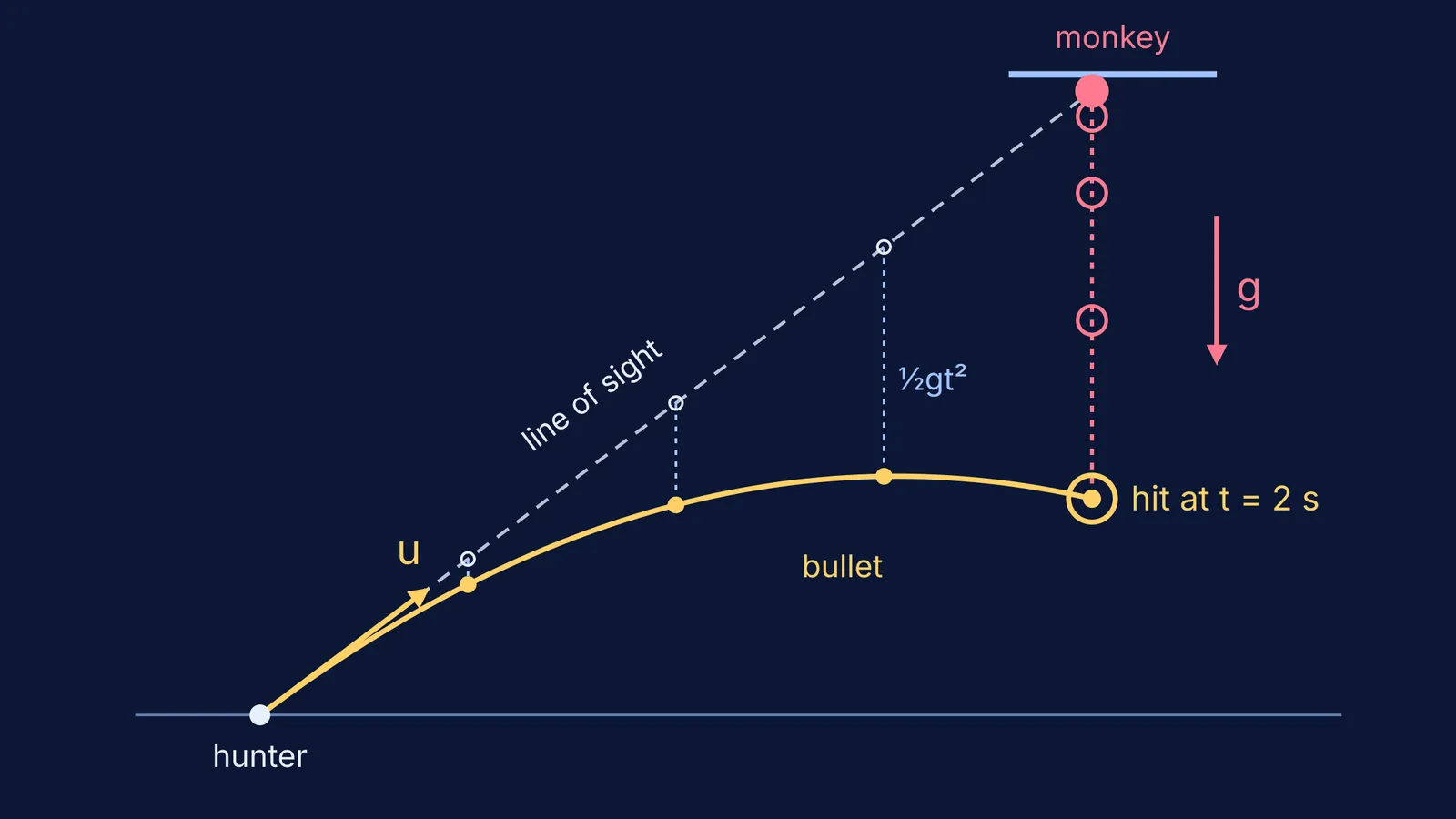
A hunter aims straight at a monkey on a branch. The monkey lets go the instant the gun fires, hoping to drop out of the way. It still gets hit. The reason is a core idea in JEE mechanics: relative acceleration.
Why does the bullet always hit the monkey?
Physics departments run this as a lecture demo. In Clemson University's version, an electromagnet holds the "monkey" in place, and the projectile breaks that circuit as it leaves the muzzle, so "the monkey then begins to fall at the same time the projectile is fired directly at the monkey" (Clemson University physics demo notes). The University of Texas at Austin's Nerf-dart version explains the hit: both the projectile and the target "accelerate downward at the same rate under gravity" (UT Austin demo page).
Projectile motion is motion "subject only to acceleration as a result of gravity", with a vertical acceleration of a_y = −g = −9.8 m/s² and air resistance neglected (OpenStax University Physics, section 4.3).
Positions from the gun, t seconds after firing:
Bullet: launch velocity u times t, minus ½gt² straight down.
Monkey: its starting point, minus ½gt² straight down.
Without gravity, the bullet would fly along the line of sight and hit a monkey sitting still. Gravity pulls both down by the same ½gt² at every instant, so the hit just happens lower.
What is the relative-acceleration argument?
A particle's acceleration in frame S equals its acceleration in frame S′ plus the acceleration of S′ relative to S (OpenStax University Physics, section 4.5).
Now sit on the monkey. Both accelerations are g downward, so the bullet's acceleration relative to the monkey is zero. In the monkey's frame the bullet moves in a straight line at the constant velocity u it left the barrel with, and u points straight at the monkey, which in this frame never moves.
Worked example: does this bullet get there in time?
Use g = 9.8 m/s², as in the OpenStax projectile chapter. The hunter stands on level ground. The monkey hangs 40 m away horizontally and 30 m up, so the line of sight is 50 m long. The bullet leaves at 25 m/s.
Time to meet: in the monkey's frame the bullet covers 50 m at 25 m/s, so t = 2 s.
Drop in that time: ½ × 9.8 × 2² = 19.6 m for both.
Meeting point: 30 − 19.6 = 10.4 m above the ground, directly below the branch.
Check with components: horizontal speed 20 m/s reaches 40 m at 2 s; vertical speed 15 m/s gives height 15 × 2 − 19.6 = 10.4 m.
Ground check: the monkey reaches the ground after √(2 × 30 / 9.8) ≈ 2.47 s. The meeting time must be shorter, so the bullet needs a speed above 50 / 2.47 ≈ 20.2 m/s. At 20 m/s it lands just short of the tree.
The general condition is u > L√(g/2h), where L is the line-of-sight distance and h the monkey's height.
What if the target or the shooter is moving?
One rule covers every variation: if the relative acceleration is zero, point the relative velocity along the line joining the two at the moment of firing.
Monkey lets go early. It is already moving down when you fire, so in its frame the bullet's velocity tilts upward and it passes overhead.
Monkey jumps with velocity v as you fire. The accelerations still match, so aim so that u − v points at the monkey. This is the same logic as two projectiles colliding in mid-air.
Hunter on a cart moving at constant velocity w. The bullet's ground velocity is u + w. Aiming the barrel at the monkey now misses; tilt it so that u + w points at the monkey.
Whole set-up inside an accelerating lift. Both objects feel the same effective gravity in the lift's frame, so a straight aim still hits (see our ball-in-a-lift relative motion guide).
Relative velocity not along the line joining them. Then they never meet, and the question becomes how close they get; see closest approach in relative motion.
Air resistance. Drag can give the two objects different accelerations, so the result becomes approximate. Exam problems neglect it.
A checklist for any moving-target question
Write each object's acceleration. Subtract.
If the relative acceleration is zero, the relative path is a straight line.
Point the relative velocity at the target's position at the instant of firing.
Time to meet = separation ÷ relative speed.
Check that nothing (ground, wall, end of the lift) interrupts before that time.
The idea is easier to believe once you watch the gap close: the Fermi Simulation Lab has interactive simulations for ideas that are easier to see than to read. For practice, the Fermi Problem Library has worked problems with a step-by-step solver that explains the reasoning rather than printing an answer, so you can check which step of the checklist went wrong.


