

On this page
An object dropped from a moving aeroplane lands far ahead of its release point, following a curved parabolic path. In a classic study published in *Scientific American*, between 30% and 53% of participants mistakenly predicted it would fall straight down. They forgot a core rule of physics: the object keeps the plane's horizontal speed the whole way down.
When an aeroplane releases a supply crate or a bomb, intuition tells many of us that the object will plummet straight down to the ground. It is one of the most famous problems in high school physics, and it trips up students and adults alike.
The reality is that the object lands thousands of metres ahead of where it was released. To understand why, we have to look at how motion works in two dimensions.
Why do we get it wrong?
Our brains are wired with an intuitive sense of physics that often contradicts the real laws of motion. Between 30% and 53% of people incorrectly state that an object dropped from a moving carrier falls straight down from the release point (McCloskey, 1983).
The error comes from a medieval idea called "impetus"—the belief that an object only moves forward if it is actively being pushed. When the bomb is released, people assume it loses its forward drive and only gravity acts on it.
However, Newton's first law of motion (inertia) dictates that an object in motion stays in motion. The moment the bomb leaves the plane, it is already travelling horizontally at the plane's speed (say, 200 m/s). Because there is no major force pulling it backward (ignoring air resistance), it keeps moving forward at exactly 200 m/s for the entire time it falls.
If you struggle to picture how these independent forces act together, the Fermi Simulation Lab provides interactive simulations for the ideas that are easier to see than to read. You can watch the downward gravity vector grow while the horizontal velocity stays perfectly constant.
What does the path look like to the pilot?
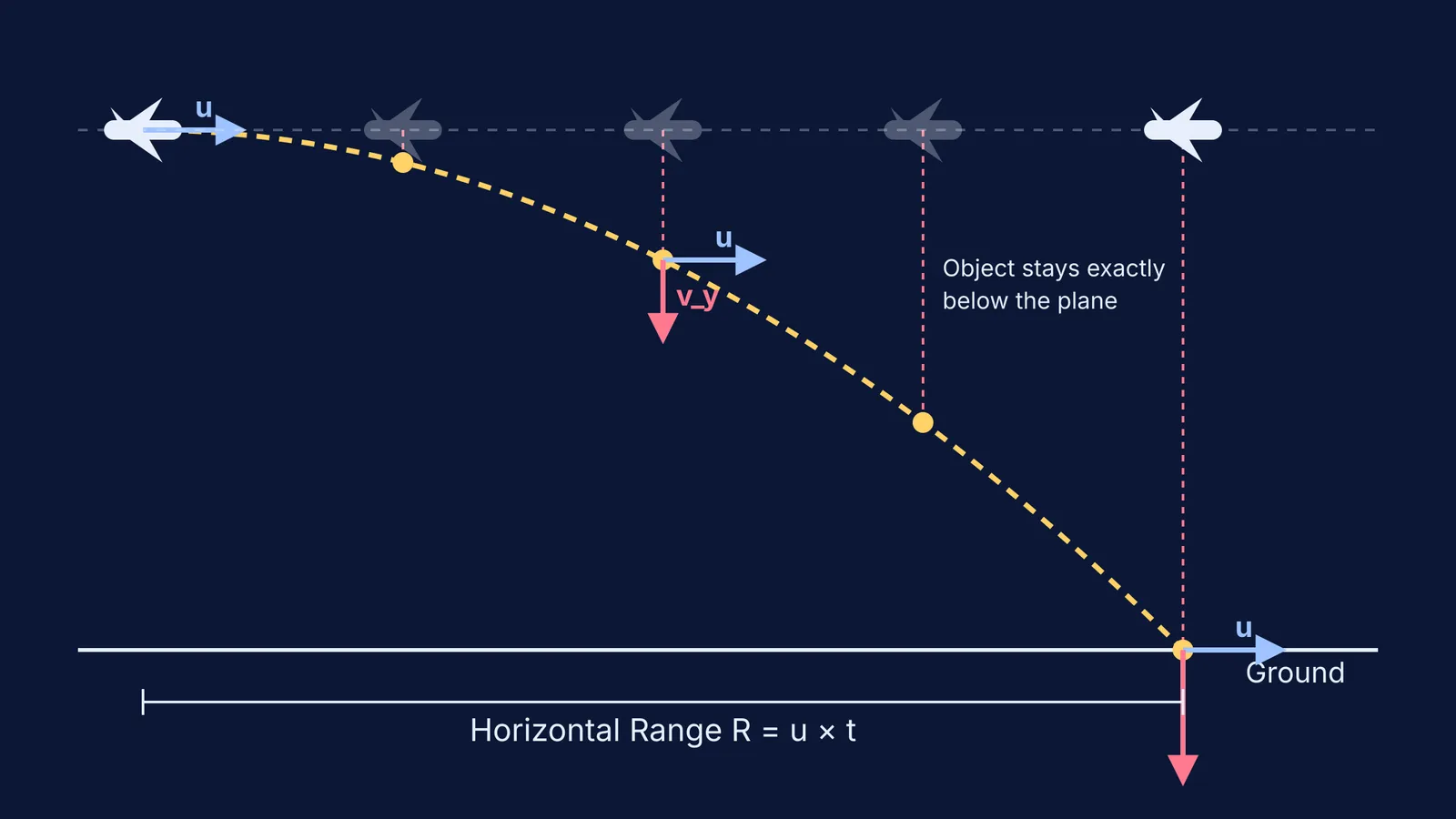
This physics problem includes a fascinating optical illusion. Because both the plane and the falling object are moving forward at the exact same horizontal speed, the object always stays directly beneath the aircraft.
If a pilot looks out the window, they do not see a curved path. They see the object getting smaller and smaller as it drops straight down relative to their seat. This perspective is often caught on camera, which reinforces the misconception that the object is falling vertically.
To an observer standing still on the ground, however, the object traces a wide, sweeping curve known as a parabola.
How do you calculate the landing distance?
To find the landing spot, you must treat the horizontal and vertical motions completely separately. This is the exact same principle you use when solving for a horizontal projectile from a cliff.
The vertical motion determines the time in the air. The object starts with zero vertical speed and accelerates downward at g (9.8 m/s²). Using the kinematic equation for height, the time of flight is t = √(2h/g).
The horizontal motion determines the range. While the object is falling for that amount of time, it is also coasting forward at a constant speed, u. Since distance is speed multiplied by time, the horizontal range R is R = u × √(2h/g).
A worked example for your physics exam
Let's put the formula into practice. Imagine an aeroplane flying horizontally at a speed of 200 m/s (about 720 km/h) at an altitude of 2000 m.
Find the time to hit the ground: Using t = √(2h/g) and taking g = 10 m/s² to keep the maths clean, we get t = √(2 × 2000 / 10) = √400 = 20 seconds.
Find the horizontal distance (range): The horizontal distance is R = u × t = 200 × 20 = 4000 metres.
The object will land exactly 4 kilometres ahead of the point in the sky where it was released. If you need to find the full equation of trajectory of a projectile, you can substitute t = x/u back into the vertical equation, proving the path is a parabola.
Mastering two-dimensional motion requires breaking problems down into independent parts. To review the foundational theory, the Fermi Concept Library covers every concept in physics, chemistry, biology, mathematics and computing, each with its own lesson and its place in the map. When you are ready for exam practice, the Fermi Problem Library has worked problems with a step-by-step solver that explains the reasoning rather than printing an answer.


