

On this page
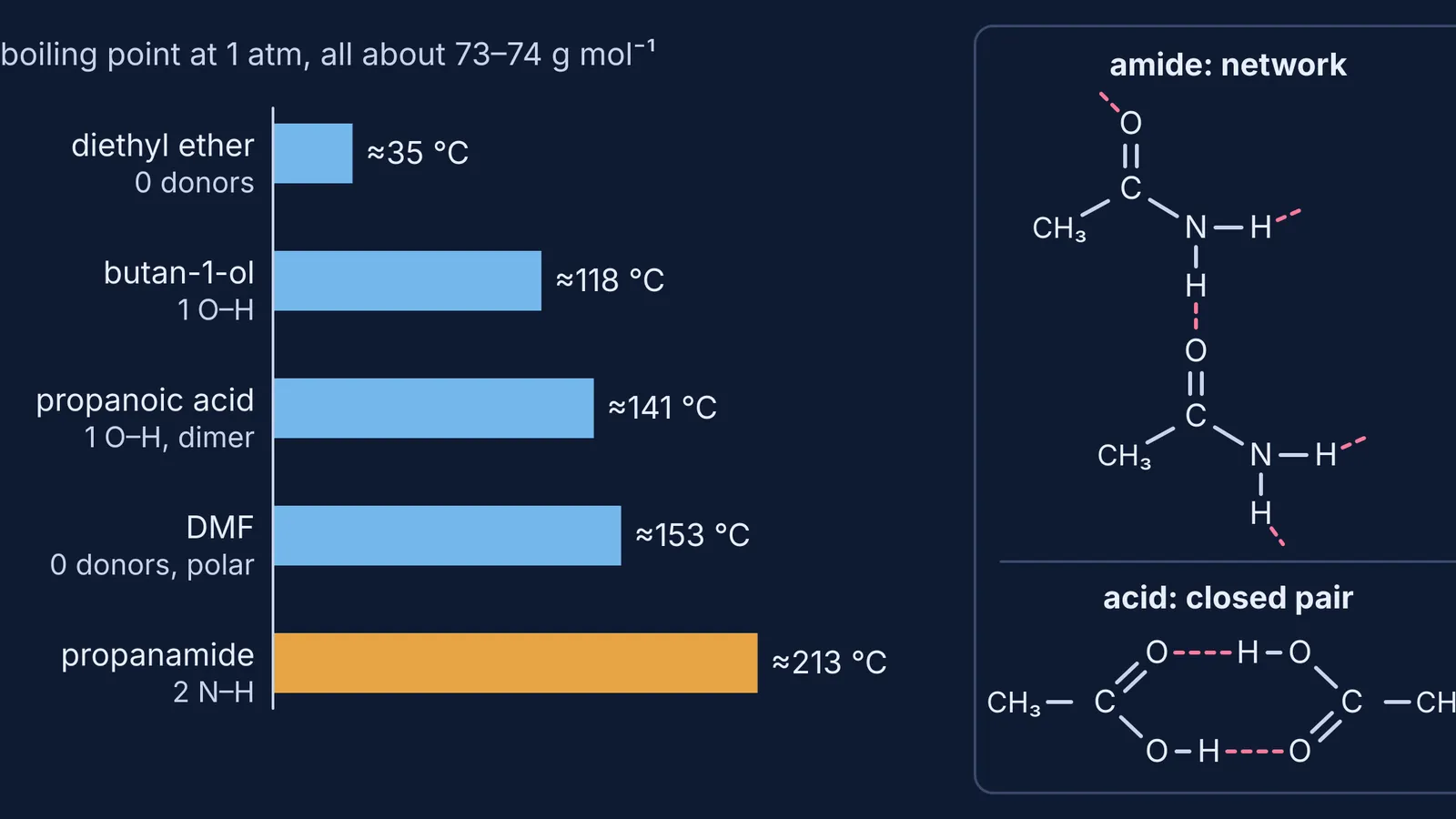
Take five compounds with almost the same molar mass, 73 to 74 g mol⁻¹. Diethyl ether boils at about 35 °C. Butan-1-ol boils at about 118 °C and propanoic acid at about 141 °C. N,N-dimethylformamide (DMF) boils at about 153 °C. Propanamide boils at about 213 °C, more than 70 °C above the acid. Since mass and size are nearly the same, the difference must come from the forces between molecules. Amides win because they combine hydrogen bonding with a very polar C=O group.
How do the boiling points compare at the same molar mass?
Approximate boiling points at 1 atm (values from standard data tables such as the CRC Handbook and PubChem; sources differ by a degree or two):
Diethyl ether, C₂H₅OC₂H₅, 74.1 g mol⁻¹: about 35 °C. No O–H, so no hydrogen bonds between molecules.
Butan-1-ol, CH₃CH₂CH₂CH₂OH, 74.1 g mol⁻¹: about 118 °C. One O–H, hydrogen-bonded chains.
Propanoic acid, CH₃CH₂COOH, 74.1 g mol⁻¹: about 141 °C. One O–H, hydrogen-bonded dimers.
DMF, HCON(CH₃)₂, 73.1 g mol⁻¹: about 153 °C. No N–H, but a large dipole.
Propanamide, CH₃CH₂CONH₂, 73.1 g mol⁻¹: about 213 °C. Two N–H and a C=O, hydrogen-bonded network.
Propanamide is also a solid at room temperature. It melts at about 80 °C, while propanoic acid melts well below 0 °C. Many simple amides are solids for the same reason, so for amides it is fair to compare melting points too.
The step from alcohols to acids is explained in why carboxylic acids boil higher than alcohols. This post picks up where that one stops.
Why are amides so polar?
The lone pair on nitrogen is delocalised into the C=O group. You can draw two resonance structures:
O=C–NH₂ (neutral form)
⁻O–C=NH₂⁺ (charge-separated form)
The real molecule is a mix of the two. The oxygen carries extra negative charge, and the nitrogen carries some positive charge. This has three effects:
A large dipole moment. Acetamide has a dipole moment of about 3.7 D, roughly twice that of acetic acid (about 1.7 D).
A better hydrogen-bond acceptor. The electron-rich amide oxygen accepts hydrogen bonds strongly.
More acidic N–H. The partial positive charge on nitrogen makes its N–H bonds better hydrogen-bond donors than the N–H of an amine.
The same delocalisation is the reason amides are hardly basic at all, as explained in why amides are less basic than amines. Note that the hydrogen-bond acceptor in an amide is the oxygen, not the nitrogen.
Why do amides boil higher than carboxylic acids?
A carboxylic acid has one O–H. Two acid molecules use their O–H and C=O groups to form a cyclic dimer held by two hydrogen bonds. That pair is closed: both donors and both acceptors are used inside it, so the dimer has little left to bond to its neighbours.
A primary amide, R–CONH₂, has two N–H donors and one strongly accepting oxygen. One molecule cannot satisfy all of them in a closed pair. Instead, each molecule bonds to several neighbours, N–H···O=C, and the molecules form extended chains and sheets. To boil the liquid, you must break into that network.
Acids also get a lower boiling point than you might expect for a different reason. Much of acetic acid vapour near its boiling point is still made of dimers. The dimer does not have to be broken to boil; it can leave the liquid as a pair. So the hydrogen bonds inside the dimer do not all count against vaporisation.
Why does DMF boil above propanoic acid with no N–H?
DMF has no hydrogen attached to N or O, so its molecules cannot hydrogen bond to each other. It still boils at about 153 °C, above propanoic acid at about 141 °C. The reason is its dipole. The same resonance as in other amides makes DMF very polar, with a dipole moment of about 3.8 D. Strong dipole–dipole attraction between all its molecules adds up to more than propanoic acid manages with its closed dimers. Compare diethyl ether, which also has no O–H: it is only weakly polar and boils at about 35 °C.
Worked example: rank four compounds by boiling point
Rank acetamide, N-methylacetamide, N,N-dimethylacetamide and acetic acid by boiling point and explain each step. Approximate data: acetamide 221 °C, N-methylacetamide 206 °C, N,N-dimethylacetamide 165 °C, acetic acid 118 °C.
Count N–H or O–H donors. Acetamide, CH₃CONH₂: two N–H. N-methylacetamide, CH₃CONHCH₃: one N–H. N,N-dimethylacetamide, CH₃CON(CH₃)₂: none. Acetic acid, CH₃COOH: one O–H.
Acetamide is highest (about 221 °C). Two N–H donors plus the polar amide oxygen give an extended hydrogen-bonded network.
N-methylacetamide is next (about 206 °C). One N–H per molecule still links the molecules into long N–H···O=C chains, the same pattern as in proteins. Fewer donors means a weaker network, even though the molar mass goes up from 59 to 73 g mol⁻¹.
N,N-dimethylacetamide comes third (about 165 °C). No donors, so no hydrogen bonds between its molecules. It has a large dipole and the largest mass of the four (87 g mol⁻¹), which keeps it above the acid.
Acetic acid is lowest (about 118 °C). One O–H, but it is used up in closed dimers, and the dimers survive into the vapour.
Answer: acetamide > N-methylacetamide > N,N-dimethylacetamide > acetic acid.
Notice that boiling point falls as the molar mass rises from acetamide to N,N-dimethylacetamide. Removing N–H donors matters more than adding mass. The same N–H counting works for amines, in why primary amines boil higher than tertiary amines. If you want more practice ranking boiling points with mixed functional groups, the Fermi Problem Library has a step-by-step solver that explains the reasoning at each step.
Which forces matter most for amides in exam answers?
When a question asks you to explain an amide's high boiling point, write three things:
Donors: how many N–H bonds the amide has (two for primary, one for secondary, none for tertiary).
Acceptor: the C=O oxygen, made electron-rich by resonance with the nitrogen lone pair.
Structure: an open network or chain, not a closed pair like an acid dimer.
For tertiary amides such as DMF, replace the first point with the large dipole moment.
Quick checklist
At about 73 to 74 g mol⁻¹: ether (about 35 °C) < butan-1-ol (about 118 °C) < propanoic acid (about 141 °C) < DMF (about 153 °C) < propanamide (about 213 °C).
Amide resonance puts extra negative charge on oxygen and makes amides very polar (acetamide about 3.7 D).
Primary amides have two N–H donors and form networks; acids form closed dimers.
Acetic acid vapour is largely dimeric, so its dimers are not broken on boiling.
DMF has no N–H: explain its boiling point by dipole–dipole forces, not hydrogen bonds.
Fewer N–H means a lower boiling point: acetamide > N-methylacetamide > N,N-dimethylacetamide.


