

On this page
Four different amines share the formula C3H9N. They have the same atoms and the same molar mass, yet at room temperature one is a liquid that boils at about 49 °C and another is a gas that boils at about 2 °C. Most of that gap comes from one small detail: whether a hydrogen atom sits on the nitrogen.
If you are preparing for Class 12 boards, JEE Main or NEET-UG, this comparison is part of the NCERT amines chapter. Here is the reason, the real numbers and a ranking method.
What makes an amine primary, secondary or tertiary?
The NCERT Class 12 Chemistry chapter on amines (Unit 9) classifies amines by how many hydrogen atoms of ammonia have been replaced by alkyl or aryl groups. A primary amine (RNH2) has two N–H bonds. A secondary amine (R2NH) has one N–H bond. A tertiary amine (R3N) has none.
For C3H9N there are four structures: propan-1-amine and propan-2-amine (both primary), N-methylethanamine (secondary) and N,N-dimethylmethanamine, better known as trimethylamine (tertiary). Our post on the structural isomers of C3H9N and the Hinsberg test explains how to draw and tell them apart.
Why do primary amines boil higher than tertiary amines?
Boiling means pulling molecules away from their neighbours, so anything that holds the molecules together raises the boiling point. The NCERT amines chapter puts it this way: primary and secondary amines show intermolecular association through hydrogen bonding between the nitrogen of one molecule and the hydrogen of another.
That association is stronger in primary amines because each molecule has two N–H hydrogens to offer, according to the same NCERT chapter. A secondary amine has only one. A tertiary amine still has a lone pair on nitrogen, but no N–H hydrogen, so its molecules cannot hydrogen bond to each other at all. Only weaker dipole and dispersion forces hold them together.
NCERT's conclusion for isomeric amines is the order primary > secondary > tertiary.
What are the boiling points of the C3H9N isomers?
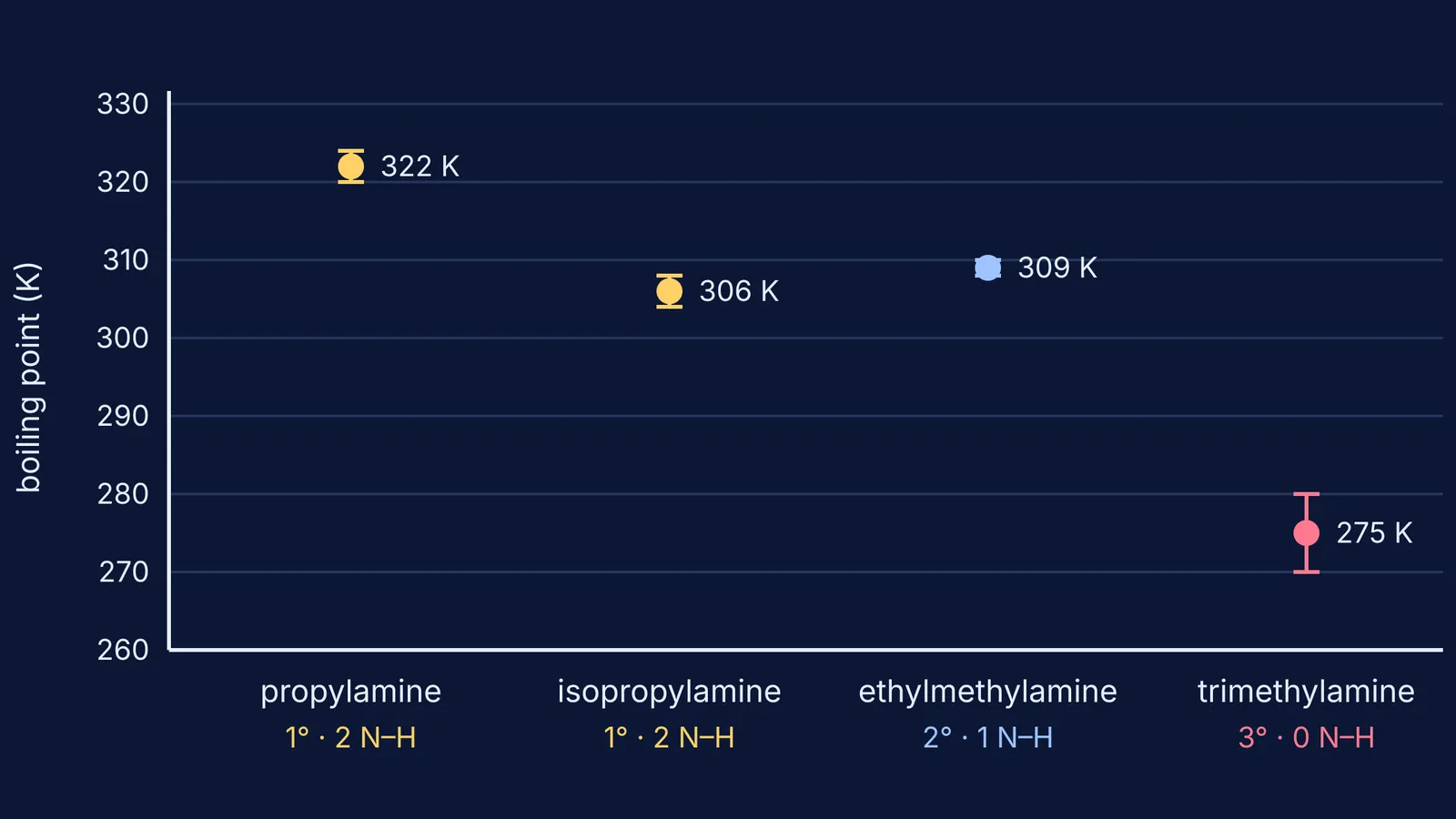
The NIST Chemistry WebBook lists averaged, measured boiling points for all four isomers:
Propan-1-amine (primary, 2 N–H): 322 ± 2 K, about 49 °C
Propan-2-amine (primary, 2 N–H, branched): 306 ± 2 K, about 33 °C
N-methylethanamine (secondary, 1 N–H): 309 ± 1 K, about 36 °C
Trimethylamine (tertiary, 0 N–H): 275 ± 5 K, about 2 °C
Propan-1-amine boils about 47 K higher than trimethylamine, its tertiary isomer, according to these NIST averages.
The NCERT chapter shows the same pattern with C4 amines of molar mass 73 in its Table 9.2: n-butylamine boils at 350.8 K, diethylamine at 329.3 K and ethyldimethylamine at 310.5 K.
Why do amines boil lower than alcohols of similar mass?
The same NCERT Table 9.2 puts butan-1-ol at 390.3 K, about 40 K above n-butylamine. NCERT explains that nitrogen (electronegativity 3.0) is less electronegative than oxygen (3.5), so alcohols are more polar and form stronger hydrogen bonds than amines. An alkane of similar mass, 2-methylbutane, boils at only 300.8 K in that table because it has no hydrogen bonding.
The same reasoning explains why aldehydes boil at lower temperatures than alcohols.
How do you rank amine boiling points in an exam?
Use this order of checks and stop as soon as one decides the answer:
Compare molar masses. If they differ a lot, the heavier compound usually boils higher.
If they are isomers, count N–H bonds: two beats one, and one beats zero.
If the N–H count is the same, compare shape: straight chains boil higher than branched ones.
Across functional groups of similar mass, remember NCERT's order: alcohol > amine > alkane.
Write one line of reason that names the force, not just the order.
Worked example: rank propan-1-amine, N-methylethanamine and trimethylamine. All three are C3H9N, so step 1 ties. Step 2 gives 2, 1 and 0 N–H bonds. Answer: propan-1-amine > N-methylethanamine > trimethylamine, which matches the NIST values of 322 K, 309 K and 275 K.
A one-line reason you can write: "Intermolecular N–H···N hydrogen bonding is greatest in the primary amine, smaller in the secondary amine and absent in the tertiary amine, so boiling point falls in that order."
If the idea of hydrogen bonding itself feels shaky, the Fermi Concept Library has a lesson for each chemistry concept and shows where it sits in the map, so you can go back one step before practising. When you want to check your ranking on new sets of compounds, the Fermi Problem Library has worked problems with a step-by-step solver that explains the reasoning rather than printing an answer.
For mixed lists with alcohols, acids and haloalkanes, read next: how to arrange organic compounds by boiling point.


