

On this page
Ranking questions ask one thing: how hard do these molecules hold on to each other? Boiling pulls molecules apart into a gas, so stronger attraction means more heat. Check the forces in a fixed order and an "arrange in increasing order of boiling point" question in CBSE boards or JEE Main becomes reasoning, not guesswork.
What decides the boiling point of an organic compound?
Three kinds of attraction do the work. At similar size, from strongest to weakest:
Hydrogen bonding needs a hydrogen attached to O or N: the O–H of alcohols and acids, the N–H of primary and secondary amines. Our guide to intermolecular hydrogen bonding covers when it forms.
Dipole–dipole attraction comes from polar bonds such as C–Cl. If you are unsure which molecules are polar, see our explainer on dipole moment and polarity.
Dispersion (van der Waals) forces act in every molecule and grow with the number of electrons and the contact area between molecules.
For haloalkanes, dispersion matters more than polarity. The LibreTexts page on alkyl halides/Alkyl_Halides/Properties_of_Alkyl_Halides/Physical_Properties_of_Alkyl_Halides) says "the effect of the permanent dipole-dipole attractions is much less important than that of the temporary dipoles which cause the dispersion forces." That is why boiling point rises from chloride to bromide to iodide: PubChem lists chloromethane at −23.7 °C, bromomethane at 3.4 °C and iodomethane at 42.5 °C.
Why do acids boil higher than alcohols, and alcohols higher than amines?
Carboxylic acids pair up. Two acid molecules form a dimer held by two hydrogen bonds, and the LibreTexts page on carboxylic acids/Carboxylic_Acids/Properties_of_Carboxylic_Acids/Physical_Properties_of_Carboxylic_Acids) puts their "exceptionally high boiling points" down largely to these dimers. Its comparison: butanoic acid boils at 164 °C, 1-pentanol, a molecule of the same molar mass, at 138 °C.
Alcohols beat amines because O–H···O hydrogen bonds are stronger than N–H···N ones; oxygen is more electronegative than nitrogen. The LibreTexts page on amine properties/23%3A_Amines/23.12%3A_Physical_Properties) says that, measured against alkanes of similar size, the boiling-point increase for primary amines is "roughly half" the increase for equivalent alcohols.
Within amines, count the hydrogens on nitrogen: primary amines have two, secondary one, tertiary none. The same LibreTexts page gives three amines with the formula C3H9N: the primary amine boils at 48 °C, the secondary (N-methylethanamine) at 37 °C, and trimethylamine, which has no N–H, at 3 °C.
How do molar mass and branching change the order?
Within one family, a bigger molecule has more electrons and surface, so dispersion forces and boiling point rise. Branching does the opposite: compact molecules touch less. The LibreTexts page on alkanes/03:_Organic_Compounds-_Alkanes_and_Their_Stereochemistry/3.05:_Properties_of_Alkanes) lists the C5H12 isomers: pentane 309.2 K, 2-methylbutane 301.0 K, 2,2-dimethylpropane 282.6 K.
Alcohols follow the same pattern. PubChem gives butan-1-ol at 117.7 °C, butan-2-ol at 99.5 °C and 2-methylpropan-2-ol at 82.4 °C. Practise on a full isomer set with our walk-through of the isomers of C4H10O.
How to arrange organic compounds in order of boiling point: a four-step method
Sort by the strongest force each molecule has: carboxylic acid > alcohol > primary amine > secondary amine > polar molecules with no O–H or N–H (haloalkanes, tertiary amines) > alkanes.
If two compounds fall in the same group, compare molar mass: the heavier one usually boils higher.
If the masses are equal, compare shape: the straight chain boils higher, and primary > secondary > tertiary isomers.
Watch big mass gaps. The steps assume similar sizes; a heavy haloalkane can come close to a light hydrogen-bonder. PubChem lists iodomethane (142 g/mol) at 42.5 °C, only 5.5 °C below propan-1-amine (59 g/mol) at 48 °C.
Worked example: six compounds of about 60 g/mol
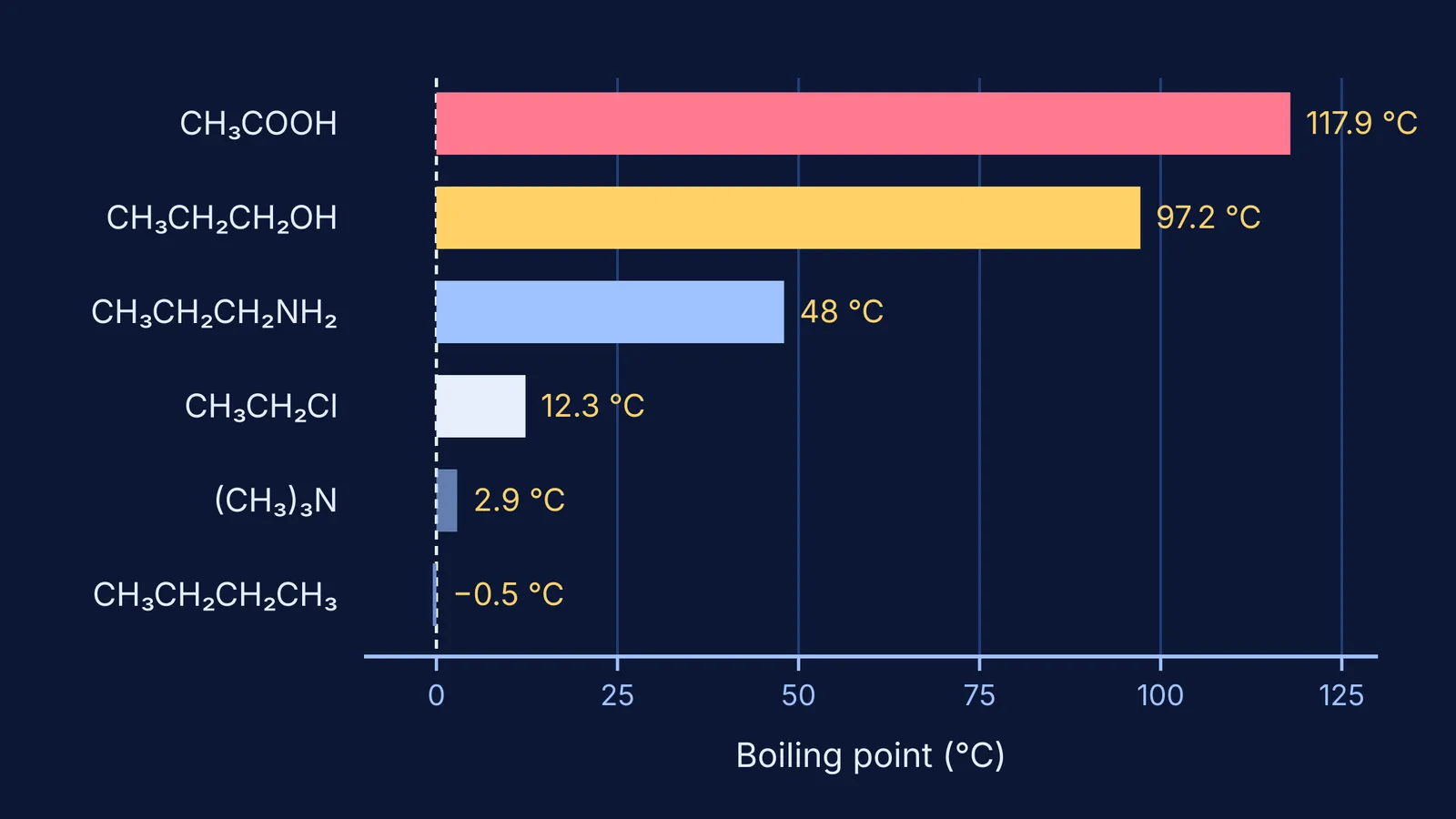
Arrange in increasing order of boiling point: butane, chloroethane, trimethylamine, propan-1-amine, propan-1-ol, ethanoic acid. PubChem puts all six between 58 and 65 g/mol, so step 1 decides almost everything.
Ethanoic acid has –COOH and forms dimers: highest.
Propan-1-ol has one O–H: second.
Propan-1-amine has two N–H: third.
Chloroethane and trimethylamine have no O–H or N–H; chloroethane is heavier and more polar, so it edges ahead.
Butane has only dispersion forces: lowest.
Answer: butane < trimethylamine < chloroethane < propan-1-amine < propan-1-ol < ethanoic acid. The data agree: PubChem lists butane at −0.5 °C, trimethylamine at 2.87 °C, chloroethane at 12.3 °C, propan-1-amine at 48 °C, propan-1-ol at 97.2 °C and ethanoic acid at 117.9 °C.
Where do students lose marks on these questions?
Ranking by molar mass before checking for hydrogen bonding.
Forgetting that tertiary amines have no N–H, so they cannot hydrogen-bond with each other.
Assuming polarity beats size among haloalkanes, when dispersion usually decides.
Writing the order in reverse: check whether the question asks for increasing or decreasing.
If you keep getting the right order for the wrong reason, work a few ranking problems in the Fermi Problem Library, where the step-by-step solver explains the reasoning rather than printing an answer. If one of the forces itself is shaky, it has its own lesson in the Fermi Concept Library.
Try the four steps on your next textbook ranking question before checking the answer.


