

On this page
This set follows set 1 of our alternating current JEE Main questions and tests sub-topics that set left out.
How should you use AC practice set 2?
The NTA's Syllabus for JEE (Main) - 2027 lists peak and RMS values, reactance and impedance, the LCR series circuit, resonance, power in AC circuits, wattless current, the AC generator and the transformer under Physics Unit 14. Every question below stays inside that list, NCERT Class 12 Physics Chapter 7 and the AC generator in Chapter 6, section 6.8 (Reprint 2026-27).
Give yourself 25 minutes, on paper, no calculator.
Q3 and Q6 need a number, not an option.
New to the chapter? Start with our guide on how to prepare Alternating Current for JEE Main.
Easy: can you read phase, frequency and time from an AC equation?
Q1 (easy). A circuit element has v = 100 sin(100πt) V across it and i = 2 sin(100πt + π/3) A through it. Its average power and its nature are:
(A) 50 W, capacitive (B) 100 W, capacitive (C) 50 W, inductive (D) 86.6 W, capacitive
Answer: (A). These are peak values, so P = ½VmIm cos φ = ½ × 100 × 2 × cos 60° = 50 W. The current is ahead of the voltage by π/3, and a leading current means capacitive. Trap: (C), which gets the power right but links a leading current with an inductor.
Q2 (easy). A series LCR circuit is driven at one third of its resonant angular frequency ω₀. The ratio XL/XC and the phase of the current are:
(A) 1/9, current leads (B) 1/9, current lags (C) 1/3, current leads (D) 9, current lags
Answer: (A). At ω₀, XL = XC. Cutting ω to a third cuts XL to a third and triples XC, so XL/XC = (1/3)/3 = 1/9. XC is larger, so the current leads. Trap: (C), which changes only one reactance.
Q3 (easy, numerical). A 230 V rms, 50 Hz supply passes through zero, rising, at t = 0. Find the instantaneous voltage, in volts, at t = 2.5 ms.
Answer: 230. The peak is 230√2 ≈ 325 V and ωt = 100π × 0.0025 = π/4, so v = 325 × sin 45° = 230 V. Trap: 163, which uses 230 V as the peak.
Medium: can you handle RC phase, the generator and a non-sine wave?
Q4 (medium). A 100 Ω resistor and a capacitor are in series on a 50 Hz supply. The current leads the supply voltage by 60°. The capacitance is closest to:
(A) 9.2 μF (B) 18.4 μF (C) 31.8 μF (D) 55.1 μF
Answer: (B). In an RC circuit tan φ = XC/R, so XC = 100 × √3 = 173.2 Ω and C = 1/(100π × 173.2) ≈ 18.4 μF. Trap: (D), from tan φ = R/XC, which puts XC at 57.7 Ω.
Q5 (medium). A 100-turn coil of area 0.050 m² spins at 50 rad/s about an axis perpendicular to a 0.20 T field. The emf at the instant the plane of the coil makes 30° with the field is:
(A) 25 V (B) 35.4 V (C) 43.3 V (D) 50 V
Answer: (C). The peak emf is NBAω = 100 × 0.20 × 0.050 × 50 = 50 V. NCERT writes e = NBAω sin ωt, where ωt is the angle between the field and the coil's area vector (its normal). With the plane at 30° to the field, the normal is at 60°, so e = 50 sin 60° = 43.3 V. Trap: (A), which puts the angle of the plane into the sine.
Q6 (medium, numerical). A current rises linearly from 0 to 6.0 A over each period T and then drops instantly back to 0 (a sawtooth). It flows through a 5.0 Ω resistor. Find the average power dissipated, in watts.
Answer: 60. With i = 6t/T, the mean of i² over a period is (1/T)∫36t²/T² dt from 0 to T = 36/3 = 12 A², so P = 12 × 5.0 = 60 W. Trap: 90, from the sine rule irms = Im/√2; 45 uses the mean current, 3 A.
Hard: can you find half-current points and spot a coil's resistance?
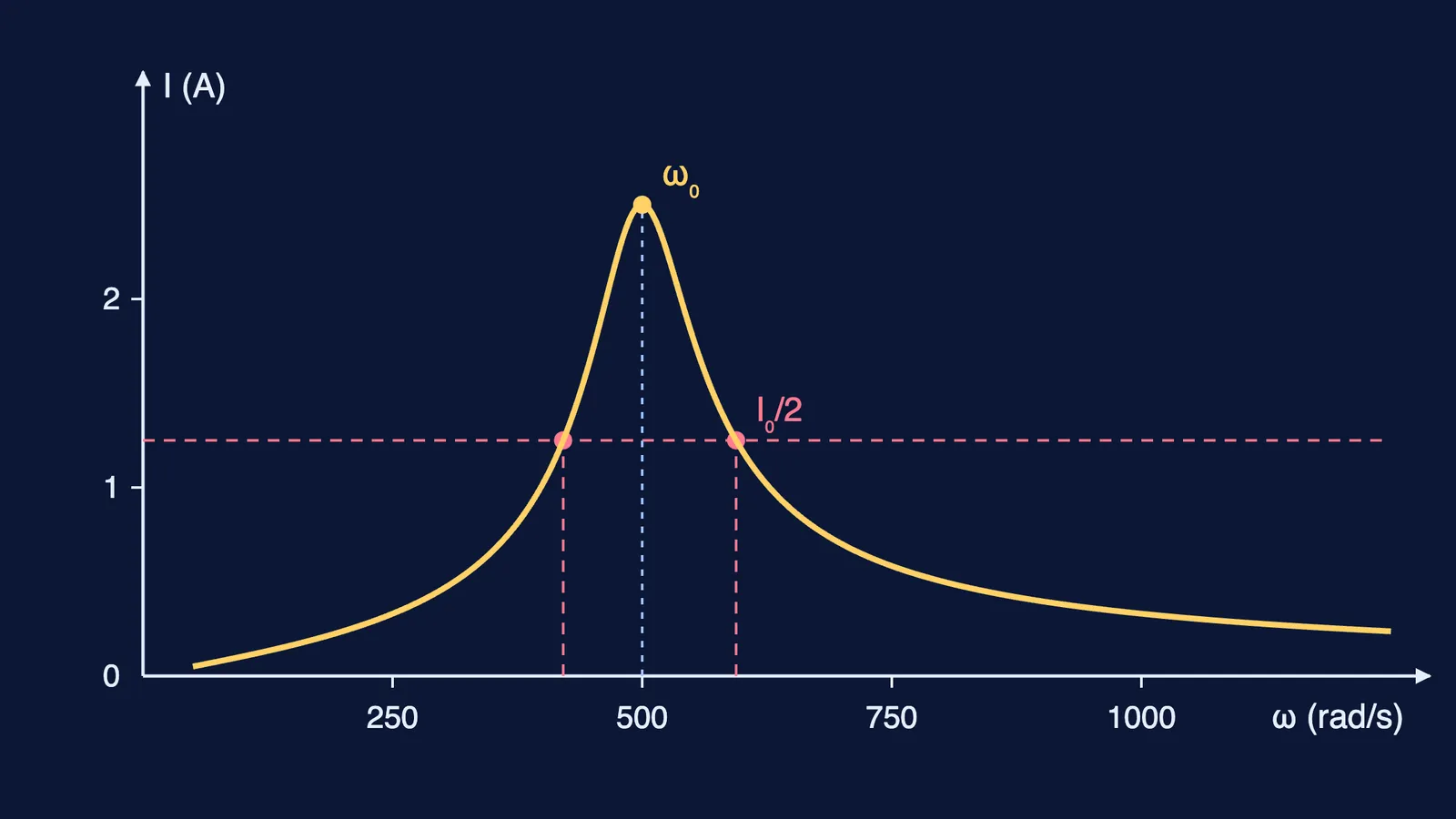
Q7 (hard). A series circuit has R = 40 Ω, L = 0.40 H and C = 10 μF. Above resonance, the angular frequency at which the current falls to half its value at resonance is closest to:
(A) 552 rad/s (B) 594 rad/s (C) 866 rad/s (D) 1000 rad/s
Answer: (B). ω₀ = 1/√(LC) = 500 rad/s, where Z = R. Half the current means Z = 2R, so XL − XC = √3R = 69.3 Ω. Then 0.40ω − 10⁵/ω = 69.3 gives ω ≈ 594 rad/s (the curve at the top; the lower point is 421 rad/s). Trap: (A), which sets XL − XC = R. That is the half-power point (current 1/√2 of peak).
Q8 (hard). An 18 Ω resistor is in series with a coil on a 75 V rms AC supply. Voltmeters read 36 V across the resistor and 51 V across the coil. The average power drawn by the coil is:
(A) 0 W (B) 48 W (C) 72 W (D) 102 W
Answer: (B). The current is 36/18 = 2.0 A. Let the coil's resistive and inductive voltages be a and b. Then a² + b² = 51² and (36 + a)² + b² = 75², which give a = 24 V and b = 45 V. The coil's resistance is 12 Ω, so it takes 2.0 × 24 = 48 W. Trap: (A), which treats the coil as a pure inductor. If it were, the supply would be √(36² + 51²) ≈ 62 V, not 75 V.
What should you do after marking set 2?
Sort each miss into one bin: phase and sign (Q1, Q2, Q4), instantaneous and rms values (Q3, Q5, Q6) or resonance and power (Q7, Q8). Redo the fullest bin in two days without the solutions. For sign slips such as calling a leading current inductive, our list of common EMI and AC mistakes in JEE and NEET is a quick read.
If a whole method breaks down rather than one step, the Fermi Problem Library has worked problems with a step-by-step solver that explains the reasoning rather than printing an answer.


