

On this page
These eight new questions follow the JEE Main numerical format and run easy to hard and stay inside the AC part of Unit 14 of the NTA syllabus for JEE (Main) 2027 and NCERT Class 12 Physics Chapter 7. For theory first, read how to prepare alternating current for JEE Main.
What is a JEE Main numerical-value question?
In Paper 1 of JEE (Main) 2027, each subject has Section A with 20 multiple-choice questions and Section B with 5 questions whose answer is a numerical value, according to the NTA Information Bulletin for JEE (Main) 2027. Section B has negative marking: +4 for a correct answer, −1 for a wrong one, 0 if left blank. You type the answer on an on-screen keypad, rounded off to the nearest integer.
So every answer below is an integer. Take all AC values as rms unless a question says peak.
Easy: can you read rms, phase and energy correctly?
Q1 (easy). A sinusoidal voltage on an oscilloscope spans 6.0 vertical divisions from crest to trough. The scale is 10 V per division. Find the rms value of the voltage, in volts, to the nearest integer.
Answer: 21. Peak-to-peak is 60 V, so the peak is 30 V and the rms value is 30/√2 ≈ 21.2 V.
Trap: 42 divides the peak-to-peak value, not the peak, by √2.
Q2 (easy). A 20 Ω resistor and a pure inductor of reactance 20 Ω are in series across a 50 Hz supply. Each current peak comes a short time after the voltage peak before it. Find that time, in microseconds (μs).
Answer: 2500. tan φ = X_L/R = 1, so φ = π/4. The delay is φ/ω = (π/4)/(100π) = 1/400 s = 2.5 ms, or 2500 μs: one-eighth of the 20 ms period.
Trap: 5000 is a quarter-period, the lag for a pure inductor; the resistor cuts the phase to 45°.
Q3 (easy). A kettle element (a pure resistor) draws 4.0 A from a 230 V, 50 Hz supply. Find the heat it produces in one cycle, in joules, to the nearest integer.
Answer: 18. Average power is 230 × 4.0 = 920 W, and one cycle lasts 1/50 s, so the heat is 920/50 = 18.4 J.
Trap: 37 multiplies the peak voltage by the peak current, which is twice the average power.
Medium: what changes when the current varies inside a cycle?
Q4 (medium). A sinusoidal current of 5.0 A at 50 Hz flows in a wire. Find the charge that passes a cross-section during one half-cycle (between two zeros of the current), in mC, to the nearest integer.
Answer: 45. The peak current is 5.0√2 ≈ 7.07 A. Integrating I₀ sin ωt over a half-cycle gives q = 2I₀/ω = 2 × 7.07/(100π) ≈ 0.0450 C.
Trap: 50 multiplies the rms current by the half-period, 0.01 s.
Q5 (medium). A 60 Ω resistor and a pure inductor of reactance 80 Ω are in series across a 250 V, 50 Hz supply. Find the largest energy stored in the inductor during a cycle, in units of 0.1 J, to the nearest integer.
Answer: 16. Z = √(60² + 80²) = 100 Ω, so I = 2.5 A and I₀ = 2.5√2 A. L = 80/(100π) ≈ 0.255 H. The energy peaks when the current does: ½LI₀² = ½ × 0.255 × 12.5 ≈ 1.59 J, or 15.9 in units of 0.1 J.
Trap: 8 uses the rms current in ½LI², which halves the answer.
Q6 (medium). A series LCR circuit is driven by a source of fixed voltage. The rms current is the same at 40 Hz and at 90 Hz. Find the resonant frequency, in Hz.
Answer: 60. Equal currents mean equal |X_L − X_C|, with the circuit capacitive at 40 Hz and inductive at 90 Hz. Setting X_L − X_C at one frequency equal to X_C − X_L at the other gives f₁f₂ = 1/(4π²LC) = f₀², so f₀ = √(40 × 90) = 60 Hz.
Trap: 65 takes the arithmetic mean. The resonant frequency is the geometric mean.
Hard: can you handle power factor and instantaneous power?
Q7 (hard). An inductive load takes 920 W from a 230 V, 50 Hz supply at a power factor of 0.8, lagging. A capacitor connected in parallel with the load brings the power factor of the supply current to 1. Find its capacitance, in μF, to the nearest integer.
Answer: 42. The load current is 920/(230 × 0.8) = 5.0 A. Its wattless part is 5.0 × sin φ = 5.0 × 0.6 = 3.0 A. The capacitor must draw exactly 3.0 A, leading, so X_C = 230/3.0 ≈ 76.7 Ω and C = 1/(100π × 76.7) ≈ 41.5 μF.
Trap: 69 cancels the whole 5.0 A instead of only its wattless part.
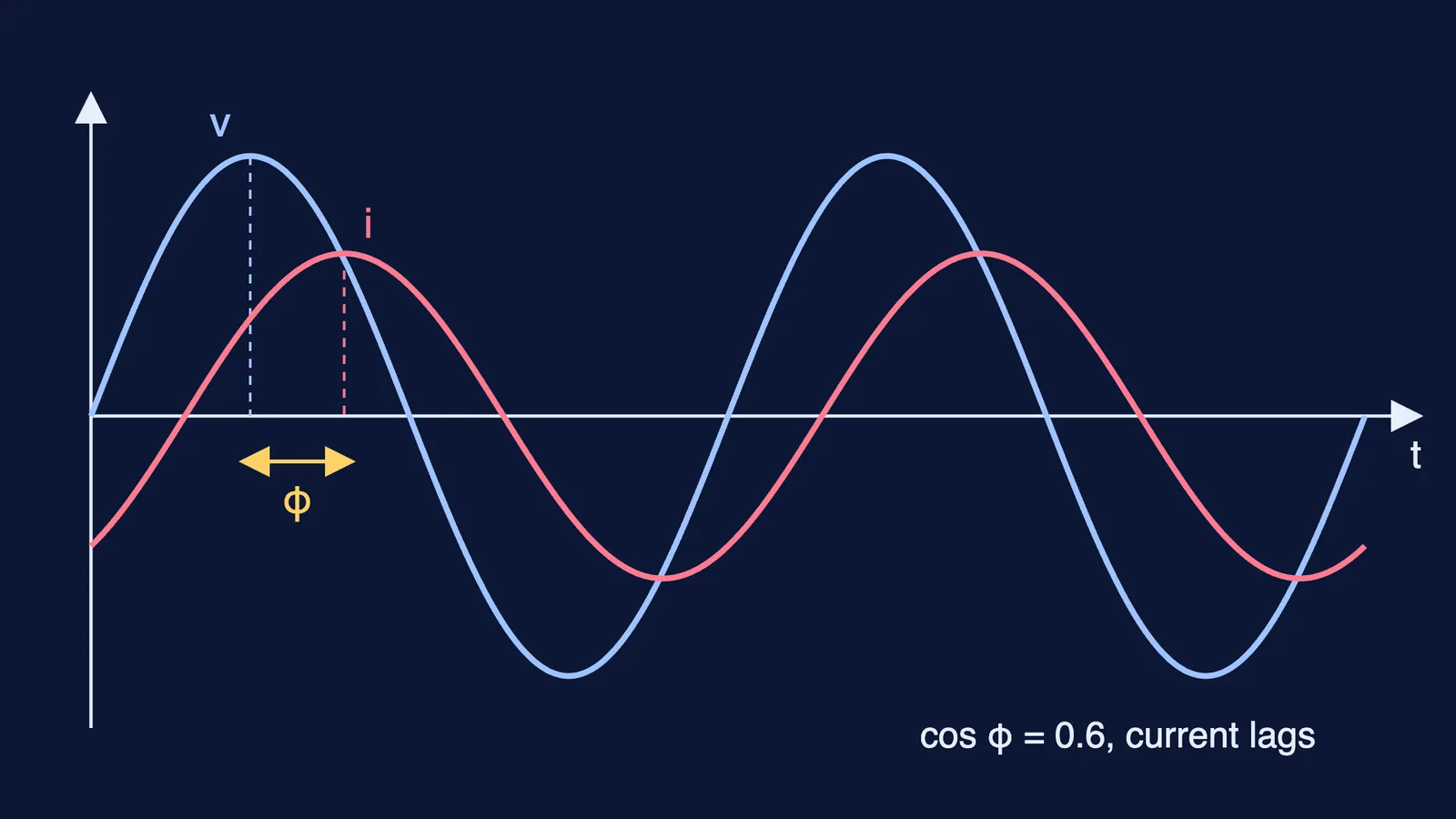
Q8 (hard). A series circuit on a 200 V supply carries 5.0 A with a power factor of 0.6, the current lagging. For part of each cycle the circuit returns energy to the source. Find the largest rate at which it does so, in watts.
Answer: 400. With v = V₀ sin ωt and i = I₀ sin(ωt − φ), the product is p = V_rms I_rms[cos φ − cos(2ωt − φ)]. Here V_rms I_rms = 1000 W, so p swings between 1000(0.6 + 1) = 1600 W and 1000(0.6 − 1) = −400 W. The negative peak, 400 W, is energy flowing back from the inductor.
Trap: 600 is the average power, not the reverse flow.
How to get the number right
Write ω = 2πf before any reactance; 50 Hz gives ω = 100π ≈ 314 rad/s.
Label each value rms or peak as you copy it.
Convert mH and μF to H and F first, then convert back to the asked unit at the end.
Scale to the asked unit: "in units of 0.1 J" means 2.47 J is typed as 25.
Round once, at the end. Keep full precision until you type the integer.
Can't picture why the current peak trails the voltage peak in Q8? The Fermi Simulation Lab has interactive simulations for ideas that are easier to see than to read.
For multiple-choice practice, try our alternating current JEE Main practice questions with solutions.


