

On this page
Some JEE numericals give you two molar masses: one for an unknown compound and one for its derivative. They want you to work out how many groups reacted. You do not need the structure first. Each type of reaction adds a fixed mass per group, so the difference in molar mass divided by that fixed amount gives the count. The commonest case is acetylation, and its number is 42, not 43.
Why does acetylation add 42 per OH group, not 43?
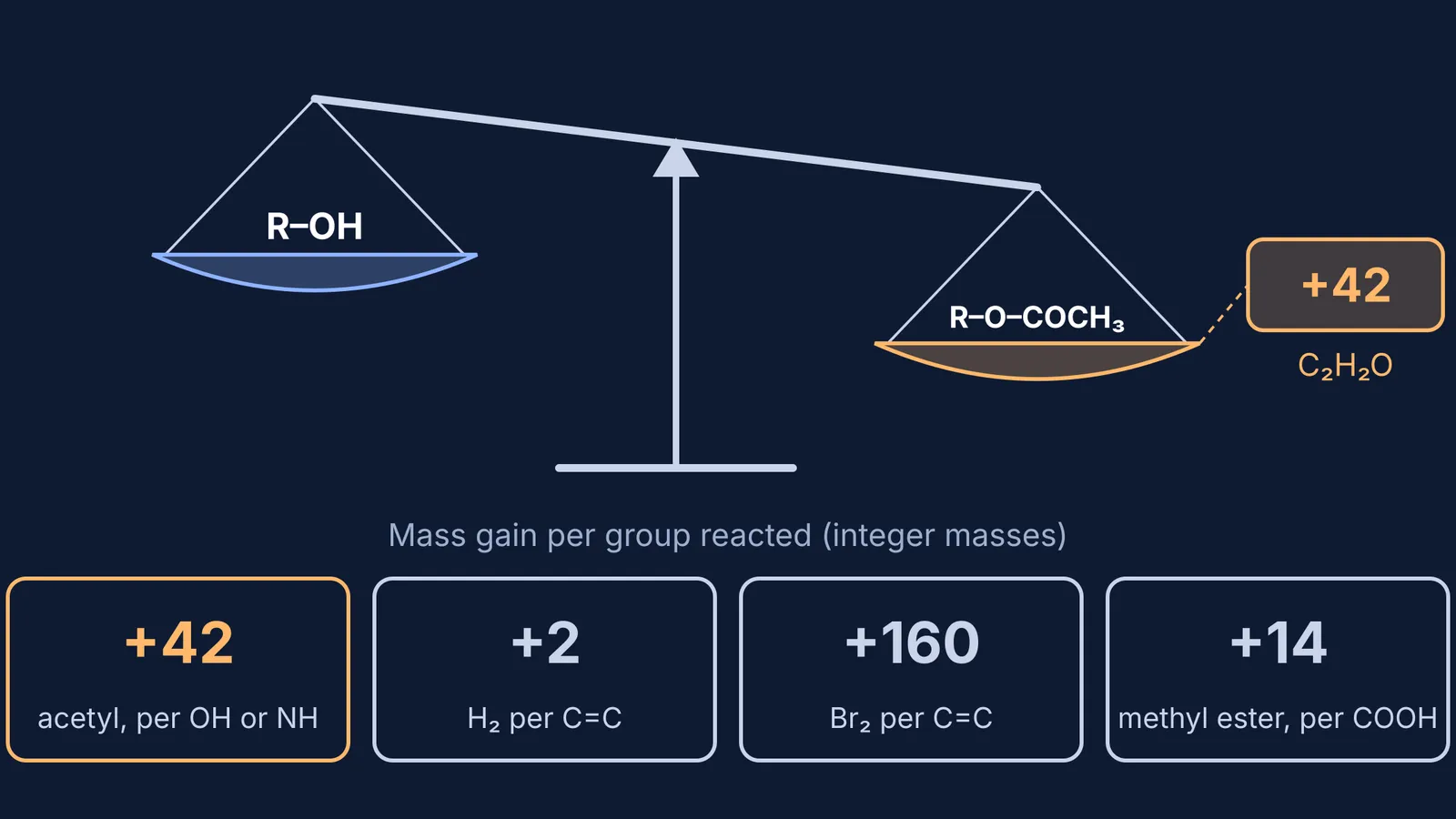
Acetylation swaps the H of an O–H for an acetyl group, CH₃CO–:
R–OH + (CH₃CO)₂O → R–O–COCH₃ + CH₃COOH
R–OH + CH₃COCl → R–O–COCH₃ + HCl
The acetyl group CH₃CO has mass 12 + 3 + 12 + 16 = 43. But one H (mass 1) leaves the molecule. So the net gain is 43 − 1 = 42, which is the mass of C₂H₂O.
Many students write 43 because they count only what was added. Always ask what was added and what was removed. With accurate atomic masses the gain is 42.04, so use 42 only when the question uses integer masses.
The same +42 applies to the N–H of a primary or secondary amine: R–NH₂ + (CH₃CO)₂O → R–NH–COCH₃ + CH₃COOH. A primary amine usually takes only one acetyl group under ordinary conditions. A tertiary amine has no N–H and gains nothing.
How do you find the number of OH groups from molar mass?
Use one formula:
number of groups = (M of derivative − M of original) ÷ gain per group
Then check that the answer is a whole number. If it is not, you have used the wrong gain, or the question gave masses of samples rather than molar masses (see the last example below).
Worked examples: glycerol, glucose and an unknown
Example 1: glycerol. Glycerol, C₃H₈O₃, has M = 92. Its full acetate has M = 218.
Difference: 218 − 92 = 126.
Divide by 42: 126 ÷ 42 = 3.
Glycerol has 3 OH groups. Check: the triacetate is C₉H₁₄O₆, and 9 × 12 + 14 + 6 × 16 = 218.
Example 2: glucose. Glucose, C₆H₁₂O₆, has M = 180. Its pentaacetate has M = 390.
Difference: 390 − 180 = 210.
Divide by 42: 210 ÷ 42 = 5.
Glucose has 5 OH groups. NCERT uses this result as evidence that glucose has five OH groups. How that and the missing Schiff's test fit together is in why glucose gives no Schiff's test or bisulphite product.
Example 3: an unknown. An organic compound has M = 136. With excess acetic anhydride it gives a product with M = 220. Lassaigne's test is then used. What groups are present?
Difference: 220 − 136 = 84.
Divide by 42: 84 ÷ 42 = 2. Two groups were acetylated.
They can be OH or NH (each +42), so mass alone cannot tell them apart.
Use the nitrogen rule as a check. A compound of C, H, O and N with an even integer molar mass has zero or an even number of N atoms. M = 136 is even, so "one OH and one NH₂, with no other N" is ruled out.
If Lassaigne's test shows no nitrogen, both groups are OH. A formula that fits is C₈H₈O₂ (8 × 12 + 8 + 32 = 136); its diacetate is C₁₂H₁₂O₄ = 220.
If Lassaigne's test shows nitrogen, two NH₂ groups fit. C₈H₁₂N₂ (96 + 12 + 28 = 136) gives a diacetyl product C₁₂H₁₆N₂O₂ = 220.
Example 4: masses of samples, not molar masses. 1.84 g of glycerol gives 4.36 g of acetyl derivative. First find moles: 1.84 ÷ 92 = 0.0200 mol. One mole of glycerol gives one mole of product, so the product's molar mass is 4.36 ÷ 0.0200 = 218. Now proceed as in Example 1: 3 OH groups.
If you want more problems of this type with each step explained, the Fermi Problem Library has a step-by-step solver that explains the reasoning.
What other reactions can count groups by mass?
The method is the same; only the gain changes.
Hydrogenation: +2 per C=C (one H₂), +4 per C≡C (two H₂). Limonene, C₁₀H₁₆ (M = 136), takes up two H₂ to give C₁₀H₂₀ (M = 140): (140 − 136) ÷ 2 = 2 C=C bonds.
Bromine addition: +160 per C=C (Br₂, integer masses). With accurate masses it is 2 × 79.9 = 159.8. Limonene gives C₁₀H₁₆Br₄, M = 456, and (456 − 136) ÷ 160 = 2.
Methyl ester formation: +14 per COOH. R–COOH becomes R–COOCH₃: CH₃ (15) added, H (1) lost.
Benzoylation: +104 per OH or NH. C₆H₅CO is 105, minus the H lost.
For C=C bonds in fats measured by titration rather than by molar mass, see saponification value and iodine value of fats. A third counting method, measuring the volume of methane given off with a Grignard reagent, is covered in why water, alcohols and ammonia turn Grignard reagents into alkanes.
Which groups can trip up the count?
Phenols acetylate too. A phenolic OH gains 42 exactly like an alcohol OH, so the count is of acetylatable groups, not only alcohol groups.
Tertiary alcohols react slowly. Under mild conditions a hindered tertiary OH may not be acetylated, and the count comes out low. Questions usually assume complete reaction; say so if you rely on it.
Amines and alcohols both give +42. Use Lassaigne's test or the formula to separate them.
Percentages are not molar masses. If the question gives percentage composition, find the formula and M first.
Quick checklist
Acetylation adds C₂H₂O: +42 per OH or N–H (42.04 with accurate masses).
Count = (M derivative − M original) ÷ gain; the answer must be a whole number.
Glycerol 92 → 218: 3 OH. Glucose 180 → 390: 5 OH.
Other gains: H₂ +2 per C=C, Br₂ +160 per C=C, methyl ester +14 per COOH, benzoyl +104.
Mass gain cannot tell OH from NH; Lassaigne's test and the nitrogen rule can help.
Given sample masses? Convert to moles first, then find M of the derivative.


