On this page
Glucose has an aldehyde group, and NCERT's own evidence shows it: glucose forms an oxime with hydroxylamine, and bromine water oxidises it to gluconic acid. Yet in some reactions it seems to vanish, and NCERT uses these puzzles to show the straight-chain formula is incomplete.
What does NCERT say the open-chain structure cannot explain?
Under "Cyclic Structure of Glucose", the NCERT Class 12 Chemistry chapter on Biomolecules (Unit 10, page 285) lists three facts the open-chain formula fails on:
Despite having an aldehyde group, glucose does not give Schiff's test and does not form the hydrogensulphite addition product with NaHSO₃.
Glucose pentaacetate does not react with hydroxylamine, which points to the absence of a free –CHO group.
Glucose exists in two crystalline forms: α (m.p. 419 K, crystallised from concentrated solution at 303 K) and β (m.p. 423 K, crystallised from hot saturated aqueous solution at 371 K).
NCERT's answer is that the –OH on C5 adds to the –CHO group to form a six-membered cyclic hemiacetal, and that the two ring forms exist in equilibrium with the open chain.
Why doesn't glucose give Schiff's test or the NaHSO₃ product?
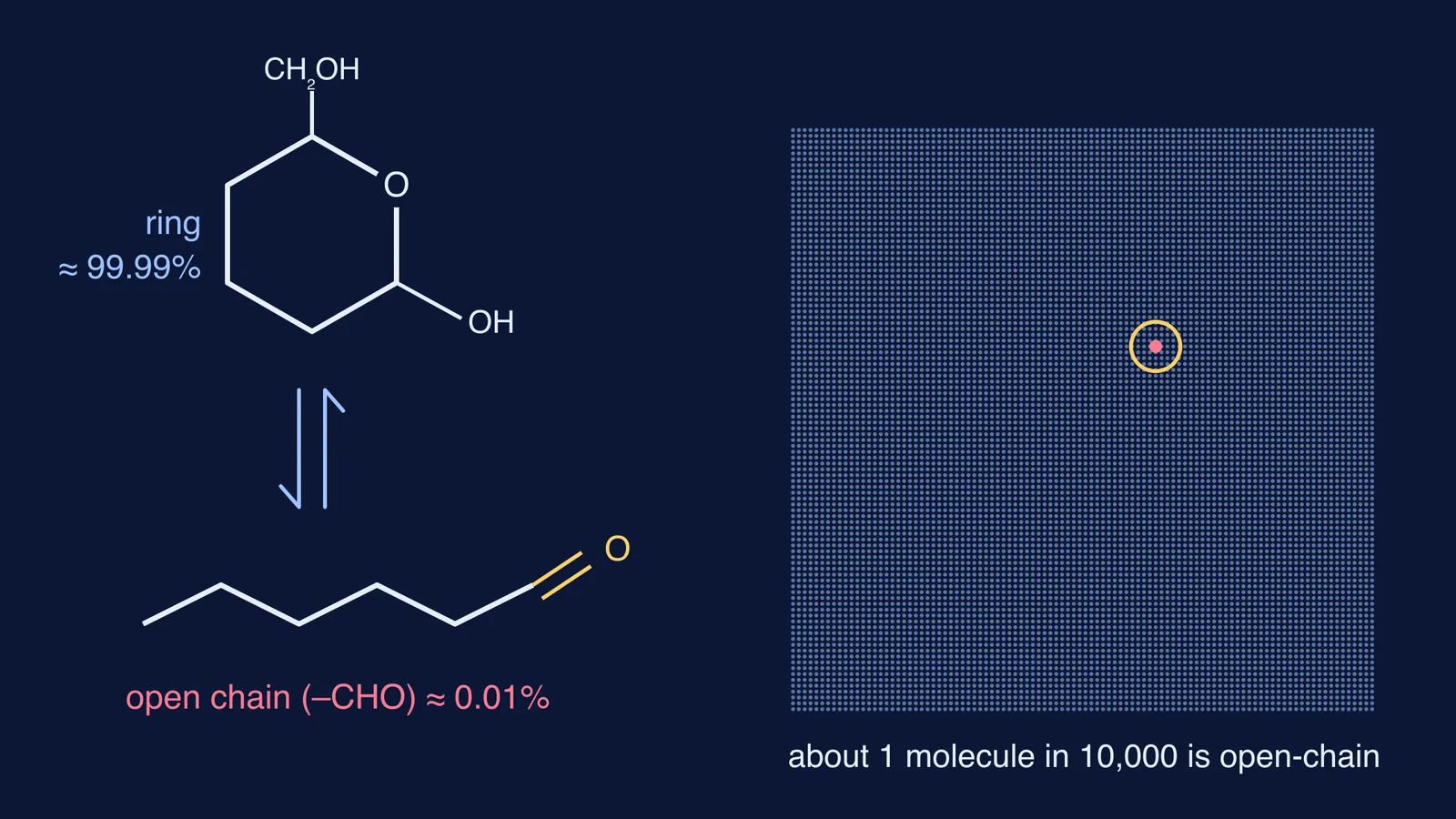
At any moment, almost no glucose is in the aldehyde form. A 2021 study measured the open-chain content of D-glucose in a pH 4.5 aqueous buffer at 0.0097%, roughly 1 molecule in 10,000, close to the literature NMR value of 0.010% it compared against (Kalaus et al., European Journal of Organic Chemistry, 2021). The paper notes that this small aldehyde content "hampers reactivity when chemistry addresses the carbonyl moiety".
Schiff's test and bisulphite addition are both quick checks for a free aldehyde. The usual textbook explanation is that, with only about 1 molecule in 10,000 carrying a –CHO, there is too little free aldehyde to give either result.
So why do hydroxylamine, bromine water, Fehling's solution and Tollens' reagent still react? Each one turns open-chain molecules into a new product. As they are used up, the equilibrium shifts (Le Chatelier's principle) and more rings open to replace them, so over time much of the glucose can react.
Why does glucose pentaacetate not react with hydroxylamine?
On page 283, NCERT draws the pentaacetate as an open chain with a –CHO at the top: that is what the open-chain structure predicts. Page 285 reports the test of that prediction, and it fails.
Count the –OH groups to see why. In the open chain they sit on C2, C3, C4, C5 and C6. In the ring, C5's oxygen is part of the ring and a new –OH sits on C1, so they are on C1, C2, C3, C4 and C6. Both forms give five acetate groups, so acetylation alone cannot tell them apart. Hydroxylamine can. An open-chain pentaacetate would still carry a –CHO and form an oxime. It does not, so the acetylation happened on the ring, including the –OH on C1. Once that hemiacetal –OH is an acetate, the ring stays closed and no –CHO appears.
How does the ring structure explain each NCERT observation?
Use this as a revision check: prediction, observation, explanation.
Schiff's test: the open chain predicts a positive test; none is seen; the ring leaves only a tiny fraction of glucose as free aldehyde.
NaHSO₃: the open chain predicts an addition product; none forms; same reason.
Pentaacetate with NH₂OH: the open chain predicts an oxime; there is no reaction; the C1 –OH is acetylated, so the ring is locked and has no –CHO.
Two crystalline forms: the open chain predicts one compound; there are two, α and β; ring closure makes C1 a new stereocentre (the anomeric carbon), which gives two anomers.
For more, read our explainers on glucose structure: open chain, cyclic forms and anomers, the difference between epimers and anomers and why glucose and fructose give the same osazone.
How should you write this in a board or entrance exam answer?
A short answer can follow this script:
State the facts: glucose gives no Schiff's test and no NaHSO₃ addition product, and its pentaacetate does not react with NH₂OH.
Conclude: glucose has no free –CHO group under these conditions, so the open-chain structure is incomplete.
Explain: the C5 –OH adds to the C1 aldehyde to form a six-membered cyclic hemiacetal (pyranose). C1 becomes the anomeric carbon, which gives α and β forms in equilibrium with a small amount of open chain.
Draw: the Haworth structure of α-D-glucopyranose, with C1 to C6 numbered.
Two traps: do not write that glucose "has no aldehyde group" (it reacts with NH₂OH and bromine water), and do not draw the pentaacetate with a free –CHO here, since that is the prediction that failed.
To see how hemiacetals, anomers and the open chain connect, the Fermi Concept Library covers every concept in chemistry, each with its own lesson and its place in the map. To practise this reasoning on new questions, the Fermi Problem Library has worked problems with a step-by-step solver that explains the reasoning rather than printing an answer.