

On this page
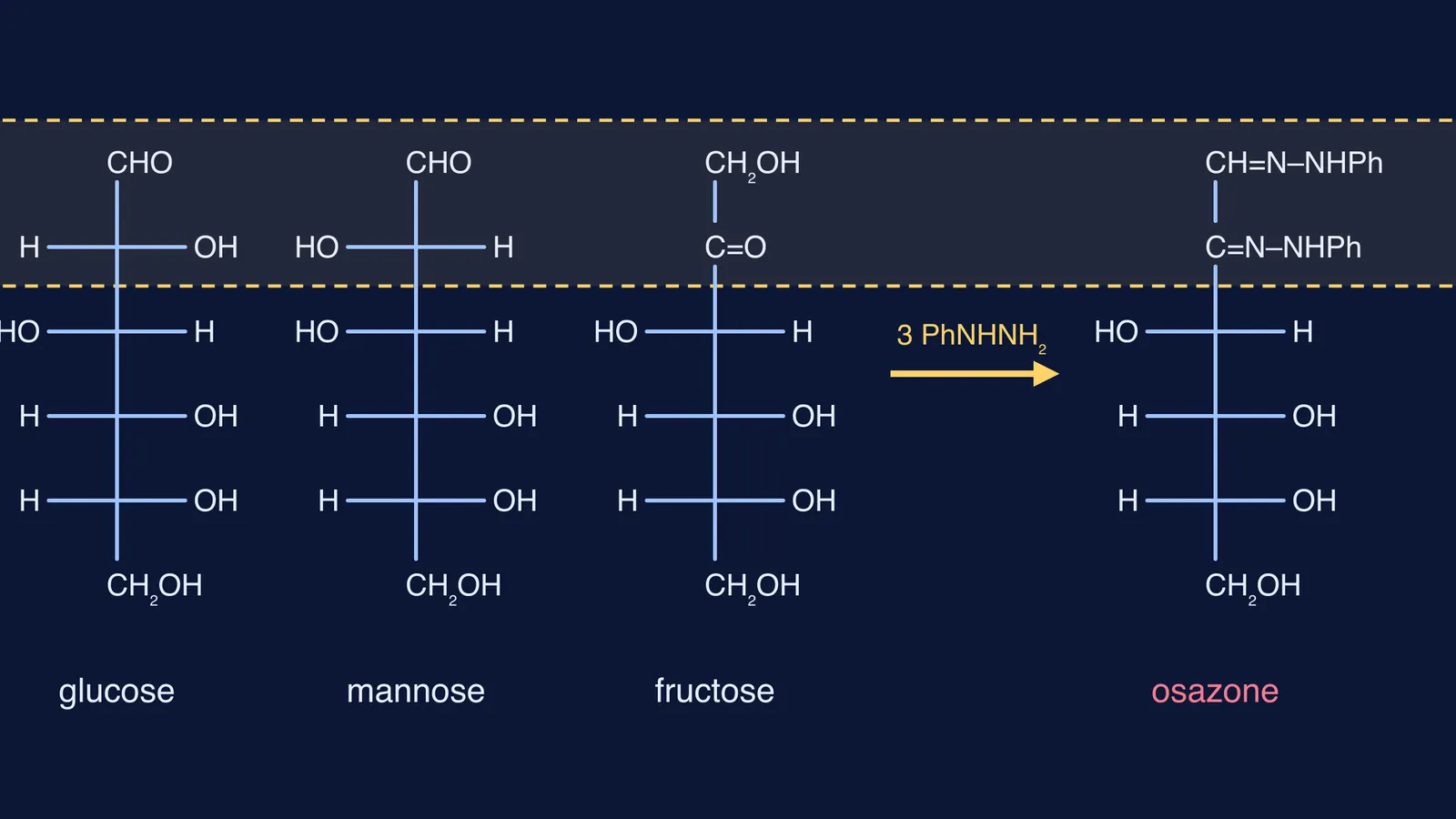
Glucose is an aldose and fructose is a ketose. They test differently in many reactions, yet heat either one with excess phenylhydrazine and you get the same crystals. Mannose does the same thing. The reason is short: the reaction rewrites carbons 1 and 2, and those are the only carbons where these three sugars differ.
This is a favourite question in the biomolecules chapter because you can't just memorise the answer. You have to look at structures. Here is the reasoning, then a three-step check you can use on any sugar.
What does phenylhydrazine do to a sugar?
An osazone forms when a reducing sugar is heated with excess phenylhydrazine, a reaction Emil Fischer developed and used to identify monosaccharides (Wikipedia: Osazone). One of his papers on it, "Ueber einige Osazone und Hydrazone der Zuckergruppe", appeared in Berichte der deutschen chemischen Gesellschaft in 1894 (Crossref record).
According to an NPTEL carbohydrates module, C1 and C2 react with three equivalents of phenylhydrazine to form a bis-hydrazone called an osazone.
The three molecules have different jobs, as this SATHEE (IIT Kanpur) worked solution explains:
The first molecule adds to the carbonyl group: the CHO of glucose or the C=O of fructose.
The second molecule oxidises the neighbouring carbon: the CHOH at C2 in an aldose, or the CH2OH at C1 in a ketose, becomes a carbonyl.
The third molecule adds to that new carbonyl.
At the end, C1 carries CH=N–NHPh and C2 carries C=N–NHPh, whichever sugar you started with. Chemists were still studying the exact route decades later; Barry and Mitchell's 1955 Nature note was titled "Mechanism of Osazone Formation" (Crossref record). For exams, the three-step picture above is what you need.
Why do glucose and fructose give the same osazone?
Write both sugars as open chains, one above the other.
Glucose: C1 is CHO, C2 is CHOH, C3 to C6 follow.
Fructose: C1 is CH2OH, C2 is C=O, C3 to C6 follow.
From C3 down to C6, the two are identical: same atoms, same OH on the left at C3, same OH on the right at C4 and C5 in the Fischer projection. Our posts on the open-chain and cyclic structure of glucose and fructose as a ketohexose draw these out if you need a refresher.
All the difference sits in C1 and C2. The osazone reaction converts exactly those two carbons into the same pair of hydrazone groups. Once the difference is gone, the products are one compound. The NPTEL module states it directly: D-glucose and D-fructose form the same osazone.
Why does mannose give the same osazone as glucose?
Mannose is the C2 epimer of glucose: the two differ only in whether the OH on C2 points left or right. (Our explainer on epimers vs anomers covers the term.) In the osazone, C2 no longer has an OH or an H; it is a flat C=N carbon. The NPTEL module puts it this way: the configuration at C2 is lost, so C2 epimers form identical osazones.
So glucose, mannose and fructose all give the same product, usually called glucosazone.
How do you check whether two sugars give the same osazone?
Use this three-step check in an exam:
Draw both sugars as open-chain Fischer projections, same carbon numbering, carbonyl end at the top.
Cover C1 and C2 with your thumb.
Compare everything below. If C3 to the last carbon match exactly, the osazones are the same. If even one OH points the other way, they are different.
Worked example: does galactose give the same osazone as glucose? Galactose differs from glucose at C4, below your thumb. So the answer is no. Wikipedia's osazone page lists galactosazone separately, as rhombic plates, while glucosazone forms broomstick or needle-shaped crystals.
Try it on a sugar that differs from glucose only at C3. The same check tells you it gives a different osazone too.
If you want to practise questions like this and see each step argued out, the Fermi Problem Library has worked problems with a step-by-step solver that explains the reasoning rather than printing an answer.
Can the osazone test tell glucose and fructose apart at all?
Not by the product. The crystals are the same compound. Some teaching material notes a difference in speed: Aakash's osazone notes give about 2 minutes for fructose and 5 minutes for glucose, both forming needle-shaped crystals. Treat timing as a lab observation, not a way to name an unknown sugar on paper.
If the open-chain drawings themselves feel shaky, the Fermi Concept Library gives each chemistry concept its own lesson and shows where it sits in the map, so you can fix the structure before the reaction.


