On this page
Add a few drops of water to ethylmagnesium bromide and the reagent is gone: you get ethane gas and a magnesium salt. Alcohols, phenols, ammonia, amines, carboxylic acids and terminal alkynes do the same. For Class 12 and JEE, this one idea explains dry reaction conditions, a route to alkanes and a way to count acidic hydrogens.
Why does a Grignard reagent react with water to give an alkane?
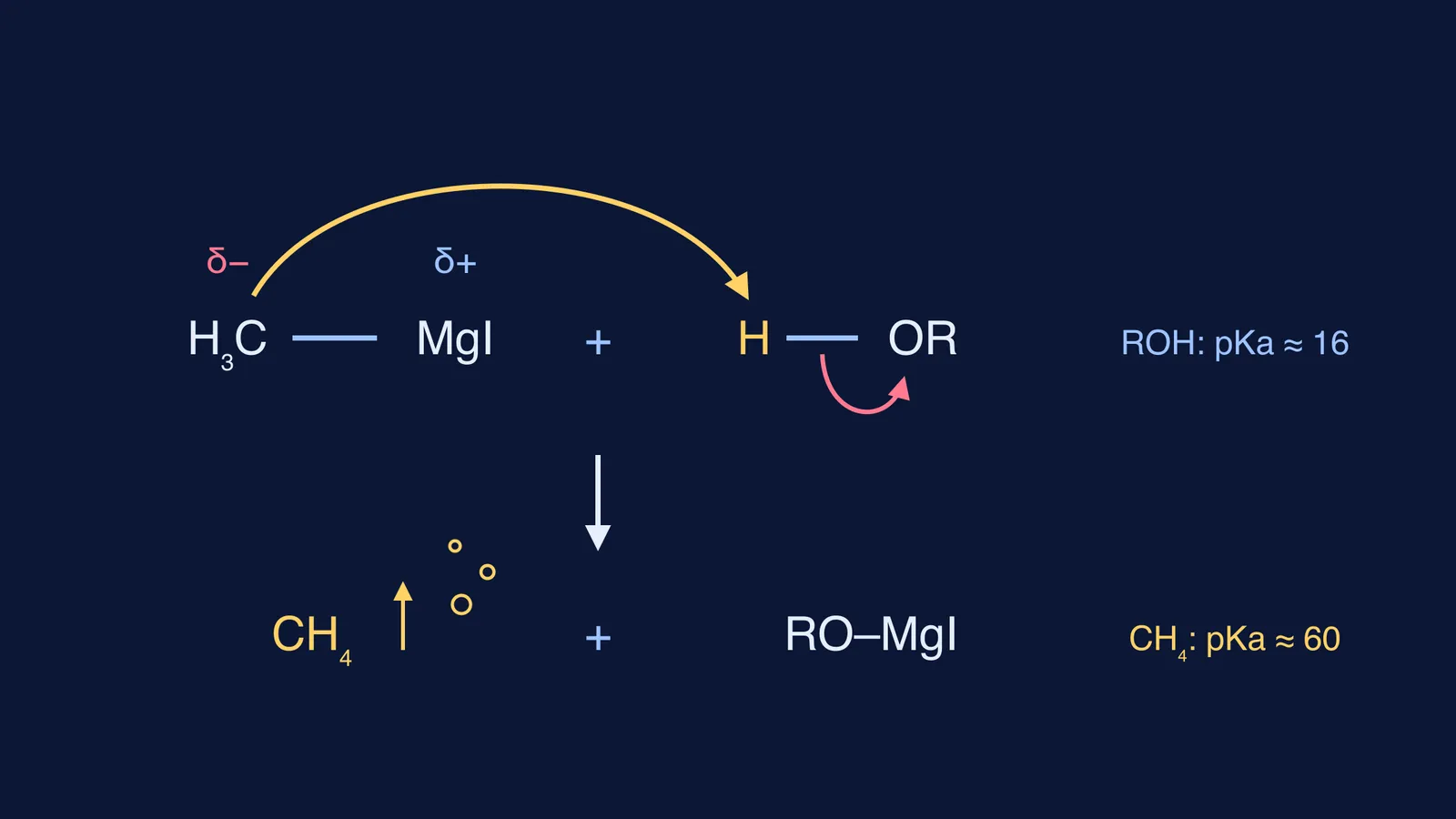
In R–MgX, carbon is more electronegative than magnesium, so the bonding pair is pulled towards carbon and carbon carries a partial negative charge, as Chemguide's introduction to Grignard reagents explains. That carbon behaves like a carbanion, R⁻, a very strong base, so it takes a proton.
CH₃CH₂MgBr + H₂O → CH₃CH₃ + Mg(OH)Br
LibreTexts' chapter on Grignard reagents/10%3A_Organohalides/10.06%3A_Reactions_of_Alkyl_Halides_-_Grignard_Reagents) puts numbers on it: saturated hydrocarbons have pKa values of 42 to 50, so their conjugate bases are extremely strong.
An acid–base reaction runs towards the weaker acid. On the UMass Amherst OWL pKa table, water has a pKa of 15.74, ethanol 16.0 and ammonia 36, while methane is about 60. Estimates for alkanes vary between sources, but each of those is a far stronger acid than the alkane, so the carbanion takes the proton and the alkane forms.
Which compounds count as having active hydrogen?
An active hydrogen is one acidic enough to protonate a Grignard reagent. In school problems that means H on oxygen, nitrogen or sulfur, plus the H of a terminal alkyne. With values from the UMass OWL pKa table:
Carboxylic acids (acetic acid pKa 4.8): one active H per –COOH
Phenols (phenol pKa 9.9): one per –OH
Water (pKa 15.74) and alcohols (ethanol pKa 16.0): one per –OH
Terminal alkynes (ethyne pKa 25): the ≡C–H counts
Ammonia (pKa 36), primary and secondary amines: each N–H counts
C–H bonds in alkanes, alkenes, ethers and benzene rings: not active
That last line is why Grignard reagents are made in dry ether: it has no O–H to destroy them.
Two uses follow. You can turn an alkyl halide into an alkane in two steps: Mg in dry ether, then water. Use D₂O instead of water and a deuterium atom lands exactly where the halogen was, which LibreTexts/10%3A_Organohalides/10.06%3A_Reactions_of_Alkyl_Halides_-_Grignard_Reagents) describes as a convenient labelling method. For other routes, see our comparison of Wurtz, Kolbe and decarboxylation methods for preparing alkanes.
How do you count active hydrogens with methylmagnesium iodide?
This is the Zerewitinoff determination: methylmagnesium iodide is added to the sample and the volume of methane given off is measured, as described in the Zerewitinoff entry in Wiley's Comprehensive Organic Name Reactions and Reagents. Each active hydrogen releases one CH₄. The method is credited to F. V. Tserevitinov working with L. A. Chugaev between 1902 and 1907, according to Wikipedia's article on the Zerewitinoff determination.
Exam problems usually take 22.4 L per mole of gas at 0 °C and 1 atm; the exact NIST value at 101.325 kPa is 22.414 L/mol, and at 1 bar NIST gives 22.711 L/mol. Use whichever your question states.
Worked example 1: from compound to gas
How much methane does 0.92 g of glycerol, CH₂OH–CHOH–CH₂OH, give with excess CH₃MgI at 0 °C and 1 atm?
Molar mass of C₃H₈O₃ = 3(12) + 8(1) + 3(16) = 92 g/mol, so moles = 0.92 ÷ 92 = 0.010 mol.
Active hydrogens: three –OH groups, so 3 per molecule. The five C–H bonds do not count.
Methane = 3 × 0.010 = 0.030 mol.
Volume = 0.030 × 22.4 L = 0.672 L, or 672 mL.
Worked example 2: from gas to structure
0.0050 mol of an unknown compound gives 224 mL of methane at 0 °C and 1 atm. How many active hydrogens does it have?
Moles of CH₄ = 0.224 ÷ 22.4 = 0.010 mol.
Active H per molecule = 0.010 ÷ 0.0050 = 2.
Candidates include ethane-1,2-diol or a primary amine with one –NH₂.
What mistakes do students make with these questions?
Run this checklist before you write the answer:
Did you count C–H bonds? Only O–H, N–H, S–H and terminal ≡C–H count in standard problems.
Did you count –NH₂ as one? It is two.
Is the Grignard reagent in excess? If not, the reagent limits the methane.
Which molar volume does the question use?
Is the H more acidic than the alkane? If not, it does not react.
Real samples are messier: the Wiley entry notes the method yields incorrect data for certain types of molecules.
If the acid–base step feels shaky, read the pKa ladder from alkanes to carboxylic acids; for the carbonyl reactions that stray water ruins, see Grignard reagents: what they make and the common exam traps. To practise, the Fermi Problem Library has worked problems with a step-by-step solver that explains the reasoning rather than printing an answer, and the Fermi Concept Library gives every concept in chemistry its own lesson.