

On this page
One freezing point gives you one molar mass. Two compounds made of the same two elements in different ratios give you two molar masses, and two molar masses give you two equations. Solve them together and you get the atomic mass of each element. NCERT sets exactly this problem with AB₂ and AB₄ in benzene, and it is a regular in board exams and JEE Main. This post works it step by step, shows how to check the answer, and points out the assumption most students miss.
What does the AB₂ and AB₄ problem ask?
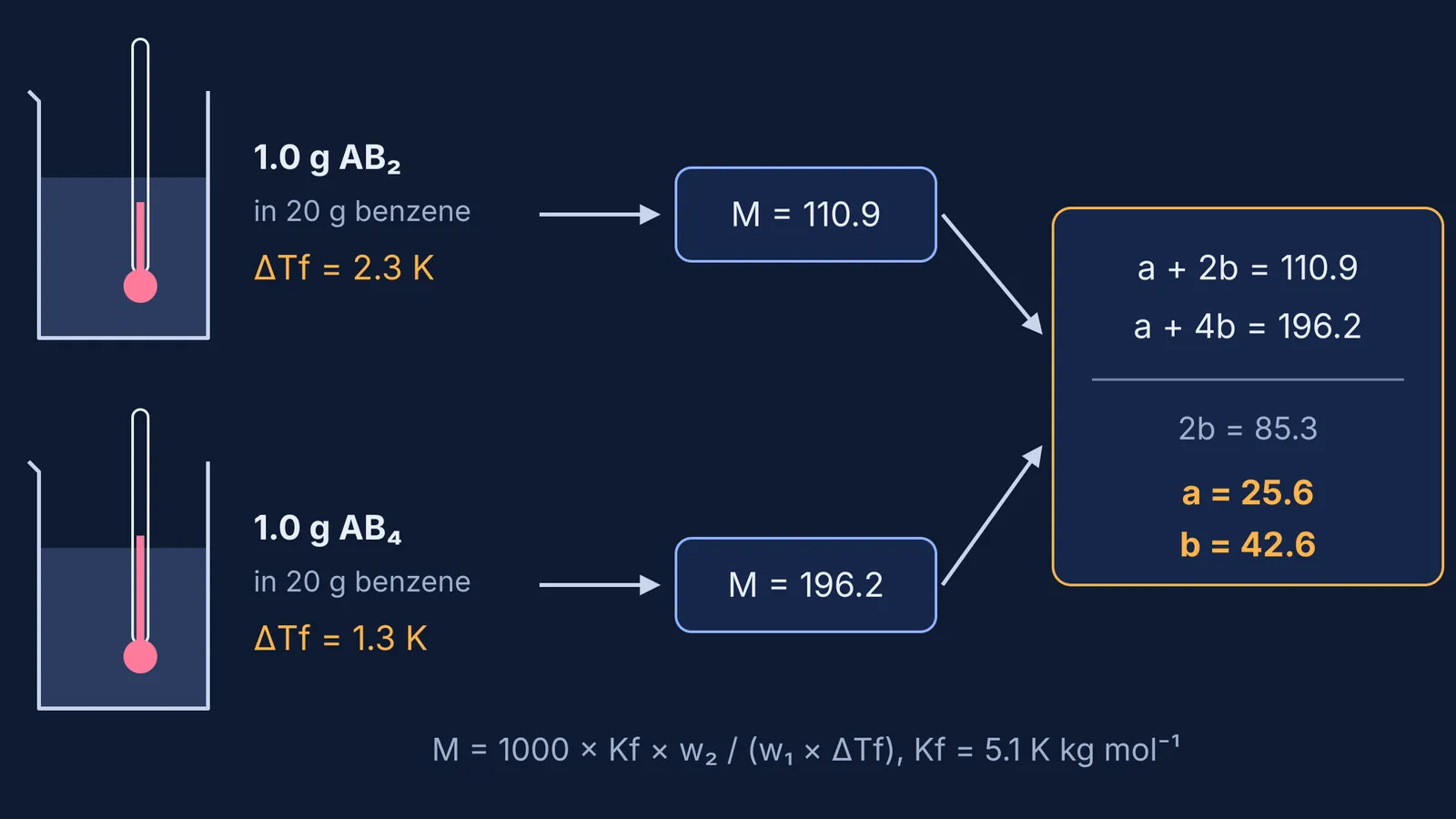
The NCERT exercise reads like this. Two elements A and B form compounds with formulae AB₂ and AB₄. Dissolved in 20 g of benzene, 1.0 g of AB₂ lowers the freezing point by 2.3 K, while 1.0 g of AB₄ lowers it by 1.3 K. The molal depression constant of benzene is 5.1 K kg mol⁻¹. Find the atomic masses of A and B.
There are two unknowns, so you need two independent pieces of data. The two freezing points supply them.
How do you get each molar mass from its freezing point?
The standard formula is:
M = 1000 × Kf × w₂ / (w₁ × ΔTf)
Here w₂ is the mass of solute in grams, w₁ is the mass of solvent in grams, and the 1000 converts grams of solvent into kilograms. If you want the derivation, see how to find molar mass from depression in freezing point. The same formula drives the Rast method with camphor; only the solvent and Kf change.
Use the Kf given in the question, 5.1 K kg mol⁻¹, not the table value of 5.12. The examiner's answer is built on 5.1.
How do you solve for the atomic masses of A and B?
Let the atomic mass of A be a and of B be b.
Molar mass of AB₂: M = 1000 × 5.1 × 1.0 / (20 × 2.3) = 5100 / 46 = 110.87 g mol⁻¹.
Molar mass of AB₄: M = 1000 × 5.1 × 1.0 / (20 × 1.3) = 5100 / 26 = 196.15 g mol⁻¹.
Sense check: the same mass of AB₄ gave a smaller ΔTf, so it must contain fewer moles and have the larger molar mass. It does.
Write the equations: a + 2b = 110.87 and a + 4b = 196.15.
Subtract the first from the second: 2b = 85.28, so b = 42.64.
Back-substitute: a = 110.87 − 2 × 42.64 = 25.59.
Check in the other equation: 25.59 + 4 × 42.64 = 196.15. It matches.
So A = 25.59 u and B = 42.64 u, which are NCERT's answers.
Keep at least four significant figures until after the subtraction. The difference 196.15 − 110.87 is much smaller than either number, so early rounding shows up strongly in b and even more in a.
Can you tell which elements A and B are?
No. 25.59 and 42.64 do not match the atomic masses of real elements closely enough to name them, and NCERT does not ask you to. The numbers are made up to test the method. In an exam, give the two atomic masses and stop. Do not "identify" A and B.
What assumption hides inside this problem?
The method assumes that each compound stays as single molecules in benzene, so i = 1 for both. Benzene is non-polar, so the compounds will not split into ions. But molecules can pair up in benzene, and then the measured molar mass is too large. Acetic acid is the classic case: it forms hydrogen-bonded dimers and shows a molar mass of about 120 instead of 60, as explained in why acetic acid shows a molar mass of 120 in benzene.
See what association would do here. Suppose AB₂ formed dimers completely and you did not know. Its apparent molar mass would be 2 × 110.87 = 221.74 g mol⁻¹. Then 2b = 196.15 − 221.74 = −25.59, and b = −12.8. An atomic mass cannot be negative, so the result tells you something is wrong. Partial association is harder to catch, because it gives positive but wrong values. That is why the question states, or should state, that neither compound associates or dissociates.
How sensitive is the answer to the data?
Very. Suppose the depression for AB₄ were 1.4 K instead of 1.3 K. Then M(AB₄) = 5100 / 28 = 182.14 g mol⁻¹, 2b = 71.27, b = 35.64 and a = 39.60. A change of 0.1 K in one reading moves a by about 14 u. This happens because the method subtracts two measured numbers, so any error in either one lands entirely on the difference. Copy the data carefully and do not round the molar masses to whole numbers.
Does the method work for other formula pairs like XY and XY₃?
Yes. Any two compounds whose formulae differ by a known number of atoms give two equations. Here is a second example with made-up data.
Problem. 1.0 g of XY in 25 g of benzene lowers the freezing point by 3.40 K. 1.0 g of XY₃ in 25 g of benzene lowers it by 1.46 K. Kf = 5.1 K kg mol⁻¹. Assume neither compound associates. Find the atomic masses of X and Y.
M(XY): 1000 × 5.1 × 1.0 / (25 × 3.40) = 5100 / 85 = 60.0 g mol⁻¹.
M(XY₃): 5100 / (25 × 1.46) = 5100 / 36.5 = 139.73 g mol⁻¹.
Sense check: XY₃ is heavier, as it should be.
Equations: x + y = 60.00 and x + 3y = 139.73.
Subtract: 2y = 79.73, so y = 39.86.
Back-substitute: x = 60.00 − 39.86 = 20.14.
Check: both values are positive, and 20.14 + 3 × 39.86 = 139.72, which matches to rounding.
The general pattern: if one formula has p atoms of B and the other has q, with one A each, then (q − p) × b = M₂ − M₁. The bigger the difference in the number of B atoms, the less any measurement error matters, because you divide the error by a larger number.
If you get stuck on setting up equations like these, the Fermi Problem Library has a step-by-step solver that explains the reasoning behind each line.
Quick checklist
Find each molar mass with M = 1000 × Kf × w₂ / (w₁ × ΔTf).
Use the Kf given in the question.
Smaller ΔTf for the same mass means a larger molar mass.
Write one equation per compound and subtract to remove A.
Keep four significant figures until after the subtraction.
Check that both atomic masses are positive and fit both equations.
State the assumption: no association or dissociation in benzene.
Do not try to name the elements.


