

On this page
In 1909, John Wade and Horace Finnemore reported something odd about ether that every chemist thought was pure. Dried with calcium chloride, sodium or phosphorus pentoxide, it still did not distil at one temperature. The reason was water. Ether and water form a mixture that boils at 34.15 °C, which is 0.35 °C below pure ether, and it holds about 1.3% water. That is a minimum-boiling azeotrope, the same idea as ethanol and water in Class 12 Solutions, but squeezed into a gap smaller than half a degree.
Who were Wade and Finnemore, and what did they publish?
The paper is "Ethyl Ether. Part I. The Influence of Water and Alcohol on its Boiling Point", in the Journal of the Chemical Society, Transactions, volume 95, pages 1842 to 1854. It names the authors as John Wade, D.Sc., and Horace Finnemore, B.Sc., and the work as coming from the Chemical and Pharmaceutical Laboratories, Guy's Hospital, London. The paper gives nothing more about them, so we don't either. You can read the scanned volume on the Internet Archive.
Earlier workers all agreed that ether boils at 34.6 °C, yet their densities for "pure" ether disagreed by more than experimental error. Wade and Finnemore suspected a hidden mixture.
How did they find a mixture hiding inside pure ether?
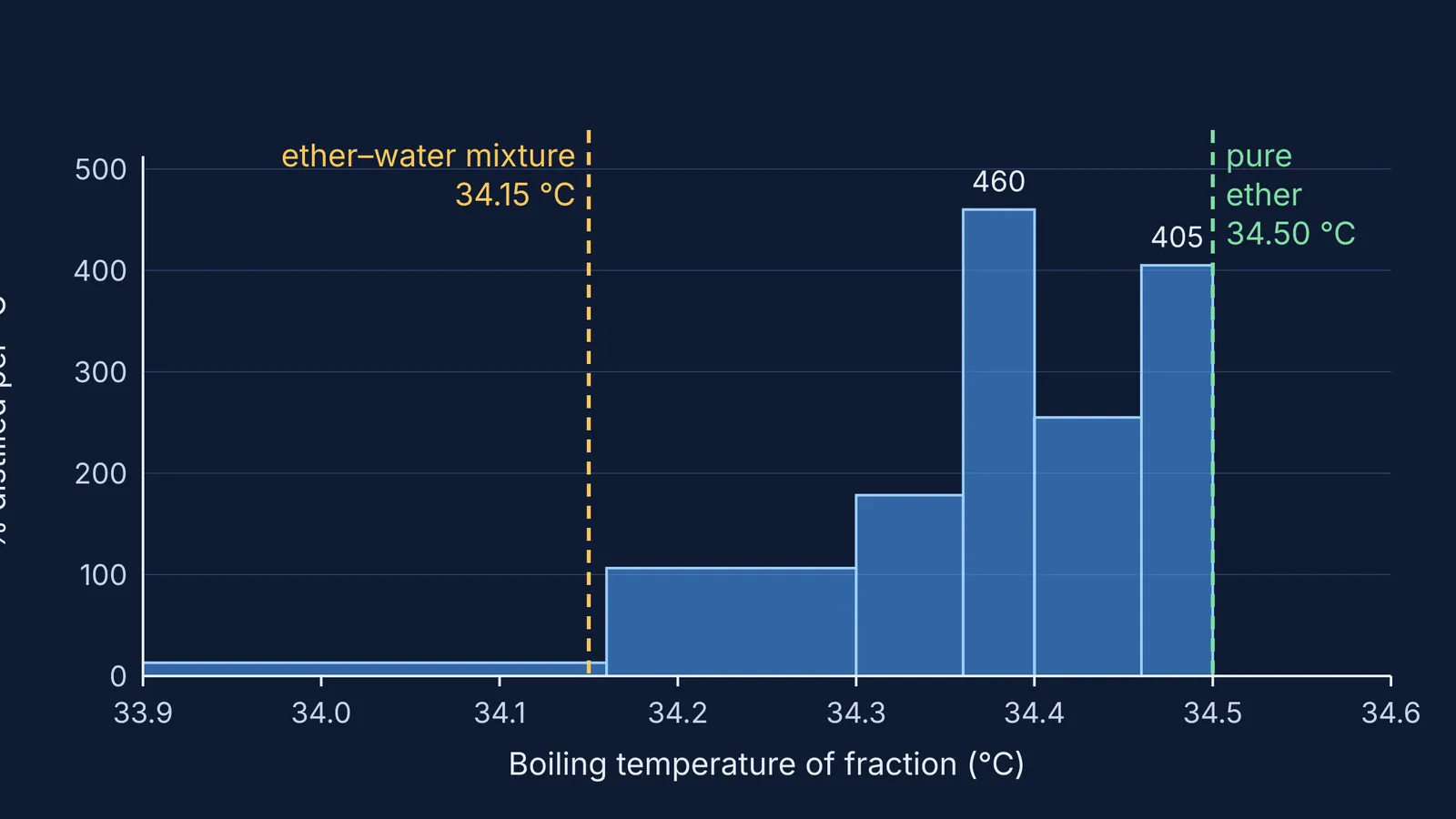
They distilled ether through an eight-section fractionating column and read the boiling point to 0.01 °C. For each fraction they worked out how much distilled per degree. A pure substance or constant-boiling mixture gives a sharp peak: much liquid comes over while the temperature hardly moves.
Ether dried with calcium chloride gave two peaks, not one. The first fraction turned cloudy with carbon disulphide, a sign of water, and the densities fell as distillation went on. Most drying methods left the same pattern; only washing, then calcium chloride and phosphorus pentoxide, made the first peak almost vanish.
Next they distilled purified ether (boiling point 34.49 °C) with an equal mass of water. The temperature locked at 34.15 °C with a very sharp peak. In their words, ether forms with water "a binary mixture of minimum boiling point", which boils at 34.15 °C "and contains approximately 1.3 per cent. of water". The 1.3% was calculated from density at 15 °C, not by analysis, because evaporation losses were too uncertain.
Why does wet ether boil below pure ether?
Because the mixture shows positive deviation from Raoult's law. Molecules escape more easily than Raoult's law predicts, so the vapour pressure reaches 1 atm at a lower temperature.
Water molecules hold each other in a strong hydrogen-bonded network. Ether can accept a hydrogen bond but cannot donate one, and its ethyl groups attract water weakly. So water–ether attraction is weaker than water–water attraction, and dissolved water escapes readily. A visible clue is that the two liquids barely mix: Wade and Finnemore measured that 1 g of ether dissolves only 0.013 g of water at 15 to 20 °C. Poor mixing and positive deviation go together.
The 0.013 g per gram is 1.28% water by mass, which matches the 1.3% in the azeotrope. Their conclusion was that the constant-boiling mixture holds "enough water to saturate it at the ordinary temperature".
Worked example: how far from ideal is the ether–water mixture?
Take the azeotrope as 1.3% water by mass.
Mole fraction. In 100 g: water 1.3 / 18.015 = 0.0722 mol; ether (C₂H₅)₂O, 98.7 / 74.12 = 1.3316 mol. So x(water) = 0.0722 / 1.4038 = 0.0514, and x(ether) = 0.9486.
Pure vapour pressures at 34.15 °C. For water, the NIST WebBook vapour-pressure equation gives about 40.2 mmHg. For ether we use the Clausius–Clapeyron equation, starting from 760 mmHg at Wade and Finnemore's boiling point of 34.50 °C and taking ΔvapH = 26.52 kJ mol⁻¹ (the value near the boiling point listed by the NIST WebBook): ln(p/760) = −(26520 / 8.314) × (1/307.30 − 1/307.65), so p = 751.1 mmHg.
What Raoult's law predicts. p(total) = 0.9486 × 751.1 + 0.0514 × 40.2 = 712.5 + 2.1 = 714.5 mmHg. That is below 760, so an ideal mixture would not boil at 34.15 °C. Solving for where the ideal total reaches 760 mmHg gives about 36.0 °C, about 1.5 °C above pure ether.
What really happens. The real mixture boils at 34.15 °C, so its vapour pressure there is 760 mmHg, about 6% more than the ideal 714.5. At an azeotrope the vapour has the same composition as the liquid, so water's partial pressure is 0.0514 × 760 = 39.1 mmHg. Raoult's law gave it 2.1 mmHg. Water escapes about 19 times more readily than the ideal model says, and almost as freely as from pure water (40.2 mmHg).
Steps 2 to 4 are our estimate, not the 1909 paper's. They use modern data and assume ΔvapH is constant over 2 °C, so treat 36.0 °C and the factor of 19 as approximate. The sign does not depend on them: ideal would boil higher, the real mixture boils lower.
Why can't you get dry ether just by distilling it?
Because distillation cannot cross an azeotrope. Moist ether first sends over the 34.15 °C mixture, and the two boiling points are only 0.35 °C apart, which the authors called "impracticable" to separate completely. Their conclusion: "unless all but a trace of the water is first removed, the pure substance cannot be obtained from it by any process of distillation."
Alcohol, left from manufacture, worked the other way: it raised the boiling point (one ether fraction boiled at 34.75 °C). They found no ether–alcohol azeotrope and no ether–alcohol–water mixture. So a steady boiling point could be a trap: water pushing it down and alcohol pushing it up could cancel, and constancy "cannot ... be accepted as conclusive evidence of the purity of this substance."
Ether is extremely flammable and forms dangerous peroxides on storage. This post is about the history and the calculation only, not a method to try. For the storage hazard, see why old ether bottles form explosive peroxides.
Where does this come up in JEE, NEET and boards?
Class 12 Solutions. Raoult's law, positive deviation and minimum-boiling azeotropes. Our posts on Raoult's law for ideal and non-ideal solutions and minimum and maximum boiling azeotropes cover the theory with ethanol and nitric acid.
Class 12 Haloalkanes. "Dry ether" for Grignard reagents. This paper shows why drying ether is hard; why a Grignard reagent must be made in dry ether shows why it matters.
Class 11 Some Basic Concepts. Mass percentage to mole fraction, as in step 1.
If vapour-pressure curves still feel abstract, the Fermi Simulation Lab has interactive simulations for ideas that are easier to see than read. To revise Raoult's law and its deviations as connected ideas, the Fermi Concept Library gives each concept its own lesson and shows where it sits on the map.
Quick checklist
Ether + water: boils at 34.15 °C with about 1.3% water (Wade and Finnemore, 1909); pure ether near 34.50 °C.
Lower than both pure liquids means a minimum-boiling azeotrope and positive deviation.
1.3% water by mass is about 5% by moles (x = 0.051).
Raoult's law would put this mixture near 36 °C (our estimate); the real one boils lower.
Distillation alone cannot dry ether; water must be removed first, and alcohol raises the boiling point.
A constant boiling point does not prove purity.


