

On this page
If you work in an organic chemistry laboratory, you will eventually be warned about old bottles of diethyl ether. According to the International Chemical Safety Card (ICSC 0355), diethyl ether can form explosive peroxides when exposed to light and air. These peroxides are so sensitive to friction and shock that simply unscrewing a crusty cap or moving a heavily contaminated bottle can trigger a detonation.
Understanding the chemistry behind this process—and the strict protocols for managing it—is a fundamental part of laboratory safety for anyone handling volatile organic solvents.
Why do old ether bottles form explosive peroxides?
Ethers degrade through a radical process called photooxygenation, often referred to as auto-oxidation. When exposed to ambient air and light, ultraviolet excitation of molecular oxygen causes it to react with diethyl ether to form diethyl ether hydroperoxide (C₂H₅OCH(OOH)CH₃), according to chemical mechanisms.
Over time, these hydroperoxides condense to form polymeric diethyl ether peroxides. This process is slow, meaning a freshly opened bottle is generally safe. However, if a bottle sits on a shelf for months and is repeatedly exposed to air, the peroxide concentration quietly builds up in the background. To inhibit this radical formation, commercial chemical suppliers often add small amounts of antioxidants, such as butylated hydroxytoluene (BHT), to stabilize the solvent.
If you are studying reaction mechanisms like the Kharasch peroxide effect, you will know that peroxides are excellent radical initiators that drive useful chemical transformations. However, in a solvent storage bottle, they are a severe hazard. If you are unsure about the radical mechanisms behind organic oxidation, the Concept Library has every concept in chemistry, each with its own lesson and its place in the map, so you can trace the path of the electrons step by step.
Why do peroxides explode during distillation?
The greatest hazard arises when chemists attempt to distil ether to purify it, or when they evaporate it using a rotary evaporator to isolate a synthesized product.
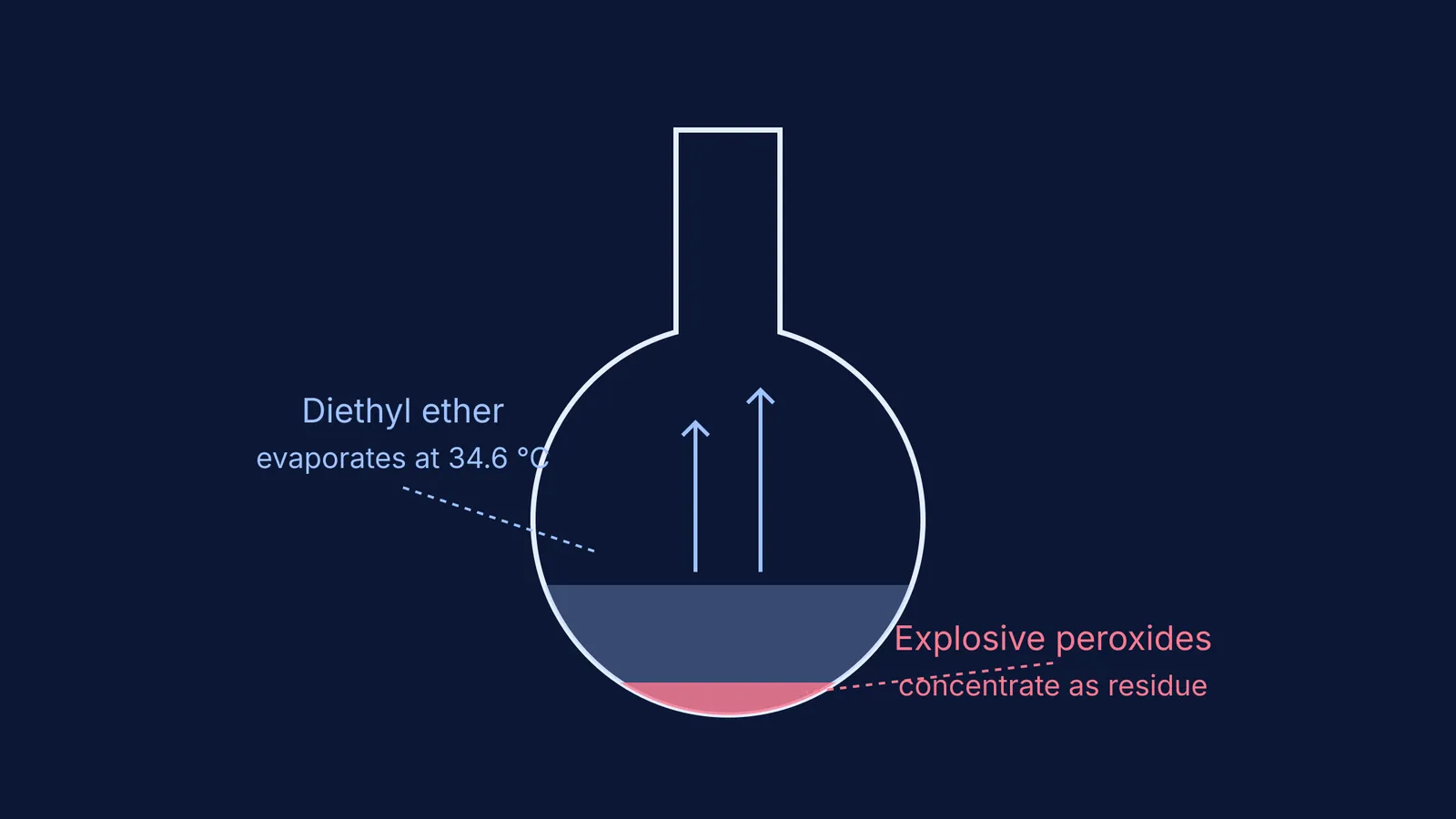
Diethyl ether has a very low boiling point of 34.6 °C. The peroxides and hydroperoxides formed during auto-oxidation, however, are larger, more complex molecules with much higher boiling points. As the ether boils away as a gas, the peroxides are left behind in the liquid phase. Their concentration in the remaining liquid rises rapidly as the solvent volume shrinks.
If the distillation is taken all the way to dryness, you are left with nearly pure, highly unstable solid or oily peroxide residue at the bottom of a hot flask. At this concentrated state, the slightest bump, scrape, or increase in heat will cause the peroxides to detonate violently. This is exactly why the International Chemical Safety Card explicitly dictates that you must always check for peroxides prior to distillation.
How do labs test for ether peroxides?
Because you cannot reliably smell or see low levels of dissolved peroxides, labs must strictly use chemical tests before using any stored ether.
Potassium Iodide (KI) Solution: A small liquid sample of the ether is added to a test tube containing a solution of potassium iodide in acetic acid. A positive result turns the ether phase yellow or brown due to the liberated elemental iodine.
KI/Starch Paper: A commercial diagnostic test strip is dipped directly into the ether. If peroxides are present, a dark bluish spot appears on the paper strip as the iodine forms a complex with the starch.
How do you remove peroxides from ether?
If a test reveals a low level of peroxides and the liquid is entirely clear, the ether can be safely rescued using chemical treatments rather than being discarded.
Activated Alumina: The contaminated ether can be purified by passing it through a chromatography column packed with activated alumina, which traps the peroxides.
Precipitation: Storing the ether over solid sodium hydroxide (NaOH) precipitates the intermediate ether hydroperoxides, effectively removing them from the liquid.
Distillation over Sodium: For applications requiring an extremely dry and pure solvent, ether is often distilled from sodium metal and benzophenone. The sodium actively destroys both water and peroxides, while the benzophenone acts as an indicator that turns deep blue when the solvent is completely dry and safe to collect.
A checklist for safe ether storage
Good laboratory practice relies on strict inventory control rather than relying solely on chemical removal methods. Just as you might rely on an ester smell test to safely identify an unknown alcohol, you should rely on this checklist for your ether inventory to ensure everyone in the lab remains safe:
Date every bottle: Write the exact date received and the date opened on the label with a permanent marker.
Store in the dark: Keep the ether in amber glass bottles or metal cans to completely block the UV light that initiates auto-oxidation.
Check before use: Always perform a KI test before attempting any distillation or evaporation to confirm the solvent is peroxide-free.
Never distil to dryness: Always leave a protective pool of solvent in the distillation flask so any trace peroxides cannot concentrate and crystallize.


