On this page
Every Class 12 student writes the same line: CH3CH2Br + Mg, dry ether, gives CH3CH2MgBr. The NCERT chapter on haloalkanes shows exactly this equation, with "dry ether" written over the arrow (NCERT Class 12 Chemistry, Unit 6). Those two words do two separate jobs: the ether keeps the reagent stable, and "dry" stops it being destroyed. Once you see both, a whole family of exam questions becomes easy.
What does ether actually do for a Grignard reagent?
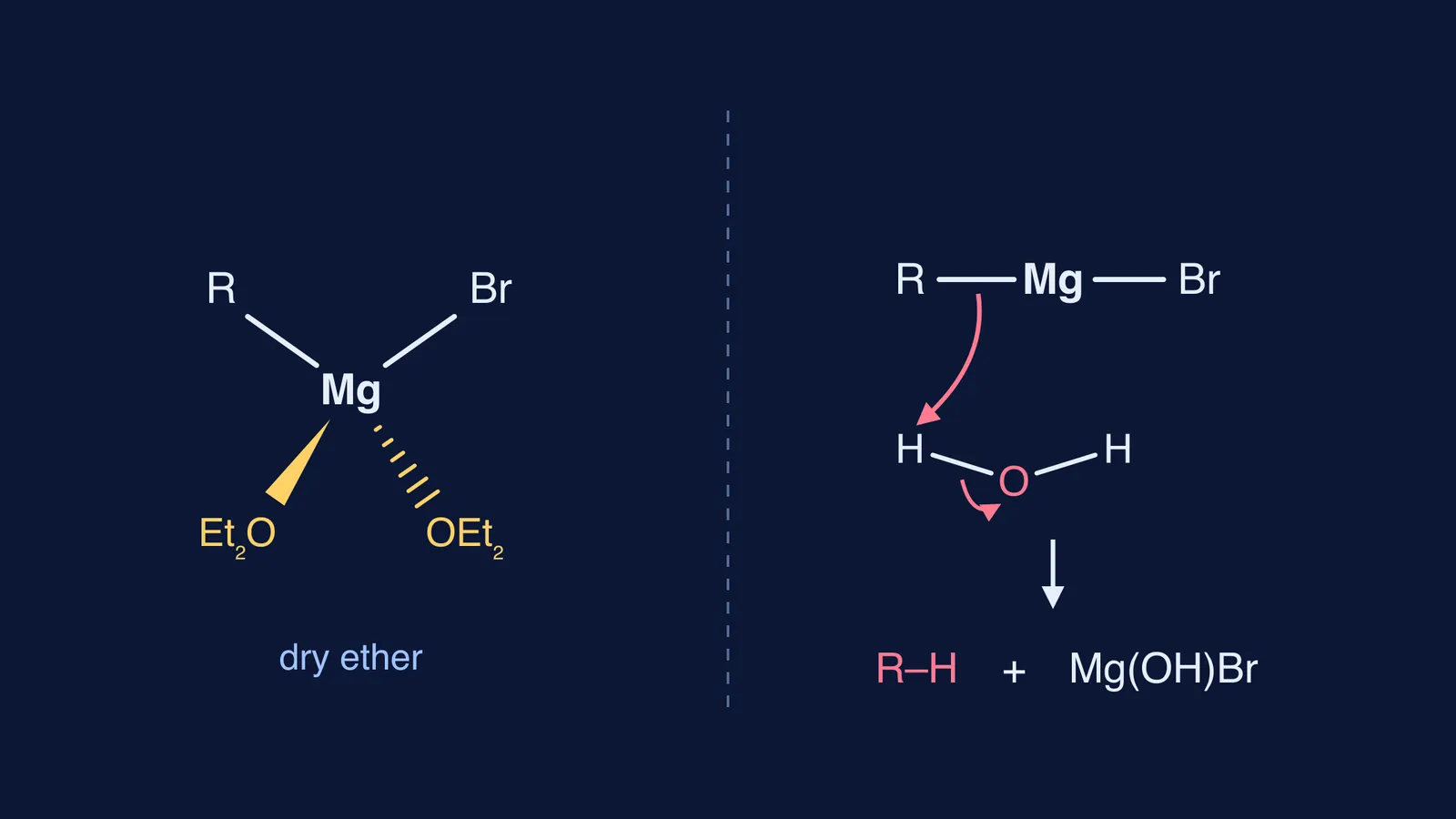
Magnesium in RMgX is short of electrons. The C–Mg bond is covalent but highly polar, with carbon pulling electrons away from magnesium, and the Mg–X bond is essentially ionic (NCERT Class 12 Chemistry, Unit 6). A magnesium atom with only two groups on it would gladly take more electron pairs.
The oxygen in diethyl ether has two lone pairs, so it can give them. Lone pairs from two ether molecules form a complex with the magnesium, which stabilises the organometallic (LibreTexts, Organic Chemistry I/10%3A_Organohalides/10.06%3A_Reactions_of_Alkyl_Halides_-_Grignard_Reagents)). In a Lewis-basic solvent the magnesium centre is tetrahedral, bonded to two ether ligands as well as R and X (Wikipedia, Grignard reagent).
This is more than a textbook sketch. In 1964 L. J. Guggenberger and R. E. Rundle published an X-ray diffraction study of ethylmagnesium bromide dietherate, a compound whose name says it carries two ether molecules for each EtMgBr (J. Am. Chem. Soc. 86, 5344).
In practice, Grignard reagents are rarely isolated as solids and are normally handled as solutions in diethyl ether or tetrahydrofuran (THF), another ether (Wikipedia, Grignard reagent). Ether also has no O–H or N–H hydrogen, so it gives the reagent electrons without giving it a proton. That second point is the key to the rest of this post.
Why does water turn a Grignard reagent into an alkane?
The polar C–Mg bond makes the carbon behave like a carbanion: it has a slight negative charge and acts as a very strong base. Saturated hydrocarbons have pKa values of 42 to 50 (LibreTexts, Organic Chemistry I/10%3A_Organohalides/10.06%3A_Reactions_of_Alkyl_Halides_-_Grignard_Reagents)). That means R–H holds on to its proton extremely weakly, so R⁻ snatches a proton from almost anything more acidic than an alkane, and water is far more acidic than that.
NCERT writes the result as RMgX + H2O → RH + Mg(OH)X, and says that it is "necessary to avoid even traces of moisture from a Grignard reagent. That is why reaction is carried out in dry ether." (NCERT Class 12 Chemistry, Unit 6). So CH3CH2MgBr and water give ethane gas, and the carbon you meant to add to a carbonyl compound is lost as an alkane.
Why can't alcohols, acids or amines be present either?
The same acid–base step applies to every group with an acidic hydrogen. NCERT says Grignard reagents "react with any source of proton to give hydrocarbons", and that even water, alcohols and amines are acidic enough to do it (NCERT Class 12 Chemistry, Unit 6). Even a terminal alkyne is acidic enough: a LibreTexts exercise has ethylmagnesium bromide taking a proton from acetylene (pKa 25) to give ethane (LibreTexts, Organic Chemistry I/10%3A_Organohalides/10.06%3A_Reactions_of_Alkyl_Halides_-_Grignard_Reagents)).
This rules out three things:
The solvent. No ethanol or water, however well they dissolve things.
The other reactant. A carbonyl compound carrying –OH or –COOH uses up Grignard reagent before any addition happens.
The halide itself. 4-Bromobutan-1-ol cannot give a stable Grignard reagent, because its own –OH would protonate the carbanion end.
If you want a reminder of what Grignard reagents make when they do survive, see our guide to Grignard reactions and the common exam traps.
How do you spot the trap in an exam question?
Run this four-step check whenever RMgX appears:
Circle every hydrogen on O, N or S, plus any terminal alkyne C–H, in the solvent, the substrate and the halide.
If you find one, the first reaction is acid–base, not addition. Write R–H as the product from the Grignard carbon.
Count equivalents: each acidic H uses up one RMgX.
Only then look for a carbonyl group to attack.
Here is a worked example. CH3MgBr is added to ethanol. Step 1 finds the O–H in ethanol. Step 2 gives CH4 (methane) and CH3CH2OMgBr. No new C–C bond forms, so the answer is methane, not propane or an alcohol.
To practise this alongside a full synthesis, try bromobenzene to benzoic acid using a Grignard reagent, then work backwards with which Grignard reagent and carbonyl make a given alcohol.
If you keep losing marks because you pick the wrong first step, the Fermi Problem Library has worked problems with a step-by-step solver that explains the reasoning rather than printing an answer. If the gap is Lewis acids and bases themselves, the Fermi Concept Library gives each concept its own lesson and shows where it sits on the map.